





Finance Minister promises clearer ENNIA disclosures, confirms no SZV debt settlement provision and outlines tax reforms as MPs question the difference between a projected surplus and money available to spend.
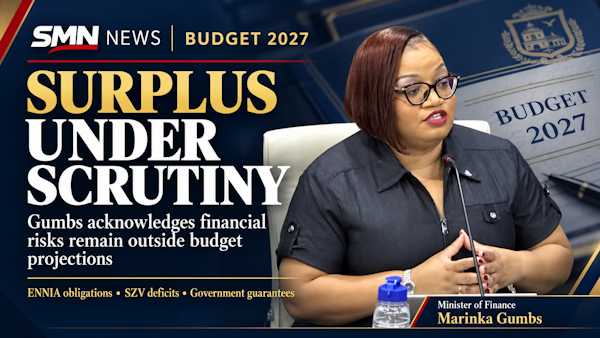 PHILIPSBURG:--- Minister of Finance Marinka Gumbs acknowledged that financial risks have not been incorporated into the draft 2027 National Budget’s projected result, while promising corrections to the presentation of Sint Maarten’s long-term ENNIA obligations following detailed questioning in Parliament.
During the Central Committee budget deliberations on October 2, Gumbs addressed projected tax revenue, government exposure to GEBE and TELEM, ENNIA contributions and guarantees, liquidity, and the deteriorating financial position of several funds administered by Social and Health Insurances SZV.
Her answers outlined planned improvements to tax administration but also exposed significant unfinished work: no complete reconciliation of the budget result against major fiscal risks, no completed stress test of the potential impact of faster SZV reserve deterioration, and no specific provision for settling outstanding balances between government and SZV.
MP Ludmilla de Weever welcomed the Minister’s detailed responses but warned that a projected annual surplus must not be presented as freely available money while substantial debt and long-term obligations remain.
Minister: Financial risks have not been incorporated
Responding to De Weever’s question about which material fiscal risks had been included in the projected ordinary-service surplus, Gumbs acknowledged that the risks had not been incorporated into the budget and said this had been discussed with the Committee for Financial Supervision, CFT.
She explained that the budget reflects the information and assumptions available when it was prepared. Should significant risks materialize during the financial year, government would address their effects through budget amendments.
However, the Ministry could not provide a complete reconciliation showing the projected result before and after the potential effects of healthcare deficits, SZV and social fund risks, government-owned companies and other contingent liabilities.
Gumbs said several exposures could not yet be quantified reliably and required further information and analysis. She also cited limited policy capacity within the Ministry, which must divide resources between preparing and executing the budget and conducting more detailed financial risk assessments.
The Minister maintained that the surplus remains the government’s current projection, but must be considered alongside the identified risks. If those risks produce high costs, government could have to reprioritize expenditure.
ENNIA provision to be corrected after parliamentary scrutiny
De Weever questioned why the budget provides 3 million guilders for ENNIA when the agreed annual contribution is 2.082 million guilders.
Gumbs said the larger allocation represents a precautionary provision rather than an amendment to the underlying agreement. She confirmed that neither the agreement nor its addendum had been amended.
According to her explanation, Sint Maarten’s annual contribution is structured as a subordinated loan to the resolution fund. She identified March 15, 2027, as the first contribution date and March 15, 2057, as the last, while describing the arrangement as a 30-year commitment.
De Weever also challenged the placement of this long-term obligation under the general heading of “projects and activities.”
Gumbs agreed that the commitment should be clearly identifiable and promised to correct its presentation through a budget amendment document. The recurring obligation should also be visible in the applicable multi-year estimates for 2028 through 2030, she said.
The Minister credited parliamentary scrutiny with identifying a presentation issue that had not been raised during earlier reviews.
Peak facility carries a separate guarantee exposure
The ENNIA discussion extended beyond the annual contribution to Sint Maarten’s exposure under the resolution arrangement’s peak facility.
Gumbs confirmed that Sint Maarten’s 6.49 percent share of the overall 500 million guilder facility results in a guarantee exposure of up to 32.45 million guilders. She promised to correct the disclosure of that contingent liability.
The Minister said current calculations anticipate that approximately 7.756 million guilders could be needed for Sint Maarten’s share over a 50-year period.
That projected use and the maximum guarantee exposure are different figures: the estimate describes anticipated requirements, while the guarantee represents a potential liability under the arrangement.
Gumbs also referred to a separate 55 million guilder capital injection financed through a bond subscribed to by the Central Bank of Curaçao and Sint Maarten, CBCS, and guaranteed according to the countries’ allocation shares.
She said Sint Maarten had not entered into a separate insurance arrangement for the peak-facility exposure. The addendum permits voluntary contributions to build a reserve, but her response did not establish that such a reserve had already been funded.
CBCS dividends expected to support payments
Gumbs said the financing framework anticipates CBCS dividend distributions and that government currently has no indication those expected payments will fail to materialize.
She described an expected minimum annual dividend payout to Sint Maarten of approximately 3.0336 million guilders under the arrangement, compared with the annual ENNIA contribution of 2.082 million guilders.
The 2026 budget includes 6 million guilders in anticipated CBCS dividend income, she added.
The Minister cited investments in United States Treasury bonds as supporting the financing framework. Nevertheless, she acknowledged that government would be responsible for covering a resulting shortfall if anticipated dividend contributions did not materialize.
No specific additional budget line has been identified for that scenario because government does not currently anticipate a shortfall.
SZV funds project a combined deficit
The Minister’s answers also revealed continued financial pressure across funds administered by SZV.
For 2027, she presented combined projected revenue of 318.3 million and expenditure of 332 million, producing a projected deficit of 13.7 million.
The sickness insurance fund, ZV, accounts for a substantial part of that pressure, with projected revenue of 108.2 million against expenditure of 140.8 million—a deficit of 32.6 million.
The FZOG fund is also projected to run a deficit of approximately 8.5 million.
Positive results in other funds, including the old-age pension fund AOV, reduce the combined deficit but do not eliminate the negative positions of the financially strained funds.
Gumbs reported that total projected reserves decline from 302.7 million in 2026 to 289 million in 2027 and 246.5 million by 2030.
She emphasized that certain individual funds already show negative reserve positions at the beginning of the projection period and are expected to deteriorate further under the current policy scenario.
The figures, she said, demonstrate the urgency of healthcare reform. They remain projections based on the assumptions available when the analysis was prepared.
No SZV settlement provision or completed stress test
Asked how much government and SZV owe each other, broken down by type and year, Gumbs said the balances were still being compiled and verified.
She promised to provide that information before the public budget meeting.
“At this time, no specific provision has been incorporated into the budget 2027 for a repayment or settlement arrangement,” the Minister stated.
Discussions are continuing to reconcile the amounts and determine how they should be settled. Any necessary provision would be addressed through the appropriate budgetary process once the financial implications are established.
Gumbs also confirmed that a formal stress test assessing the effect on the government’s budget if SZV reserves deteriorate faster than projected has not yet been completed.
The extent to which healthcare shortfalls could become a country obligation remains part of the ongoing general health insurance and healthcare reform discussions.
Year-end cash projected at approximately 2 million
Gumbs rejected suggestions that the budget’s liquidity tables contradicted each other, explaining that they present the same information at different levels of detail.
She said the projected opening cash balance for 2027 is 5 million, with a closing balance of approximately 2 million—a net decline of 3 million during the year.
She also confirmed that total loan repayments for 2027 amount to 22 million, rather than 17 million.
These cash figures are distinct from the ordinary-service surplus: a positive projected annual result does not mean government has that amount sitting in available cash.
Tax revenue increase rests on economic growth
Responding to MP Lyndon Lewis, Gumbs said the projected 19 million increase in tax revenue is based on expected economic growth.
Government has not included a separately quantified gain from improved tax compliance because it cannot yet measure that contribution reliably.
Instead, the projections apply the 2025 tax-to-GDP ratio to anticipated growth. Additional receipts resulting from better compliance would therefore be above the current estimate.
Lewis pressed for measurable collection targets and criticized delayed assessments, referring to complaints about 2021 assessments arriving in 2026.
Gumbs had explained that assessed tax cannot automatically be treated as collectible cash because provisional assessments, objections, court decisions and administrative adjustments can change the amounts.
However, her response did not provide the requested total of assessed but uncollected taxes or a specific 2027 recovery target.
Taxpayers promised improvements from January
The Minister outlined tax administration reforms expected in 2027, including online filing of 2026 income tax returns, expanded business filing services, automated processing of simple returns, improved taxpayer communications and cleaner registration records.
Other measures include payment integration, filing and payment dashboards, staff training and work on the administration’s legal and organizational structure.
The individual estimated costs she listed total approximately 1.112 million guilders.
Taxpayers should begin seeing improvements from January 2027, with shorter income tax processing times expected during the second half of the year.
Gumbs also explained that business license revenue rises from 7 million to 12 million because the estimate better reflects invoiced amounts on an accrual basis. It does not necessarily represent an equivalent increase in cash collected.
GEBE and TELEM create financial exposure
The Minister identified a 75.6 million guilder loan under VROMI for GEBE generator purchases.
For TELEM, she cited a 3.5 million guilder government guarantee connected to the company’s severance program and a further requested guarantee of 5 million that remained under assessment when the budget was prepared.
Finance and General Affairs are also assessing possible use of the TELEM building. Gumbs did not announce a purchase decision.
Responding to MP Darryl York, she said answers concerning TELEM’s operational and financial challenges had been submitted confidentially on September 29 because they included commercially sensitive information, litigation matters, strategy and contract values.
She acknowledged delays in responding to parliamentary correspondence and committed to finalizing outstanding tax department responses before the public budget meeting.
York welcomed receipt of the TELEM answers but said his question about financing the Road Fund remained unanswered.
De Weever warns against treating surplus as spending money
MP Ardwell Irion asked whether changing the accounting treatment of ENNIA would increase the reported surplus from approximately 8 million to about 11 million. He also requested updates on the borrowing processes for 2026 and 2027.
These were follow-up questions; the provided proceedings do not contain the Minister’s substantive answers.
De Weever emphasized that any increase in the displayed annual result would not erase the country’s debt or long-term commitments. She referred to outstanding debt approaching a billion and warned against interpreting a surplus as permission for unrestricted spending.
She urged ministers and MPs to prioritize expenditure, exercise restraint and assess new revenue expectations realistically.
Chair of Parliament Sarah Wescot-Williams reiterated that answers delivered orally must also form part of the written responses. The Central Committee proceedings concluded with further disclosures and clarifications still expected ahead of the public debate.
Gumbs’s presentation supplied important explanations, but Parliament’s next assessment will depend on the promised corrections, reconciled balances and written answers—particularly where financial obligations remain outside the headline surplus.