
APS Discusses 2027 Budget and Employer Participation with Finance Minister.

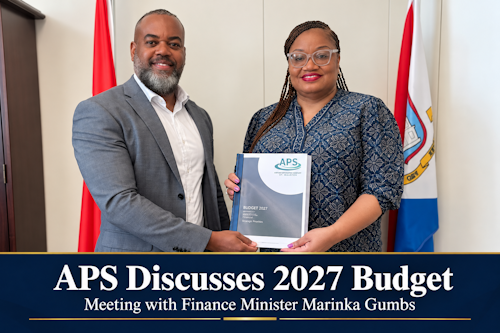
apsmarinka28102026COLE BAY:---  The management and board of Algemeen Pensioenfonds Sint Maarten (APS) met with Minister of Finance Marinka Gumbs on Thursday, October 22, to discuss the pension fund’s proposed 2027 budget and options for expanding employer participation.

APS outlined its budget priorities and explained the assumptions underlying its financial projections. The meeting also provided an opportunity to address questions about the fund’s financial planning.

“The 2027 budget reflects APS’s continued focus on responsible financial planning and the sustainable administration of the Fund,” APS management stated. “We value the constructive dialogue with the Minister of Finance, as open communication and cooperation are essential when addressing matters that may affect APS and its stakeholders.”

Discussions also covered the legislative framework governing participation in APS, including the requirements for expanding employer participation and the potential implications for the fund and participating employers.

APS said the meeting formed part of its ongoing dialogue with the Government of St. Maarten on the fund’s operations, financial planning and long-term development.

The fund reaffirmed its commitment to transparent communication and continued cooperation with government and other stakeholders.


Fueling Champions: SMAF Prepares Athletes for OECS with Nutrition Session.

champions28102026PHILIPSBURG:--- The Sint Maarten Aquatic Federation (SMAF) organized an interactive nutrition workshop for athletes and their parents as part of preparations for the OECS Swimming Championships, taking place November 6–8, 2026, in Saint Lucia.

The session was facilitated by Cayley MacKay of Oxygen Matters, who is certified in nutrition and sports nutrition and has also provided CPR, first aid, and water safety training to local swimming clubs. Through practical examples and discussion, participants explored how everyday food and hydration choices support growth, energy, training, recovery, and competition performance for young athletes.

The workshop emphasized the shared responsibilities of athletes and parents. Athletes were encouraged to take an active role in their preparation, while parents gained practical guidance on supporting healthy eating and hydration habits at home and during competition.

Athletes also received a handout reinforcing the session’s key messages, including guidance on balanced meals, suitable snacks, hydration, and fueling before and after swimming.

SMAF thanks Cayley MacKay for an engaging and informative session and the Sint Maarten Sports Federation (SMSF) for making funding available for this initiative.

The workshop forms part of SMAF’s broader efforts to prepare a delegation of 26 athletes—the largest number the federation has ever sent to a single championship—for the upcoming OECS Swimming Championships.

Businesses and individuals interested in supporting the team are invited to contact SMAF at This email address is being protected from spambots. You need JavaScript enabled to view it..

Heyliger-Marten challenges outcome of SOL meeting: Fuel-pricing answers still missing.

SOL has lawyered up and is withholding key pricing information, says Heyliger-Marten

grishasol1028202026PHILIPSBURG:--- Minister of Tourism, Economic Affairs, Transport and Telecommunication Grisha Heyliger-Marten has challenged the practical outcome of the meeting between SOL, Prime Minister Dr. Luc Mercelina and Members of Parliament, saying the discussions did not establish whether the fuel prices affecting consumers’ utility bills are justified.

Speaking at Wednesday’s Council of Ministers press briefing, at which she was the only minister present, Heyliger-Marten said critical supporting financial information remained outstanding in the examination being conducted by Bureau Telecommunications and Post, BTP.

The meeting, involving the Prime Minister, opposition MPs and some coalition MPs, therefore did not resolve the central pricing question, according to the minister’s account. She did not announce a fuel-price reduction, a utility-tariff adjustment, or a negotiated financial concession as a result.

“The value of any meeting is measured by the answers it produces, not how successful it was described afterward,” Heyliger-Marten said.

“An informational meeting may help explain SOL’s position. It does not establish whether the prices charged are justified.”

The minister said BTP had completed its fuel-clause review, while it continued examining GEBE’s base electricity rate. However, completing the fuel-clause component did not mean BTP had answered all questions about the underlying fuel-supply costs.

According to Heyliger-Marten, BTP raised concerns about rising fuel costs and comparisons with other markets. SOL supplied some information and requested an extension, but the financial documentation needed to verify the pricing remained incomplete.

She accused the supplier of failing to cooperate fully with the review, said it had engaged legal representation, and said it limited the information it was prepared to disclose. These were the minister’s characterizations; the briefing material supplied for this report contains no direct response from SOL to those allegations.

Heyliger-Marten also pointed to what she described as SOL’s ownership of the fuel pipeline and storage infrastructure, arguing that GEBE could not simply arrange for another supplier to use those facilities. She characterized SOL’s position as a monopoly and said that made scrutiny of the pricing especially important.

The wider BTP work examines whether the costs appearing on electricity and water bills are supported, justified and fairly allocated. Its scope includes customer-rate arrangements, GEBE’s billing and financial controls, and the allocation of electricity costs to water production.

The minister distinguished BTP’s technical role from the authority to change tariffs. BTP examines evidence and provides independent advice, while competent authorities make tariff decisions and must follow applicable procedures.

Heyliger-Marten said TEATT and VROMI had already initiated the examination through BTP. She argued that discussions with SOL should advance that work by providing verifiable answers.

“The public deserves better,” she said.

She committed to publishing a BTP report in November, while acknowledging that a nondisclosure agreement would restrict the release of certain commercially sensitive information. She also said the report would address the base-rate work.

Although she said a possible solution to the price buildup was already in view, she did not disclose its terms, quantify the potential savings, or provide an implementation date.

For households awaiting relief, the outcome reported at Wednesday’s briefing was therefore a continuing investigation and a promised November report. The minister’s account did not establish that the meeting with the Prime Minister and MPs had delivered lower prices.

Transport cleanup puts dormant permits under scrutiny as minister calls ATV operators to the table.

grishatransportation28102026PHILIPSBURG: Hundreds of transport permits remain outside the figures confirmed in the government’s ongoing cleanup, with Minister of TEATT Grisha Heyliger-Marten warning that inactive permits could face revocation following individual review and recommendations from the Public Transportation Committee.

At Wednesday’s Council of Ministers press briefing, Heyliger-Marten outlined a broader effort involving permit verification, amendments to the transportation legislation and plans for a more dependable transport system. She also announced talks with ATV tour operators this week on road obstructions, routes, and safety.

The minister was the only member of the Council of Ministers present at the briefing.

Only 407 taxis and 130 buses confirmed so far

Heyliger-Marten said 407 taxis met the confirmation requirements, compared with more than 600 taxis recorded in the system. For buses, 130 had been confirmed against more than 300 registered.

Other confirmed figures were 48 tow operators, 15 permits in what she described as an unregulated category, and 50 car-rental permits. Verification was ongoing, so the figures were not final.

The gap between registered and confirmed operators does not, by itself, establish that every outstanding permit has been revoked or that every operator concerned is currently operating illegally. The minister said unresolved cases require assessment.

Section Transport is reviewing more than 100 email submissions, responding to over 200 WhatsApp messages and arranging approximately 100 remaining confirmation stickers for vehicles whose status has been verified.

Some operators have completed their documentation, while others have been difficult to reach. Heyliger-Marten urged people with unresolved matters to remain accessible and respond promptly when contacted.

The committee expects to complete the administrative review and close out the process during the first week of November. The resulting database and report will support the committee’s work and give government a clearer picture of who is operating.

Inactive permits could be revoked

Heyliger-Marten said the committee, expected to be reinstated soon, will consider requests from inactive permit holders to resume operations. Reinstatement will not be automatic.

According to the minister, existing legislation allows revocation if a permit has not been used for more than six months. She accused previous administrations of failing to act on that provision, leaving permits dormant while other people were ready to work.

She said explanations such as illness or hospitalization would need concrete documentation. Decisions would follow the committee’s recommendations and the law, rather than a blanket action against everyone outside the current confirmation totals.

The exercise extends beyond taxis and buses to other businesses covered by the transportation ordinance, including car-rental companies.

“You want me to do a cleanup? We’re going to do it by the law,” she said.

Legislative changes and stronger enforcement

Heyliger-Marten said she expected a draft amendment to the transportation ordinance this week, describing the present framework as outdated and insufficient for the enforcement government wants to undertake.

Responding to questions about unauthorized passenger transport, she said repeated fines had not deterred offenders. She cited fines of 500 guilders as an example and said inspectors lacked adequate information about whether penalties had been paid.

She also said fine proceeds went to a crime fund rather than returning to support the ministry’s operations. Those comments formed part of her explanation of the weaknesses she wants addressed.

The minister expressed a preference for a “three strikes” approach. She presented it as her vision, rather than an adopted enforcement rule.

Her stated programme has three components: completing the cleanup, amending the legislation and developing a dependable transportation infrastructure. No final timetable for the full programme was announced.

ATV meeting to address obstruction and safety

The minister said ATV tour operators would meet with her and representatives of VROMI and Justice this week. Although she initially referred to “tomorrow,” she later clarified that the meeting would take place this week, without setting a precise day.

The agenda includes road obstruction, route suitability, safety and security, and the requirements governing operators and tour participants.

“Our roads are shared spaces,” Heyliger-Marten said, pointing to workers, schoolchildren, emergency vehicles, public transport and visitors all depending on the same network.

She said tourism businesses should succeed, but their activities must coexist with residents’ daily lives. Similar tourism operations will be addressed in the coming weeks.

Asked whether groups of vehicles need police escorts, she said she was researching the issue and would raise it during the discussions. She did not confirm a specific convoy threshold or announce a new escort requirement.

The minister also appealed to motorists to stop blocking intersections, overtaking dangerously and driving recklessly, warning that one collision can bring traffic to a halt.

Changes proposed for 2027

Proposals under review include an earlier confirmation period, greater emphasis on vehicle standards and clearer procedures for unresolved permits.

One proposal for discussion with the Minister of Finance would require operators to obtain their confirmation letter before proceeding with road-tax obligations. Heyliger-Marten stressed that the proposals had not yet been finalized.

She also referred to a separate compliance initiative being considered for January 2027, but left its details for the Minister of Finance to announce.

The next measurable steps are completing the administrative review, the committee’s assessment of unresolved permits, drafting legislative amendments, and discussing them with ATV operators. Wednesday’s briefing announced those steps; it did not announce mass permit cancellations or an immediate ban on ATV tours.
Six-month supermarket study could reshape St. Maarten’s basket of goods.

grishafoodsecurity28102026PHILIPSBURG:--- St. Maarten’s system for regulating essential supermarket goods could be substantially revised or replaced, Minister of TEATT Grisha Heyliger-Marten said Wednesday, as the government prepares an independent study into prices and their underlying costs.

The minister said terms of reference are expected to be published in November, inviting qualified firms to submit proposals. She wants the study completed in about six months, although she did not announce a contract award or start date.

Heyliger-Marten, the only minister present at Wednesday’s Council of Ministers press briefing, said the work must explain why households pay what they do and identify measures government can realistically take to provide relief.

“Every week, families across St. Maarten walk into supermarkets having to make a difficult decision,” she said, describing the pressure to decide what to buy, what to leave behind, and how to stretch household earnings.

The study will examine commonly purchased products and trace how costs accumulate for a representative selection. It will build on the government’s existing price information and compare St. Maarten with relevant regional and other markets.

Heyliger-Marten said meaningful comparisons must account for identical products, package sizes and quantities, as well as transportation, storage, labor, utilities, taxes and other operating expenses.

During questions, she said her own comparisons had found certain equivalent products cheaper in Curaçao, despite that market’s import duties. She wants the study to explain those differences rather than assume their cause.

The review will also examine shrinkflation: situations in which consumers receive less product without a proportionate reduction in price. An unchanged shelf price, she noted, can hide a higher cost per unit.

Another component concerns the relationships between importers, wholesalers and retailers, competition and barriers to entering the market. The minister said the government must distinguish legitimate business expenses from other factors that drive up prices.

She acknowledged that businesses face real importation, handling, storage and operating costs. Any intervention must also consider whether essential products will remain available.

Basket of goods faces fundamental review

Asked about concerns that narrowly defined controlled products can be avoided through changes in stock, brand, package size or product formulation, Heyliger-Marten said the existing basket of goods was already under review.

The examples she was given included retailers avoiding specified products and bread being sold in a different category after ingredients were added. These concerns were raised during questioning, not as findings from the proposed study.

The minister said the review could lead to adjustments or an entirely new approach. The study is intended to guide that decision by assessing household needs, pricing methodology, monitoring and enforcement.

Possible recommendations include price regulation, transparency, competition, and importation and distribution costs. No new price caps, replacement basket or immediate supermarket-price reduction was announced.

Heyliger-Marten also defended conducting the work while international fuel pressures affect production, transport and refrigeration. Those conditions, she argued, make it more important to understand how St. Maarten compares with other markets facing similar external pressures.

She wants prioritized recommendations separating measures the government can take in the short term from changes requiring longer implementation, with an explanation of costs, responsibilities and risks.

For consumers, the announcement signals an examination of the system that determines essential-goods prices. The briefing did not provide a date when families should expect lower grocery bills.


Subcategories