




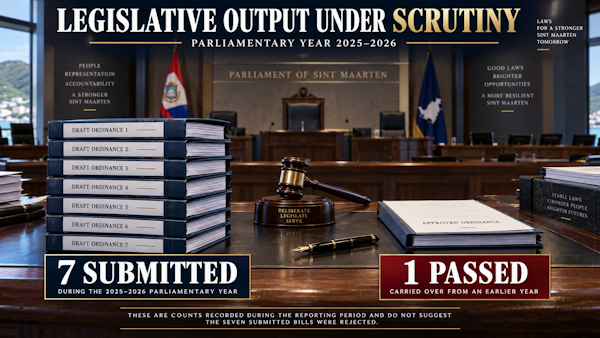
 PHILIPSBURG:--- Parliament of Sint Maarten recorded seven draft national ordinances submitted during the 2025–2026 Parliamentary Year, but only one ordinance was recorded as passed during the same reporting period, according to Parliament’s latest Annual Report.
The figures show a sharp decline in completed legislation compared with the previous parliamentary year.
In 2024–2025, Parliament recorded five draft national ordinances submitted and five passed. In 2023–2024, Parliament submitted ten and passed four. For 2025–2026, seven were submitted, while only one was recorded as passed.
|
Parliamentary year |
Submitted |
Passed |
|
2023–2024 |
10 |
4 |
|
2024–2025 |
5 |
5 |
|
2025–2026 |
7 |
1 |
The number recorded as passed therefore fell from five in 2024–2025 to one in 2025–2026—an 80% decline.
Passed Ordinance Was Carried Over
The figures must be interpreted carefully because legislation submitted and legislation passed during a parliamentary year do not necessarily belong to the same legislative group.
Draft ordinances can remain before Parliament for several years before reaching a final vote.
The only ordinance recorded as passed in 2025–2026 was the National Ordinance establishing rules for a basic payment account for consumers. Parliament’s report identifies it as legislative file 2023–2024-174, meaning it originated during an earlier parliamentary year.
It was accepted on January 9, 2026, during a continuation of Public Meeting No. 11 from the 2024–2025 Parliamentary Year.
None of the seven draft national ordinances newly submitted during 2025–2026 are listed in the report as having been passed during that same period.
Seven Ordinances Entered the Pipeline
The seven draft ordinances submitted during 2025–2026 addressed:
- The withdrawal of obsolete tax ordinances;
- Supervision of payment service providers;
- Supervision of virtual asset service providers;
- Oversight of payment and securities-settlement systems;
- Supervision of clearing and settlement-system operators;
- Repairs and harmonization involving social and health insurance legislation; and
- The national budget for 2026.
Several proposals concern the supervision and modernization of Sint Maarten’s financial sector, including payment services, virtual assets, clearing systems, and securities-settlement infrastructure.
These are significant legislative matters with implications for financial regulation, compliance, consumer protection and the country’s standing within the wider financial system.
Legislative Output Deserves Scrutiny
Parliament’s legislative role is a fundamental constitutional responsibility.
Draft national ordinances may require committee consideration, written questions, government responses, legal advice, amendments and deliberation in a Public Meeting before reaching a final vote.
A delay does not automatically mean Parliament failed to perform its duties. Complex legislation may require extensive examination, and progress can also be delayed while Parliament awaits answers, legal advice, amendments, or further action from government.
However, Parliament’s own figures demonstrate that relatively little legislation reached final passage during the 2025–2026 reporting period.
Seven draft ordinances entered the parliamentary pipeline, but the only ordinance recorded as passed was legislation carried over from an earlier parliamentary year.
That raises several questions Parliament should answer:
- How many draft national ordinances remain pending?
- How long has each pending ordinance been before Parliament?
- At what stage is each proposal?
- Which bills are awaiting government answers or legal advice?
- What is preventing more legislation from reaching a final vote?
Sint Maarten is regularly confronted with demands to modernize outdated laws in taxation, financial services, energy, justice, healthcare and social policy. The speed and efficiency with which legislation moves through Parliament are therefore matters of legitimate public concern.
The annual report does not, by itself, explain why only one draft national ordinance reached final passage. It does, however, establish the central fact: Parliament recorded seven ordinances submitted during 2025–2026, while only one—carried over from an earlier parliamentary year—was recorded as passed.