






Youth delegate Riddhi Samtani will discuss how islands can put climate data to work as a new study identifies five ways overseas territories could finance projects.
 PHILIPSBURG:--- Sint Maarten will bring its climate adaptation priorities to COP31 in Antalya, Türkiye, where youth delegate Riddhi Samtani is scheduled to speak about turning climate data into action. The island completed its first national climate adaptation report in 2026, setting out the risks it faces and priorities for protecting communities and the economy.
According to the EU-funded Green Overseas Programme, the report highlights Sint Maarten’s remaining 22.7 hectares of mangroves and the value of its coastal ecosystems, which provide services valued at more than US$76 million annually. The program estimates that about 80 percent of the economy depends on tourism, making coastal protection an economic priority as well as an environmental one.
Samtani is scheduled to speak at the Benelux Pavilion on November 13. She will also join Najannguaq Berthelsen of Greenland and Ilona Mayerau-Lonné of New Caledonia at the Climate Mobility Pavilion on November 16 to discuss climate vulnerability, biodiversity and gaps in funding for adaptation and disaster risk reduction. Mayerau-Lonné is also scheduled to speak at the France Pavilion on November 13 about how climate policy, jobs and investment can support one another.
Five ways territories could finance climate projects
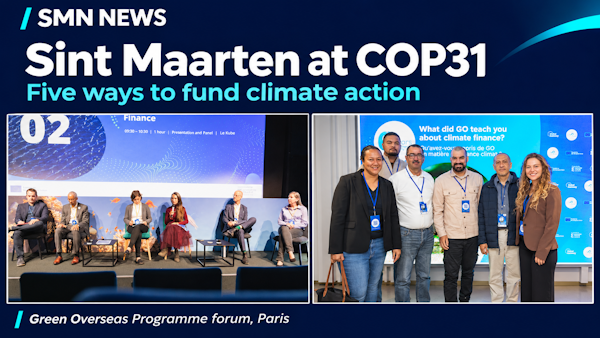
The Green Overseas Programme, implemented by Expertise France, commissioned ODI Global to assess 18 financing mechanisms. The study identified five with potential for overseas territories. The program presented its findings at a four-day closing forum in Paris before taking them to COP31.
The program says many major international climate funds are structured around sovereign states. Overseas territories participate in the Paris Agreement through the countries to which they are constitutionally linked, and those countries’ income levels can affect access to financing even when a territory has substantial adaptation needs.
- Green and blue bonds. Caribbean Utilities Company in the Cayman Islands raised US$50 million in 2024 for renewable energy, energy efficiency and climate adaptation projects.
- Carbon markets. The study points to roughly 4,500 square kilometers of peatland in the Falkland Islands and extensive seagrass beds in New Caledonia and the Turks and Caicos Islands as opportunities to explore whether carbon finance could support conservation and coastal protection.
- Conservation trust funds. Ascension Island established its AIMPACT fund with a £2 million endowment. In the British Virgin Islands, 40 percent of a US$10-per-passenger tourism levy goes to a trust fund supporting climate resilience and renewable energy. Niue’s program lets donors contribute NZ$250 to protect one square kilometer of ocean for 20 years.
- Blended finance. Combining public, concessional and philanthropic funding can reduce risk for private investors. In the Caribbean, an EU-backed initiative is using this approach to support start-ups making commercial products from sargassum.
- Environmental levies. Aruba collects a US$20 visitor contribution that provides a local revenue stream for climate infrastructure and conservation.
The study found that viable options depend on local laws, the capacity of institutions and financial markets, and the size of individual projects. Smaller investments can be especially difficult to finance when legal and technical work absorbs a large share of project costs.
“The funding exists. The challenge is to match OCTs with the right funding opportunities and build their capacity to turn priority projects into fundable proposals,” said Nicolas Andrade, the program’s project manager.
From adaptation plans to projects that can attract funding
Over six years, the Green Overseas Programme supported 31 projects in 23 territories. The work covered water security, coastal management, local food production, building efficiency, electric mobility and renewable energy, alongside training and policy studies.
In the Falkland Islands, where water demand in Stanley is projected to rise by 35 to 40 percent by 2050, the program helped assess the costs of developing groundwater supplies, building a river intake or installing desalination. On Ascension Island, a study identified about £87,000 in proposed investments that could raise local vegetable self-sufficiency to 65 percent. Those investments are awaiting funding.
In French Polynesia, researchers used public meetings and interviews to inform a study of future shoreline changes across six Tuamotu atolls and Pointe Vénus in Tahiti. In New Caledonia, the program helped develop a vehicle emissions label that lets buyers compare cars imported from markets with different rating systems. It also helped Greenland develop the evidence for its first climate strategy, including different approaches for towns connected to hydropower and settlements that depend on diesel.
At the Paris forum, the United Kingdom presented a separate £20.5 million pilot expected to begin in 2027. The three-year initiative is intended to help UK Overseas Territories develop climate projects that can attract investment. The EU has also proposed more than €999 million for its Overseas Countries and Territories under its 2028–2034 programming, with half earmarked for Greenland.
In Antalya, the program and its partners are scheduled to take part in sessions on climate finance, energy cooperation, youth-led climate action and the use of climate data in island planning. For Sint Maarten, the national adaptation report provides a local starting point for those discussions by identifying what needs protection and what the island stands to lose if its coastal ecosystems continue to decline.
 COLE BAY:--- The Police Force of Sint Maarten (KPSM) is investigating the reported kidnapping of two men on Richmond Drive in Cole Bay on Monday, November 9, 2026.