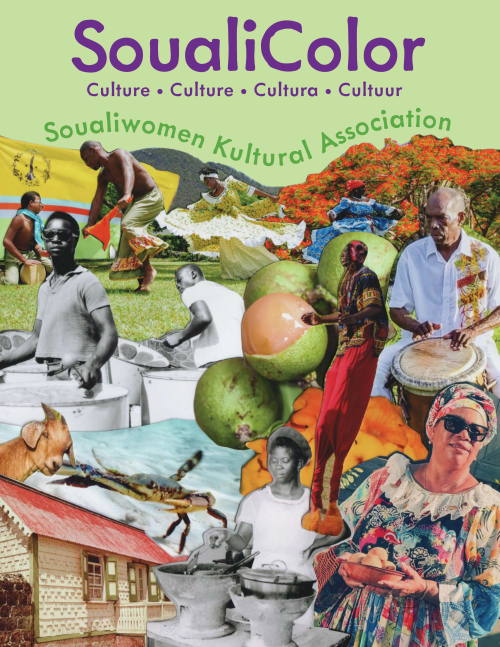
Launch and Giveaway of Cultural Coloring Book SoualiColor on Sunday, July 5th

soualicolor28062026French Quarter, St. Martin:--- The public is invited to celebrate the launch of SoualiColor, a color and write book about St. Martin culture! The free, festive launch event will be held at Amuseum Naturalis at The Old House in French Quarter from 9 am to noon. SoualiColor was created by the Soualiwomen Kultural Association (SKA) and the Les Fruits de Mer association. Guests attending the launch will receive a free copy of the book. The event will also feature a cultural scavenger hunt, a coloring station, and refreshments for all to enjoy.

“SKA was formed to celebrate Carnival in another way, more creative and cultural. Then we opened up more to promote and share our culture and traditions,” explained Erica and Laticha Stephen, President and Vice-President of SKA. “After SoualiKulture, our cultural activity book, we wanted to make a multilingual book for the younger ages. SoualiColor promotes our culture among young students learning to read and write. Each page is fun: images to color, and related words to read and write. Young ones can connect with our culture and traditions while they are learning these skills.”

SoualiColor is full of lively coloring pages featuring heritage themes such as St. Martin music, dance, cultural attire, Carnival, livestock, agriculture, and food traditions. Each coloring page has related words in English, French, Spanish, and Dutch, and a second page where kids can practice writing the words. Seven members of SKA worked together with Les Fruits de Mer to develop and write the book.

“We are delighted to help SKA launch their second book about St. Martin culture!” said Les Fruits de Mer president Jenn Yerkes. “Every child here deserves to learn about the rich culture of their island and feel proud of it. This book is a great way to showcase culture and traditions for younger kids! We look forward to giving SoualiColor to thousands of students over the coming years as part of our book program.”

The book launch will be held on Sunday, July 5th, from 9 am to noon at Amuseum Naturalis at The Old House on the hill above Coconut Grove. Free copies of the book will be given to those who attend the event. The launch is also a great chance to visit the museum and learn more about SKA. The event will feature a special cultural scavenger hunt and a coloring station. Light refreshments will also be served.

Free printed copies of SoualiColor will be given to local schools and students as part of Les Fruits de Mer’s book program. The book is also available as a free download from http://lesfruitsdemer.com and for purchase on Amazon.com worldwide. Teachers and youth group leaders interested in copies are encouraged to contact Les Fruits de Mer at This email address is being protected from spambots. You need JavaScript enabled to view it.. Companies, organizations, or individuals interested in sponsoring copies for schools are also encouraged to contact the association.

This book was produced with the support of the Fonds pour le développement de la vie associative (FDVA).


HNLMS Groningen heads to disaster-stricken Venezuela for emergency aid.

venezuelaaid28062026HNLMS Groningen departed from Curaçao this morning for Venezuela to deliver emergency aid following the devastating earthquakes in the country. The naval vessel was loaded in Curaçao with supplies, including water and relief goods. Also on board are an NH90 helicopter and two FRISCs (fast interceptor boats).

Defense Caribbean is deploying HNLMS Groningen to provide assistance following the devastating earthquakes. The ship carries a supply of water and can produce additional drinking water using its onboard water purification system. The crew of HNLMS Groningen stands ready to provide emergency aid on site, in close cooperation with national and international partners. Through this action, the Netherlands is contributing to international humanitarian relief efforts.

In addition to the deployment of the station ship, the Caribbean Coast Guard is contributing to the transport of goods and personnel from the Caribbean islands to Venezuela using its Dash-8 aircraft. Defense Caribbean is also supporting the US emergency relief operation being coordinated from Hato Airport.

Upon request and in coordination with local authorities on Curaçao, Bonaire, and Aruba, Defense Caribbean contributes to humanitarian relief operations following disasters or emergencies in the region throughout the year by supporting local authorities. Such deployments are particularly important during hurricane season. HNLMS Groningen has been in the Caribbean since early June and is deployed for various maritime security tasks, such as surveillance, law enforcement, and countering illegal activities like drug smuggling.

Xtratight Entertainment Announces St. Maarten's First-Ever Back 2 School Expo.

~A new annual event designed to connect students and parents with the resources they need for a successful school year.~

xstraight28062026PHILIPSBURG:---  Xtratight Entertainment is proud to announce the launch of the Back 2 School Expo (B2S Expo), a first-of-its-kind event that will bring together schools, businesses, government agencies, health organizations, community groups, and service providers under one roof to help families prepare for the upcoming academic year.
The inaugural Back 2 School Expo will take place on Sunday, August 9, 2026, at the Aleeze Convention Center in St. Maarten. Admission is free and open to the public.

More than just a school supplies fair, the Back 2 School Expo has been created as a one-stop destination where students and parents can discover educational opportunities, connect with essential services, and prepare for a successful school year.

Visitors can expect a wide range of exhibitors representing:

  • Primary and secondary schools
  • Colleges and universities
  • Technical and vocational education providers
  • Tutoring and after-school programs
  • Scholarships and educational opportunities
  • Health and wellness services
  • Youth organizations
  • Government departments
  • Financial institutions
  • Technology providers
  • School supply retailers
  • Uniform suppliers
  • Sports and extracurricular organizations
  • Community support services

The event is designed to make back-to-school preparation easier for families while creating meaningful opportunities for organizations to engage directly with the community.

"Education is one of the greatest investments we can make in our future," said Rude Fleming, Founder of Xtratight Entertainment. "The Back 2 School Expo is about bringing the entire community together to support our students. Whether it's finding the right school, learning about scholarships, accessing health services, purchasing uniforms, or discovering extracurricular opportunities, families should be able to find everything they need in one place."

The Expo is being organized in partnership with F.O.C.U.S. Foundation, whose commitment to youth and community development aligns with the vision of creating greater access to educational resources across St. Maarten.

In addition to exhibitor booths, attendees can look forward to educational presentations, demonstrations, family-friendly activities, giveaways, and opportunities to connect with organizations that play an important role in student success.

Businesses, schools, government agencies, non-profit organizations, and service providers interested in exhibiting are invited to reserve their space early.

The Back 2 School Expo is envisioned as an annual community event that grows each year, strengthening collaboration between education, business, healthcare, and the wider community while helping every student begin the school year equipped for success.

For exhibitor information, sponsorship opportunities, or general inquiries, please contact Xtratight Entertainment.

Event Details

Event: Back 2 School Expo
Date: Sunday, August 9, 2026
Venue: Aleeze Convention Center, St. Maarten
Admission: Free

How Caribbean Values Is Redefining Global Tourism and Investment.

By ir. Damien Richardson

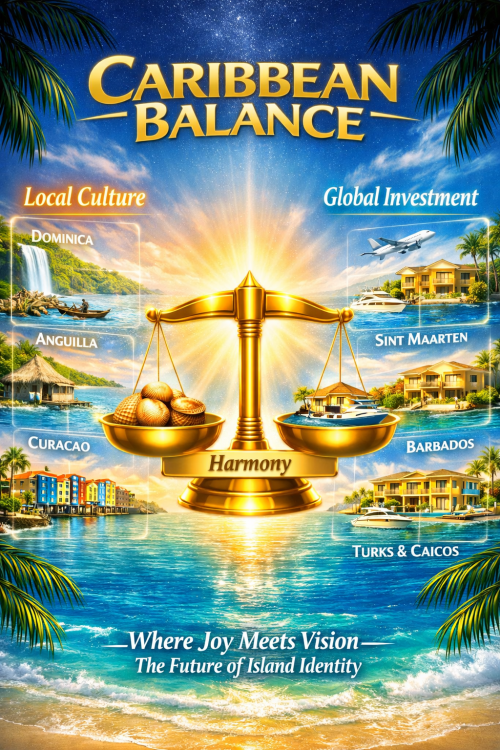
caribbeanbalance27062026PHILIPSBURG:--- The Caribbean is undergoing a profound transformation. Wealth is arriving at a pace the region has never experienced. New villas rise along familiar coastlines. Private jets land where fishing boats once anchored. Investors see opportunity. Developers see potential. The world sees paradise. But those who live here understand something deeper: the Caribbean is not simply a destination. It is a way of relating to the world.

Caribbean life is built on a culture of joy — not the superficial joy of entertainment, but a relational joy rooted in community, generosity, rhythm, and belonging. This joy is not a product. It is a value system. And in a world hungry for authenticity, it may be the region’s most strategic advantage.

As global wealth accelerates, the question is no longer only how the Caribbean balances identity with investment. The real question is how the region can share its joy without losing it. Sharing joy, when done with intention, becomes a form of sovereignty.

Across the region, two development models have emerged. Both are grounded in Caribbean values, yet each expresses them differently. Together, they reveal how identity shapes economic outcomes.

Dominica represents the guardianship model. It protects its ecological soul not to restrict tourism, but to preserve the intimate relationship between people and land. Its forests and rivers are not attractions; they are partners in the island’s identity. Environmental stewardship becomes cultural preservation.

St. Barthélemy demonstrates the power of architectural discipline. The island enforces a strict visual language — no high‑rises, no visual noise, no architectural ego. Beauty is treated as a shared experience. Wealth adapts to the island, not the other way around.

Curaçao offers another form of guardianship. Its UNESCO‑protected historic core is a living city where color, rhythm, and memory shape daily life. Heritage is not nostalgia. It is a strategy. Curaçao proves that cultural continuity can be an economic engine.

Anguilla adds a quiet but powerful dimension. The island has built a reputation for understated luxury anchored in local warmth and simplicity. Its low‑rise development model, its emphasis on locally owned hospitality, and its refusal to chase mass tourism have created a brand defined by intimacy rather than spectacle. Anguilla’s strength lies in its quiet confidence — a place where the experience is shaped not by scale, but by sincerity.

Sint Maarten stands at a different kind of crossroads. As one of the region’s most dynamic hubs — a crossroads of cultures, aviation, commerce, and tourism — it carries both the benefits and the pressures of high visibility. The island’s dual‑nation structure, its dense tourism economy, and its limited landmass create a unique tension between opportunity and vulnerability. Yet Sint Maarten’s greatest asset remains its people: resilient, multilingual, entrepreneurial, and deeply relational. The challenge ahead is ensuring that large‑scale development does not overshadow the human-scale vibrancy that defines the island’s character.

Other islands have chosen a more integrative path. They welcome global capital, but they do so with intention and clarity. The Cayman Islands integrates finance and tourism while ensuring locals remain central to the workforce and the social fabric. Its success is engineered through regulation and transparency.

Barbados blends culture and capital with confidence. Its creative industries, festivals, and remote‑worker programs invite the world to participate in a distinctly Barbadian way of life. Culture becomes an export, not an ornament.

Turks & Caicos uses spatial discipline to manage luxury. By concentrating development in Grace Bay and protecting the rest of the island, it ensures that community life remains intact. This is cultural preservation expressed through planning.

Yet even with these successes, the region faces a real risk. When wealth arrives too fast, locals can disappear from their own landscape. Land prices rise. Culture becomes performance. Coastlines become gated. A Caribbean without Caribbean people is not the Caribbean. It is a theme park.

A useful lens is the Wealth‑to‑Local Presence Ratio — a measure of how strongly foreign wealth shapes an island relative to its local population strength. Cayman, the Bahamas, and Turks & Caicos sit at the high end. Barbados, Curaçao, Anguilla, and Sint Maarten occupy the middle. Dominica remains anchored on the low‑moderate side. The pattern is clear: where wealth dominates, relational culture weakens. Where locals remain strong, joy remains abundant.

The path forward requires a shift in mindset. The Caribbean is not selling beaches. It is sharing a way of being. To protect that way of being, islands must preserve architectural identity, ensure local equity in major developments, protect coastlines as shared spaces, strengthen cultural industries, and educate the next generation to lead in high‑value fields with Caribbean values at the center.

The Caribbean stands at a crossroads. It can become a region shaped by wealth, or it can become a region that shapes wealth through its values. The future belongs to those who understand that the Caribbean’s greatest contribution to the world is not luxury. It is joy — relational, generous, and deeply human.

And joy, when shared with intention, becomes a transformative force.

Former Parliamentary Candidate Julian Rollocks Jr. demands action on prepaid electricity.

~Says Sint Maarten has talked long enough while neighbors have benefited for decades~

julianrollocks09092023PHILIPSBURG:---  More than two years after making prepaid electricity one of the central pillars of his 2024 parliamentary election campaign, former parliamentary candidate Julian Rollocks Jr. is renewing his call for the Government and NV GEBE to stop talking and finally implement what he describes as a proven solution that would benefit every household and business in Sint Maarten.

Rollocks' renewed appeal comes in response to recent statements by GEBE official Patrick Drijvers confirming that the utility company is working to introduce a prepaid electricity system.

While welcoming the update, Rollocks questioned why Sint Maarten continues to lag behind other Caribbean islands that have successfully operated prepaid electricity systems for decades.

"I commend Mr. Drijvers for being transparent with the public," Rollocks said. "But if we are still not ready today, then when will we be?"

Rollocks reminded the public that prepaid electricity was one of the issues he consistently advocated during the January 2024 parliamentary election campaign, arguing that it would provide immediate financial relief and greater control over electricity expenses for consumers.

According to Rollocks, the neighboring island of Curaçao introduced prepaid electricity as early as 2002, proving that the technology is neither experimental nor complicated.

During his campaign, Rollocks said he personally discussed the system with the director of one of Curaçao's largest electricity companies, who explained that implementing prepaid electricity had been relatively straightforward.

"That raises a serious question," Rollocks noted. "Why does every technological improvement somehow become so complicated in Sint Maarten?"

Promises Stretch Back Years

Rollocks revealed that discussions about prepaid electricity did not begin during the election campaign.

He said nearly three years ago, he also spoke extensively with the late former GEBE Temporary Manager Troy Washington, who at the time assured him the utility company was already working toward introducing prepaid electricity.

"Three years later," Rollocks observed, "the public is still hearing the same message—that GEBE is working on it."

He also expressed disappointment that the political party on whose ticket he contested the 2024 parliamentary elections is now part of the governing coalition, yet has not aggressively pursued the proposal despite what he described as overwhelming public support.

Meanwhile, Rollocks noted, several neighboring islands are already expanding beyond prepaid electricity by introducing prepaid water services.

Putting Consumers in Control

Rollocks argues that prepaid electricity functions much like prepaid mobile phone service.

Consumers purchase a specific amount of electricity before using it, allowing them to monitor and manage consumption without worrying about receiving unexpectedly high bills at the end of the month.

"If someone buys only 30 kilowatt-hours," he explained, "they know they must carefully manage how they use electricity. They may decide to use a fan instead of the air conditioner or simply reduce unnecessary consumption."

He believes this approach gives consumers complete control over their monthly spending while encouraging more responsible energy use.

Benefits for Consumers and GEBE

According to Rollocks, prepaid electricity would deliver multiple advantages across the country.

Among the key benefits he identified are:

  • Easier household budgeting and improved cash-flow management.
  • A simple "pay-as-you-go" system similar to prepaid mobile phones.
  • Greater awareness of electricity consumption encourages energy conservation.
  • Elimination of disputes between landlords and tenants over unpaid utility bills, while reducing the administrative burden of changing accounts between occupants.
  • No unexpected high monthly electricity bills.
  • Real-time monitoring of electricity usage through mobile applications, allowing consumers to track consumption before their credit runs out.

Rollocks also believes the system would significantly improve GEBE's financial position by reducing outstanding receivables and improving the utility company's cash flow through advance payments.

Cost of Living Demands Urgent Action

With many families continuing to struggle under the rising cost of living, Rollocks said Government and GEBE should treat prepaid electricity as an urgent priority rather than another long-term project.

"Our people are struggling," he said. "Any measure that allows families to better control their monthly expenses deserves immediate attention."

He stressed that prepaid electricity is no longer an innovative experiment but a well-tested utility model that has been successfully operating throughout the Caribbean for more than two decades.

Rollocks concluded by thanking GEBE for updating the public on its progress but maintained that the time for discussions has passed.

"The people of Sint Maarten deserve action," he said. "Prepaid electricity is a proven system. The question is no longer whether it works. The question is how much longer the people must wait before it finally becomes reality."


Subcategories