







Vinaora Nivo Slider 3.xVinaora Nivo Slider 3.xVinaora Nivo Slider 3.x

Heyliger calls for Joint Port Planning and Water Cooperation Across the Border, Urges GEBE to invest in Solar.

theocrossborder23112026PHILIPSBURG:--- Theo Heyliger is calling for the two sides of the island to agree on five practical projects and deliver them by the next St. Martin Day. In an interview on SOS Radio, he singled out joint planning for the Dutch- and French-side ports and a possible cross-border water supply arrangement. He also urged Sint Maarten to rethink how NV GEBE invests in electricity generation as households struggle with high bills.

Heyliger said he had spoken with Collectivity President Louis Mussington and told him he looked forward to discussing what the two governments could do together. He also called for coordination on short-term rental taxation, arguing that decisions on platforms such as Airbnb should account for what happens across the border.

Two ports could share traffic and revenue

Heyliger said he had previously discussed evaluating the island’s two ports, coordinating their operations, and establishing a common tariff. Under his proposal, both governments would share in the financial benefits, and both ports would receive vessel traffic. He suggested directing suitable ships to Marigot and developing facilities there for megayachts.

He also proposed closer coordination between Grand Case Airport and Princess Juliana International Airport. He suggested developing Grand Case as a destination for private jets and exploring a role for Winair in serving French Caribbean routes, including Guadeloupe and Martinique. He acknowledged that French licensing requirements would have to be addressed.

Water shortages and a stalled sewage project

Heyliger argued that the Dutch side purchases more water than it needs and questioned why that capacity could not help communities facing shortages on the French side. The interview also raised the possibility that pumping infrastructure had previously been installed near the border. Heyliger pointed to the practical question residents still face: whether water is actually being delivered.

He recalled work on a joint sewage treatment plant near the border that he said was intended to receive European Union financing and help address problems in the Cole Bay area. He said the project had stalled and that he believed the funding opportunity had been lost.

More reliable power and lower bills are different goals

Heyliger said residents had told him that GEBE bills were consuming much of their pay. He argued that new engines can improve reliability while leaving households exposed to fuel costs. He also questioned whether three new engines would provide enough capacity once planned developments come online.

He said solar power should have been pursued earlier and called on the government to follow up on what he described as renewable-energy commitments under GEBE’s concession. On the broader cost of living, he favored more competition and targeted subsidies over price controls. He also called for faster business permits and licenses.

Heyliger said the two governments could begin by choosing a short list of projects and setting a deadline residents can judge. His proposed benchmark was the next St. Martin Day.


You cannot continue importing the amount of cars’ — Heyliger presses St Maarten on traffic and road capacity.

Theo Heyliger says three major road projects could buy Sint Maarten about five years of relief. He argues that the government must also confront the number of vehicles entering the country.

theocarsimportation23112026PHILIPSBURG:---  Theo Heyliger says St Maarten cannot build its way out of traffic congestion while continuing to import cars at the current pace. In an interview with Billy D. Hamlet on SOS Radio, the former commissioner, minister, and member of Parliament called for immediate investment in roads and intersections and a policy discussion about how many more vehicles the island’s road network can absorb.

“The main issue is the importation of cars in the country,” Heyliger said. He estimated that Sint Maarten imports about 1,000 cars a year, a figure he offered during the interview without citing official import records. He argued that even the three road projects he considers necessary would provide only temporary relief if vehicle imports continue at the same pace.

Airport traffic backed up to Cole Bay, Heyliger says

Heyliger recalled arriving at Princess Juliana International Airport around 4 p.m. for a meeting. By about 6 p.m., he said, traffic stretched from the airport to the Cole Bay roundabout. He also pointed to backups between Marigot and Cole Bay, arguing that congestion on either side of the border affects drivers across the island.

He pushed back against blaming visitors for the daily gridlock. He said he had seen heavy traffic before the tourist season and observed that many of the vehicles on the road carried local plates. He argued that residents bear the cost in time and fuel, while visitors stuck in traffic have less time to shop and move around the island.

Heyliger defended the Simpson Bay Causeway, saying it gave motorists a way across the lagoon without driving around through Cole Bay. He said it worked well in its first years and argued that growth in the number of cars has since put more pressure on the roads feeding into it. “You don’t need to build a causeway on a causeway,” he said.

Three road projects face design and land questions

Heyliger singled out the proposed Cole Bay–St. Peters connection, the South Reward–Dutch Quarter link, and the Ring Road. He said the first two lacked completed design and engineering work and criticized what he described as a lack of follow-through with landowners. He also said the government does not own the existing Ring Road design and questioned whether the budget provides enough money to get road projects ready for construction.

He called for hiring an engineering firm to draw up a plan for the entire road network. In the meantime, he said, the government could repair deteriorating roads and redesign intersections that routinely hold up traffic. On Pondfill Road, he proposed reconfiguring the roadway and parking so drivers would spend less time reversing into or across traffic. He said he had seen congestion there as early as 7 a.m.

Heyliger also questioned plans to expand cruise pier capacity before Philipsburg can move more passengers through its existing road network. He said the government should address how people get in and out of town before adding to the volume the roads already handle.

Heyliger raises luxury vehicle taxes but gives no import target

Asked how the government could pay for infrastructure, Heyliger said he favored indirect taxes and used a Mercedes-Benz purchase as an example of a transaction from which the government could raise revenue. He argued that motorists already pay for congestion through the fuel they burn sitting in traffic.

Heyliger gave no proposed annual import cap, tax rate, or rules for distinguishing luxury purchases from ordinary replacement vehicles. His immediate priorities were road repairs, intersection changes, and engineering work. His longer-term challenge to the government was to decide how it would manage vehicle imports before rising traffic volumes erode the gains from new roads.

Heyliger calls for affordable homes on public land and urges government to buy Mullet Bay.

The former commissioner says acquiring land is only the first step. In Belvedere, he wants to see a plan to build homes residents can afford. At Mullet Bay, he wants the government to set development terms and preserve the 18-hole golf course.

theoland23112026PHILIPSBURG:--- Theo Heyliger is calling on the government to use public land to bring down housing costs and to acquire Mullet Bay so it can decide how one of the island’s most prominent properties is developed.

Speaking with Billy D. Hamlet on SOS Radio, the former commissioner, minister, and member of Parliament said land acquisition in Belvedere was a step forward. He pressed for the next decision: what will be built there and whether working families will be able to buy the homes.

“You cannot put our people to buy housing that’s $300,000 and a half, a million dollars,” Heyliger said, citing prices of roughly $300,000 to $500,000 as beyond what many households can afford. He pointed to electricity bills as one cost already stretching family budgets.

Public land could lower the price of a home

Heyliger argued that the government could reduce housing costs by making land available at little or no cost. In his view, the public benefit should be measured by what residents ultimately pay for a home. He cited an earlier development involving the General Pension Fund of Sint Maarten, known as APS, as an example in which land was made available at what he recalled was a nominal cost.

He also pointed to land behind the landfill that he said had gone undeveloped and recalled a housing development in Sucker Garden involving land held by the Housing Foundation. For Belvedere, he called for a construction plan. He gave no estimate of how many homes could be built there, what buyers would pay, or how households would qualify.

Heyliger wants public control over Mullet Bay’s development

Heyliger said the government should buy Mullet Bay and set the conditions for its redevelopment. He said the 18-hole golf course should remain part of the island’s tourism offering. He envisioned bringing in private developers to finance improvements, with the government determining what could be built and what would be preserved.

He drew a parallel with efforts on the French side to secure the Beauperthuy estate. Asked about Collectivity President Louis Mussington’s push to acquire that property, Heyliger backed securing land for future public needs.

Heyliger put two decisions before Sint Maarten’s government: turn land already acquired for development into homes residents can afford, and spell out what the public would gain from buying Mullet Bay. The interview offered a direction for both properties. It left the cost, financing, and timetable open.

Heyliger says bank account barriers can shut former prisoners out of work.

The former lawmaker says his own account was closed after his conviction and calls on the government and central bank to address banking access for residents and businesses.

bankaccount23112026PHILIPSBURG:---  Theo Heyliger says a person can leave Point Blanche prison ready to work and still struggle to get paid. In an interview with Billy D. Hamlet on SOS Radio, the former lawmaker pointed to a basic obstacle to rebuilding a life after prison: getting a bank account that can receive a paycheck.
Heyliger said the Windward Islands Bank closed his personal account after his conviction. He said he had been a customer for about 45 years and that the bank notified his wife by letter. He described the closure during the interview. The bank did not present its explanation.

“Without a bank account, how are you going to have a job?” Heyliger asked. He said that when employers pay by bank transfer, losing access to an account can make it harder to take a job and earn a steady income after release. He also questioned how people with convictions are expected to support themselves if they encounter barriers when trying to start a business.

A car loan can come faster than an account, Heyliger says

Heyliger used car financing to illustrate what he sees as a mismatch in local banking. He argued that a customer can get preapproved for a car loan more quickly than they can open a basic account. He also said some legally operating businesses struggle to obtain accounts and may have to pay employees in cash.

He called on the Government of Sint Maarten and the Centrale Bank van Curaçao en Sint Maarten to discuss how local businesses can obtain banking services while banks address money-laundering risks. He cited lottery operators and casinos as examples of businesses that employ people but, in his account, can face difficulty getting an account.

Heyliger gave no figures on how often residents or businesses are refused accounts, or how long applications generally take. His challenge to policymakers was concrete: when someone leaves prison and finds a job, what route is available to them if they cannot open the account they need to receive their wages?

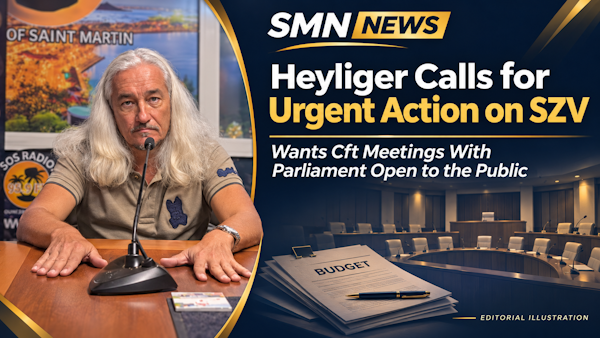
Heyliger calls for urgent action on SZV, says Cft meetings with parliament should be public.

theoszv23112026PHILIPSBURG:---  Theo Heyliger is calling on the government to explain how it plans to protect Sint Maarten’s social and health insurance system. In an interview with Billy D. Hamlet on SOS Radio, the former lawmaker questioned how SZV’s funds are being managed and said the government should treat the institution's financial pressures as a national emergency.


Heyliger said one fund was being used to cover another and questioned the legal basis for that practice. He did not identify the funds, cite audited accounts, or give amounts. He also raised concerns about hospital spending and asked how much the government was prepared to contribute toward addressing the financial problems he described.

“If that institution goes bankrupt, then a lot of people in trouble,” Heyliger said. He framed insolvency as a risk and called for government action to protect the people who depend on SZV.

Heyliger wants financial oversight debated in public

Heyliger also renewed his criticism of the Board of Financial Supervision, known as the Cft. He argued that the board had shifted its expectations as Sint Maarten worked toward a balanced budget. He gave no specific budget decision or change in requirements as an example during that part of the interview.

His criticism extended to how Parliament meets with the board. Heyliger recalled closed-door discussions during his time as an MP and said lawmakers should be able to debate the Cft’s positions in front of the public.

“I believe every meeting of Parliament should be open,” he said. He argued that when the Cft speaks publicly after a closed meeting, residents hear the board’s account while lawmakers are constrained in what they can disclose about the exchange.

Dutch financing and the cost of oversight

Heyliger said Sint Maarten’s reliance on Dutch financing limits its room to choose policy. He pointed to the establishment of the Integrity Chamber as a condition he said was attached to post-hurricane assistance. He acknowledged that he had voted for it and questioned what the institution had delivered for the public relative to its cost.

On SZV, Heyliger demanded that the government say what it intends to do and how it will pay for it. On budget oversight, he called for residents to hear directly how the Cft and their elected representatives defend the decisions that shape public spending.


Subcategories

Vinaora Nivo Slider 3.x
Vinaora Nivo Slider 3.xVinaora Nivo Slider 3.x
Vinaora Nivo Slider 3.x