Vinaora Nivo Slider 3.xVinaora Nivo Slider 3.xVinaora Nivo Slider 3.x

PM Mercelina Explores Smarter, More Connected Healthcare for Sint Maarten During Philips Visit.

mercelinanetherlands22102026BEST, THE NETHERLANDS: The Honorable Prime Minister Dr. Luc Mercelina continued his working mission in the Netherlands with a visit to Philips Healthcare in Best on October 22, exploring how medical innovation, artificial intelligence, and remote specialist support could strengthen healthcare in Sint Maarten.

Mr. Léon Kempeneers, CEO of Philips Benelux, and his team, including Jan-Willem Scheijgrond, Vice President, Global Government & Public Affairs, and Jesse Schilperijn, Manager, Global Government & Public Affairs, received and hosted the Prime Minister and his delegation.

The visit followed an initial meeting between Minister of Public Health, Social Development and Labor (VSA) Claret Connor and Philips representatives during his attendance at the 81st United Nations General Assembly in New York last month.

“This visit builds on the engagement initiated by Minister Connor and his delegation while in New York and demonstrates the importance of continuity and coordination within Government. Advancing healthcare requires us to work across ministries, share knowledge and follow through on opportunities together. We cannot deliver effectively if we operate in silos,” Prime Minister Dr. Mercelina stated.

Presentations introduced the delegation to advances in medical imaging, AI-assisted technology and connected patient monitoring. They also explored how remote clinical support and monitoring beyond hospital walls could help healthcare professionals maintain continuity of care.

“Conventional medicine has served us well and remains essential, but we must continue strengthening it through innovation. Artificial intelligence can contribute to greater efficiency, support our healthcare professionals and help them devote more attention to patient care,” the Prime Minister said.

Among the developments highlighted during the visit was the prospect of certain MRI examinations being completed in approximately five minutes, depending on the examination and technology used. Mercelina described shorter examination times as an example of how innovation could make a meaningful difference to patients.

“The possibility of certain MRI examinations taking just five minutes and radiology diagnostics being AI-supported gives us an indication of where healthcare is heading. That is the kind of efficiency and priority in patient care that I want for my people in Sint Maarten,” he said.

Reflecting on the visit's relevance to Sint Maarten’s new hospital, Mercelina emphasized that physical infrastructure must be matched by the technology and expertise needed to deliver modern care.

“We cannot build a new hospital without incorporating the modernization and innovation our people need. For a small island like Sint Maarten, that also means exploring how technology can connect our medical teams with specialized doctors and clinical support remotely,” he stated.

“A new hospital must strengthen what we can do for patients. Its value will be measured by the quality, accessibility and reliability of the care people receive.”

The Prime Minister highlighted the potential of remote consultations and clinical collaboration to support local healthcare professionals and bring specialist expertise closer to patients. He stressed that healthcare institutions and professionals must assess new technology, considering training, maintenance, digital infrastructure, patient privacy, and long-term affordability.

The Prime Minister was accompanied by Minister Plenipotentiary Gracita Arrindell and Chief of Staff Stuart Johnson.

The Philips Healthcare visit complemented earlier healthcare engagements during the Netherlands mission, including discussions on healthcare cooperation and mental healthcare capacity.

“Behind every examination is a person waiting for answers. Behind every referral is a patient and a family seeking reassurance. Those realities must guide our work, across ministries and with our healthcare partners, as we pursue better care for the people of Sint Maarten,” Prime Minister Dr. Mercelina concluded.


21 October 2026 Government announces public consultation on draft National Gambling Ordinance.

PHILIPSBURG:---  The Government of Sint Maarten announces that the public consultation on the draft National Gambling Ordinance (Kansspelenverordening) will open on Monday, 26 October 2026 and remain open until Friday, 4 December 2026.

The draft Ordinance forms part of the wider Gambling Sector Reform under the Country Package. The reform aims to modernize Sint Maarten’s gambling framework and establish a sustainable regulatory system with effective licensing, supervision, and enforcement, while strengthening player protection, integrity, and transparency.

After internal preparation, sector research, and earlier stakeholder engagement, the Government is inviting the public and relevant stakeholders to review the draft and share their views. The purpose is to identify practical concerns, improve the legislation's quality and workability, and help ensure the future framework is appropriate for Sint Maarten and aligned with relevant international standards.

The public consultation is open to everyone. No invitation is required to submit a response. From Monday, 26 October, the draft Kansspelenverordening, the Explanatory Memorandum and supporting consultation information will be available at gamblingauthority.sx/consultationLVO. The official legislative documents will be published in Dutch, together with supporting English-language material to improve accessibility.

The government will register, assess, and consider all submissions received through the public consultation as part of the further legislative process. Where appropriate, the input may lead to amendments to the draft Ordinance, the Explanatory Memorandum or the proposed implementation arrangements. The consultation does not imply that all recommendations received will be adopted.

In addition, targeted stakeholder sessions will be held between 6 and 12 November 2026. Relevant organizations will receive direct invitations. Other interested stakeholders may also register their interest through the consultation website from 26 October. Participation in these targeted sessions is a separate process and is not required in order to participate in the public consultation.

The consultation concerns a draft. After the consultation closes, the Government will consolidate and assess the input received before the proposal proceeds through the subsequent formal advisory and legislative process.

NAGICO Health & Wellness Fair Returns Bigger, Better, and More Exciting Than Ever.

nagicohealth22102026PHILIPSBURG:--- NAGICO Insurance has invited the public to attend the return of its highly anticipated NAGICO Health & Wellness Fair on Saturday, November 14, 2026, at a brand-new venue: the Erwin (Baco) Richardson Little League Stadium.
The NAGICO Health & Wellness Fair, now firmly established as one of St. Maarten’s premier health-focused community events, is once again 100% hosted and sponsored by NAGICO Insurance and remains dedicated to promoting healthier lifestyles, preventive healthcare, and improved quality of life in the community.

According to NAGICO, this year's event promises an even more engaging experience, with an expanded lineup of wellness-focused activities, educational opportunities, and family-friendly entertainment. Attendees can look forward to free health screenings, interactive wellness activities, and fun new attractions including the NAGICO Mini Olympics – Business Edition and the NAGICO Healthy Plate Cook-Off Challenge- the Influencer Version.
"As a medical insurance provider, we believe our role extends beyond simply providing coverage," said Lisa McKay, Marketing Manager at NAGICO Insurance. "We have a responsibility to help educate the public and create greater awareness about the importance of healthy living. Non-communicable diseases such as diabetes, hypertension, heart disease, and obesity continue to rise throughout our region, and prevention begins with education. “
She said that through initiatives like the NAGICO Health & Wellness Fair, they aim to empower individuals and families with the knowledge, resources, and motivation to make healthier choices and ultimately reduce these risks.

The NAGICO Health and Wellness Fair will bring together healthcare professionals, wellness experts, fitness enthusiasts, community organizations, and businesses committed to promoting healthier lifestyles.
“Attendees will have the opportunity to access valuable health information, participate in wellness activities, and connect with exhibitors offering products and services that support physical, mental, and overall well-being. So come dressed to immerse yourself in this experience,” Lisa said.
With a new venue, new friendly competitions, and a higher focus on education and prevention, the 2026 edition is shaping up to be the biggest and most impactful NAGICO Health & Wellness Fair to date.

Ottley’s amended draft law seeks residency rights for children born in St Maarten.

465 locally born students remain undocumented; MP proposes lowering eligibility age from 16 to 10 and removing a requirement that excludes children who never held residency documents.
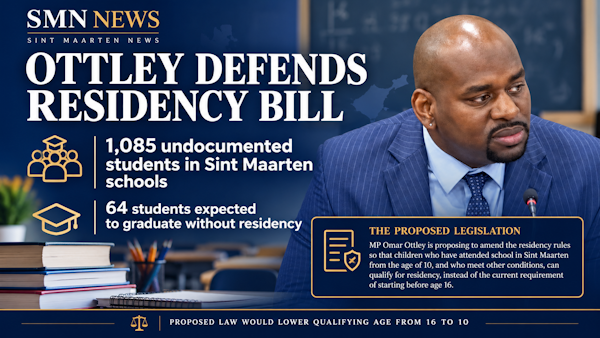
ottleylaw22102026PHILIPSBURG:--- Children born and raised in Sint Maarten could gain an earlier pathway to lawful residency under an amended initiative draft law presented by Member of Parliament Omar Ottley, who told Parliament that hundreds of locally born students remain undocumented despite attending the country’s schools.

During the continuation of a Central Committee meeting on Thursday, October 22, 2026, Ottley outlined a proposal to amend the National Ordinance on Admission and Expulsion. His initiative seeks to expand the categories of people eligible for admission by operation of law, addressing cases where children grow up in Sint Maarten without obtaining legal residency.

According to figures Ottley said he received from the Ministry of Education, Culture, Youth and Sport, 1,085 undocumented students are enrolled in primary and secondary education, including 465 who were born in Sint Maarten. He further reported that 64 undocumented students were expected to graduate this year.

Ottley argued that these children face barriers extending far beyond immigration paperwork, affecting their ability to pursue further education, travel, participate in overseas sporting activities and eventually secure lawful employment.

The proposal remains under parliamentary consideration. The supplied meeting transcript records further questions and proposed changes from MPs, followed by an adjournment; it does not record a vote approving the legislation.

Replacing “continuously admitted” with residence since birth

A central feature of Ottley’s proposal concerns both the age at which locally born children could qualify and the evidence required to establish their connection to Sint Maarten.

As Ottley described it, the existing provision applies to persons born in Sint Maarten who do not possess Dutch nationality, have reached age 16 and have been continuously admitted to the country since birth.

He identified continuous admission as a major obstacle for children whose parents never obtained residency documents for them.

A child may have lived in Sint Maarten since birth and attended school locally, yet still be unable to satisfy a requirement based on having previously held lawful admission.

Ottley’s amended proposal would lower the qualifying age from 16 to 10 and replace the emphasis on continuous admission with residence in Sint Maarten since birth. School records would help establish that the child has actually grown up in the country.

His stated objective is to prevent children from remaining dependent on discretionary humanitarian decisions because their parents failed to arrange their status.

“And our job as Members of Parliament is to see an issue, identify an issue and try our best to fix the issue,” Ottley told the committee.

A separate pathway based on parents’ tax compliance

Ottley also explained a proposed pathway through which a locally born child could qualify earlier, based on a parent’s record of meeting tax obligations for 10 consecutive years.

In the examples he presented, a child born after the parent had completed the qualifying period could become eligible at birth.

If the parent had completed only part of that period, the child could qualify once the parent completed the remaining years.

For example, Ottley explained that if a parent had three consecutive qualifying years when the child was born, another seven years would be required, allowing the child to qualify at age seven. A parent with nine qualifying years at the child’s birth would need one additional year.

He said this mechanism was intended to recognize longstanding contributions to Sint Maarten while discouraging people from coming to the island solely to give birth in anticipation of residency benefits for their children.

For children whose parents do not meet the tax condition, Ottley described the age-10 pathway, supported by evidence of residence and schooling, as a separate protection.

However, the debate revealed that the precise wording of the tax requirement still needs attention, including whether it would require compliance by both parents or only one.

Residency proposal does not confer Dutch nationality

Ottley stressed that his initiative concerns lawful residence in Sint Maarten.

It would not grant Dutch nationality or automatically provide a Dutch passport.

He explained that nationality is governed at Kingdom level, while the proposed changes address admission and residency within Sint Maarten.

That distinction matters for families: the proposal aims to address children’s local legal status, while nationality and travel-document requirements remain separate.

School records would help establish eligibility

Responding to questions about the education system’s role, Ottley said schools should register children regardless of their documentation status and maintain records that could support residency applications.

He argued that education records offer a practical way to establish whether a child has grown up in Sint Maarten.

MP Sjamira Roseburg nevertheless questioned whether the school-enrollment requirement was sufficiently embedded in the draft's operative text, rather than appearing mainly in its explanatory memorandum.

She suggested expressly including a requirement for at least six consecutive years of school enrollment, reflecting the period between ages four and 10.

Roseburg also asked how interruptions would be treated, including illness, school changes or temporary stays abroad. She was concerned that children should not lose access to the proposed protection because of circumstances that interrupt an otherwise established history of local residence.

These were suggestions raised during the discussion, not changes adopted in the supplied transcript.

Roseburg flags nationality wording and children without parental care

Roseburg also questioned wording that, in her reading, could be interpreted as focusing on children without any nationality.

She warned that the legislation must clearly cover children born in Sint Maarten who possess a foreign nationality, including through Haitian or Jamaican parents, but lack lawful local residency.

Ottley’s presentation described his intended coverage as including locally born children without Dutch nationality, as well as stateless children. The exchange highlighted the need to ensure that the final wording accurately reflects that intention.

Roseburg further proposed clarifying that at least one parent could satisfy the tax requirement, rather than requiring both parents to do so.

She pointed to single-parent households and asked how the legislation would protect children in foster care or youth homes whose parents are absent or uninvolved.

She suggested a mechanism for a guardian or the Court of Guardianship to act on a child’s behalf.

Research describes exclusion, uncertainty and disrupted ambitions

Beyond the education figures, Ottley presented findings from focus groups involving parents and young people.

The parent-focused research included 16 participants aged 23 to 61, with reported periods of residence in Sint Maarten ranging from seven to 38 years.

Participants described financial pressures, dependence on employers, complicated administrative procedures, and prolonged uncertainty when trying to obtain or maintain documents.

Ottley reported that 10 of the 16 participants believed their undocumented status negatively affected their children’s sense of belonging.

A separate youth focus group involved 10 participants aged 16 to 24 who reported being born in Sint Maarten and living there since birth.

Most said they had never held residency documents; two reported previously having documents that later expired.

All 10 expressed ambitions to pursue further education, while seven described delays or changes to their plans. Participants also described teasing, uncomfortable comments and uncertainty about whether others accepted them as belonging to Sint Maarten.

These accounts provide insight into the experiences of those interviewed, although the small focus groups do not establish how widespread each experience is across the entire affected population.

Ottley says Justice Minister and Prime Minister have not responded

The debate also exposed frustration over the government's lack of response.

Ottley said he sent questions to the Prime Minister, Minister of Justice and Minister of Education on December 17, following his December 16 presentation in 2025. A reminder followed approximately three weeks later.

He told Parliament that only the Minister of Education had responded.

As a result, he said he could not provide the committee with the Justice Minister’s position or the Immigration Department’s assessment of the proposed age reduction.

MPs Egbert Doran, Ardwell Irion and Darryl York criticized the lack of responses and raised broader concerns about government accountability to Parliament.

Parliament Chair Sarah Wescot-Williams defended the Secretariat’s efforts to obtain answers and coordinate ministerial appearances, saying reminders are issued across the board.

She also stressed the need to secure the government’s position so parliamentary approval would lead to legislation that could take effect.

Questions remain about parents’ status and implementation

Wescot-Williams questioned how parental responsibility would be addressed when children remain undocumented despite their parents’ longstanding presence and tax contributions.

MP Francisco Lacroes raised another practical concern: what would happen if a child obtained residency under the proposal while the parent remained undocumented?

He asked whether removing the parent could force the child to leave Sint Maarten or remain behind, undermining the security the initiative seeks to provide.

Lacroes also requested clarity on the nature of the residency contemplated by the proposal.

Meanwhile, several MPs warned that the reported lack of a functioning Social Economic Council, known as the SER, was obstructing the processing of legislative initiatives more broadly.

The chair outlined the history of Ottley’s draft: its submission on August 2, 2024; receipt of the Council of Advice’s opinion on October 15, 2024; and submission of his response and amended draft on September 25, 2025.

The October 22 discussion demonstrated support for addressing the position of locally born undocumented children, while leaving substantive questions about eligibility, drafting, and implementation for further handling.

For Ottley, the central issue is whether children who have known Sint Maarten as home should continue reaching adolescence and graduation without a clear route to lawful residence.


Tackling must step up or step aside: unanswered questions expose failure of accountability at Justice Ministry.

SMN News’ September 16 questions about the Miss Lalie Center remain unanswered despite two reminders, as MPs condemn the Justice Minister and Prime Minister for failing to respond to parliamentary requests.

SMN News Editorial

nathalietackling22102026PHILIPSBURG — Minister of Justice Nathalie Tackling must answer for her ministry’s failure to provide basic information about juvenile detention and rehabilitation. More than five weeks after SMN News submitted 15 questions about the Miss Lalie Center, the questions remain unanswered, despite two reminders.


The silence concerns children in detention, the facility’s capacity, staffing, rehabilitation programmes and the arrangements made for minors arrested in connection with the Festival Village break-ins and other crimes.

These are substantive questions about the administration of justice and the treatment of vulnerable young people. A minister entrusted with that responsibility should be able to answer—or, at the very least, explain what information is being gathered and when a response will follow.

Instead, SMN News is still waiting.

That experience now sits alongside complaints made openly in Parliament, where MPs criticized the absence of responses from both the Minister of Justice and Prime Minister Dr. Luc Mercelina.

The message to Tackling is straightforward: step up and account for your ministry, or step aside.

Parliament is waiting for answers too

During the October 22 Central Committee discussion on MP Omar Ottley’s amended initiative draft law concerning residency for locally born children, Ottley told Parliament that requests for information had gone unanswered by the Justice Minister and Prime Minister.

Ottley explained that following his December 16, 2025, presentation, he sent questions on December 17 to the Prime Minister, Minister of Justice and Minister of Education. A reminder followed approximately three weeks later.

Only the Minister of Education had responded, he said.

Consequently, Parliament was discussing proposed changes affecting children’s residency without the requested assessment from the ministry responsible for admission and immigration matters.

Ottley said he could not tell MPs the Justice Minister’s position because he had not received it.

This failure has practical consequences. MPs need information to scrutinize proposals, identify implementation problems and determine whether legislation will achieve its intended purpose.

Leaving those requests unanswered weakens the process through which the public’s representatives are supposed to examine government policy.

Doran challenges government’s treatment of Parliament

MP Egbert Doran criticized the lack of responses, saying the Justice Ministry’s input could help Parliament assess whether the proposal needed additions or adjustments.

His concern was substantive: ministerial engagement could improve legislation before MPs approve it.

Doran also questioned how Parliament could function effectively when requests to ministers remained unanswered. He linked those concerns to the reported difficulties at the Social Economic Council, or SER, which MPs said were holding up legislative initiatives.

His intervention exposed a troubling situation: Parliament is expected to perform its duties while chasing the executive for the information it needs to do so.

Irion and York demand accountability

MP Ardwell Irion likewise criticized the absence of responses and questioned whether political considerations were interfering with engagement on Ottley’s initiative.

That was Irion’s assessment, rather than an established explanation for the silence. Nevertheless, the failure to answer creates space for precisely that suspicion.

A minister who disagrees with a proposal can explain the disagreement. A ministry that identifies legal or operational difficulties can set them out. Silence leaves Parliament and the public without either an explanation or a position to examine.

MP Darryl York broadened the criticism, saying unanswered correspondence had become a persistent problem across multiple ministries.

He cited six outstanding letters to the Ministry of VROMI, including one he said had been awaiting a response for 562 days. Those examples concerned VROMI, but his broader argument was directly relevant to the discussion: Parliament cannot let unanswered requests become normal government practice.

The Prime Minister must also address his own outstanding correspondence and the standards of responsiveness within his government.

Chair describes the burden of chasing ministers

Parliament Chair Sarah Wescot-Williams defended the Secretariat against suggestions that it was inconsistent in pursuing answers.

She explained that staff spend considerable time coordinating with ministers, issuing reminders and arranging parliamentary appearances, regardless of who submitted the questions.

Her explanation reveals an administrative burden that should concern the public. Parliamentary staff should not have to devote excessive effort to persuading ministers to engage with parliamentary business.

Wescot-Williams also stressed the importance of obtaining the government’s position on Ottley’s initiative so that the legislative process could lead to effective implementation.

That makes the absence of a response more consequential. Government’s participation matters, yet Parliament is left pursuing it.

Fifteen questions about the Miss Lalie Center—still unanswered

SMN News’ own experience concerns an equally serious area of the Justice Minister’s portfolio.

On September 16, the newsroom submitted questions asking how many minors were detained at the Miss Lalie Center, how many were male or female, the facility’s official capacity, and whether it was full or approaching capacity.

SMN News also asked whether the Center could accommodate all four minors arrested in connection with the Festival Village break-ins.

If they were not all placed at the Center, SMN News asked the ministry to explain where they were held and why.

Those questions remain unresolved. Without answers, SMN News cannot determine whether the Center could accommodate all four suspects or what alternative arrangements, if any, were necessary.

The questions themselves do not establish that the facility was full or that placements were improper. They establish what the ministry has been asked to clarify—and has still failed to explain.

What rehabilitation are detained children receiving?

The questions extended beyond the number of available beds.

SMN News asked whether the Center has sufficient correctional officers, social workers, psychologists, educators and rehabilitation specialists.

The ministry was asked to identify the educational, psychological, vocational and behavioral programmes available to detained minors.

It was also asked whether it tracks reoffending after release and, if so, to provide the recidivism rate.

Further questions sought details of concrete interventions for repeat offenders, whether structured residential rehabilitation or other programmes were being considered, and what support helps children return to school, enter vocational training or obtain suitable employment after leaving the Center.

SMN News also asked what role parents and guardians play, whether government has a comprehensive juvenile-justice strategy, and whether the minister would provide Parliament and the public with a full report covering the Center’s population, capacity, staffing, budget, conditions and rehabilitation programmes.

These questions go to the purpose of juvenile justice.

Detention carries an obligation to explain what happens to a child during confinement and what support follows release. The public deserves evidence of the work being done, the resources available, and the shortcomings that require attention.

A communications office must communicate

The unanswered correspondence also reflects poorly on the ministry’s communications arrangements.

According to SMN News’ correspondence record, two reminders produced no response from the communications representative approached for the minister’s answers.

Taxpayer-funded communications personnel should facilitate access to information and ensure that questions reach the officials responsible for answering them.

If information is incomplete, they can communicate that. If a response takes longer, they can explain why and provide a realistic timeframe.

Weeks of silence represent a failure to perform that basic function.

Responsibility ultimately rests with the minister. Tackling leads the ministry and must ensure that its public communications serve the people who fund it.

Silence prevents scrutiny

The lack of a response does not prove that the Miss Lalie Center lacks programmes, sufficient staff or appropriate conditions. It prevents the public from assessing those matters through the information requested from the responsible ministry.

That is the accountability failure.

If effective programmes exist, the minister should identify them. If the facility faces shortages, she should explain their extent and the plan to address them. If data are unavailable, she should say so and explain how she will correct that deficiency.

The same standard applies to parliamentary questions. Ministers must engage with scrutiny even when the questions are difficult or politically inconvenient.

Step up or step aside

On this record, Tackling is failing a basic test of ministerial accountability.

SMN News has sought answers since September 16. Two reminders have followed. Parliament has separately heard that the Justice Minister and Prime Minister have failed to respond to requests concerning legislation affecting children born in Sint Maarten.

The subjects differ, but the problem is the same: unanswered questions where public responsibility demands engagement.

Minister Tackling should now provide substantive responses to the Miss Lalie Center questions, explain the delay, and address the outstanding parliamentary requests.

Parliament, in turn, must insist on answers and attach political consequences to persistent failures to provide them.

Minister Nathalie Tackling: step up, answer the questions, and demonstrate that you can lead an accountable Justice Ministry. If you cannot meet that responsibility, step aside.


Subcategories

Vinaora Nivo Slider 3.x
Vinaora Nivo Slider 3.xVinaora Nivo Slider 3.x
Vinaora Nivo Slider 3.x