Vinaora Nivo Slider 3.xVinaora Nivo Slider 3.x
Vinaora Nivo Slider 3.xVinaora Nivo Slider 3.xVinaora Nivo Slider 3.x

Suspect Arrested Following Firearm Threat Complaint.

firearm25092026PHILIPSBURG:--- On Monday, September 21, 2026, the Police Force of Sint Maarten (KPSM) received an official complaint from a victim who reported being threatened with a firearm following a verbal confrontation with a suspect.

After receiving the complaint, personnel from the Detective Department proceeded to a residence in the St. Peters area, where they located and arrested the suspect, identified by the initials D.D.C.

With the Prosecutor’s Office's cooperation, police subsequently searched the suspect’s residence. During the search, a firearm was discovered and confiscated by police.

Police transported the suspect to the police station in Philipsburg, where he remains in custody for questioning and further investigation.

KPSM reminds the public that the unlawful possession of firearms is a serious criminal offense in Sint Maarten. Firearms in the hands of unauthorized persons pose a significant threat to public safety and can quickly turn confrontations into potentially deadly situations. Persons found in possession of firearms without the required authorization may face criminal investigation and prosecution, with serious legal consequences.

KPSM will continue to take firm action against the illegal possession and use of firearms and will work closely with the Prosecutor’s Office to remove illegal firearms from our community.

The investigation remains ongoing, and we will provide further information when possible.


No Transparency if Questions Remain Unanswered.

An Analysis by Fundashon Kòrsou Transparente


On September 28, the world recognized the right of access to information. In Curaçao, this right is enshrined in law. But how does it work in practice when a request about implementing the Public Access to Government Information Ordinance (LOB) itself goes unanswered?
Access to information is essential to the functioning of democratic societies. The better-informed people are, the more capable they are of participating and bringing about change. In 2019, the United Nations established the International Day for Universal Access to Information, further underscoring
the importance of guaranteeing access to information. For Curaçao, this is an appropriate moment not only to talk about transparency, but above all to examine how it functions in practice.
Curaçao has the National Ordinance on Public Access to Government Information (LOB), which allows anyone to request information recorded in documents related to an administrative matter. Citizens and journalists can use the LOB to gain greater insight into government policy, decision-making, and its implementation. As a result, they are not solely dependent on information that the government itself releases through press statements, press conferences, or official announcements.
The LOB goes beyond responding to information requests. The law also provides for proactive disclosure: the government has an independent responsibility to make certain information about
policymaking, preparation, and implementation public on its own initiative. Government transparency is therefore not an abstract legal principle. It enables everyone to monitor and scrutinize government actions.
Against this background, Fundashon Kòrsou Transparente (FKT) submitted a request on July 23, 2026, to the Minister of Governance, Planning and Service for information concerning the
implementation of the LOB. The request did not concern a specific policy dossier. Rather, FKT wanted to understand how the transparency law itself functions in practice.
Among other things, the foundation requested information on how many LOB requests are submitted annually, how many are granted or denied, the extent to which requests are handled within the statutory decision period, and how often extensions are used. Information was also requested regarding objection and appeal procedures arising from LOB decisions. In addition, FKT sought information about the ministry's capacity and any bottlenecks affecting the timely implementation of the law. The foundation also asked what information the government discloses proactively, how citizens access that information, and to what extent the principle of "open unless there is a reason not to be" forms part of the government's transparency policy.
No response was received. As a result, on August 24, 2026, FKT sent the minister a follow-up letter.

In this reminder, the foundation explicitly referred to Article 6 of the LOB, which requires a decision on a request as soon as possible and no later than three weeks after receipt. This period may be extended by a maximum of three additional weeks, provided that the extension is communicated in writing and with reasons before the expiration of the initial period.
In its reminder, FKT noted that it had not yet received any response and once again brought its request to the minister's attention. To date, it has received no response to this reminder either.
This is precisely what makes the situation remarkable.
A request asking whether LOB requests are processed within the statutory deadline remains unanswered itself. A request seeking information about obstacles affecting the timely implementation of the LOB is itself subject to delay. And a request concerning proactive disclosure and a culture of transparency has, even after a written reminder, failed to generate a response.
As a result, this issue is not only about FKT. It raises a broader question: what can citizens and journalists reasonably expect from their government when exercising their legal right to information?
After all, a transparency law only acquires real meaning when it functions in practice. Statutory deadlines must have significance. When more time is required, authorities should communicate it. And where information can be disclosed proactively, citizens should not first have to submit a formal
request in order to gain access to it.
For that reason, September 28 is an appropriate moment for reflection. Not only on the existence of the LOB itself, but above all on how it functions. How accessible is our government in practice? Can citizens and journalists genuinely exercise their right to information? And what value does a statutory
decision period have when no response is given?
FKT is still awaiting the requested information.
The International Day for Universal Access to Information should therefore not be merely a day to reaffirm the importance of transparency in Curaçao. It should also be an opportunity to assess whether that principle is being meaningfully applied in the day-to-day practice of government.

Because public access begins with answers.
Fundashon Kòrsou Transparente (FKT)

MPs Ottley and Kotai Explore Aruba’s Electricity Pricing Model, Seek Lessons for St. Maarten and GEBE.

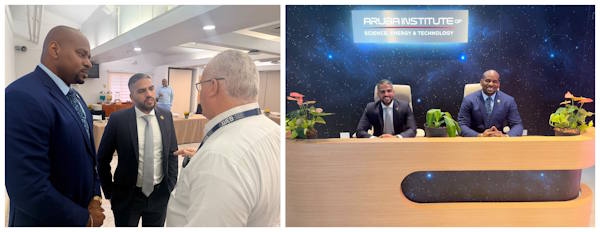
ottleykotai25092026Oranjestad, Aruba:---  Members of Parliament Omar Ottley and Viren Kotai used their attendance at the Parlatino convention in Aruba this week to look beyond discussion and explore practical solutions that could benefit the people of St. Maarten.

On Thursday, September 24, the MPs visited Aruba’s water and electricity utility, WEB, where they received an in-depth presentation on the country’s energy operations, sustainability goals and plans for the future.

The visit was particularly significant given ongoing concerns about the cost of electricity in St. Maarten. Rather than viewing Aruba’s model as something that can simply be copied, the MPs approached the meeting as an opportunity to learn, ask questions, and determine what lessons could realistically be adapted to St. Maarten’s circumstances.

One area that immediately sparked their interest was Aruba’s approach to electricity pricing.

While Aruba’s base electricity rate of approximately 37 cents per kWh appears higher than St. Maarten’s base rate of approximately 25 cents per kWh, WEB officials explained that the comparison does not tell the full story. Aruba’s rate already incorporates fuel costs, while consumers in St. Maarten are charged an additional fuel clause on top of the base electricity rate.

WEB representatives explained that Aruba previously charged fuel costs separately but subsequently changed its approach, incorporating those costs into its rate structure and eliminating a separate fuel surcharge.

The potential impact on consumers was illustrated using an actual GEBE bill presented during the discussion. The St. Maarten bill reflected consumption of 867 kWh at 0.25XCG, with a total charge of approximately XCG 671.84, including a fuel clause of XCG 425.84.

Using the figures presented during the WEB meeting, 867 kWh of consumption at Aruba’s approximate rate of XCG 0.37 per kWh, plus a standard connection fee of XCG 12.50, would total approximately XCG 333.29.

For MPs Ottley and Kotai, the comparison raised an important question: What can St. Maarten learn from Aruba to reduce the burden on households and businesses?

WEB officials stressed that continued heavy dependence on heavy fuel oil leaves electricity costs vulnerable to increases in global fuel prices. The company therefore emphasized the importance of changing long-term operational strategies and steadily moving toward alternative, sustainable energy sources.

Another area of significant interest was Aruba’s use of fuel hedging to manage exposure to fluctuations in international fuel prices. The strategy can provide greater predictability and protection against sudden increases in fuel costs, helping to safeguard both the utility and, ultimately, consumers.

MP Ottley said participating in regional forums should extend beyond attending meetings and returning home. Where another country has found a method that appears to work for its people, St. Maarten should be willing to listen, learn and investigate whether elements of that approach can work at home.

“We do not have all the answers, and we should never pretend that we do. If our neighbors are doing something that is producing better results for their people, then it is our responsibility to sit with them, understand how they got there and determine what we can take back home,” Ottley said.

“Our people are feeling the pressure of high electricity bills every month. If there are policies, financial strategies, legislative changes or alternative-energy solutions that can help ease that burden, then we owe it to the people of St. Maarten to do the research and pursue them,” Kotai said.

Both MPs committed to remaining in contact with WEB, conducting further research and examining what legislative or policy changes may be required to help St. Maarten address its ongoing energy challenges.

For Ottley and Kotai, the Aruba visit was not about suggesting that one meeting will solve St. Maarten’s energy problems. It was about being willing to learn from a neighboring country, asking difficult questions, and returning home prepared to do the work necessary to turn those lessons into possible solutions.

Perry Geerlings Appointed to Cft after years on both sides of St Maarten’s Budget Debates.

~Former finance minister will take Sint Maarten’s seat on the financial supervisory college on October 1~

perrygeerlings25092026PHILIPSBURG:--- Perry F.M. Geerlings, who dealt directly with the College of Financial Supervision (Cft) during St Maarten’s difficult post-Irma budget years, has been appointed as the country’s new representative on that same college.

The Kingdom Council of Ministers approved his appointment on St Maarten’s nomination, according to a Dutch government announcement issued Friday, September 25. His three-year term begins October 1, 2026. He succeeds Julisa Frans, who will leave the position on that date with an honorable discharge.

The appointment brings Geerlings back to an institution he knew from the government’s side of the table. As Minister of Finance, he worked with the Cft on St Maarten’s 2019 budget while the country was still managing the financial consequences of Hurricane Irma. His ministry prepared a revised draft after Cft recommendations on projected spending. Geerlings said at the time that the new draft would reflect agreement reached with the college on total projected expenditure.

That budget process also exposed sharp political divisions. During the June 2019 budget debate, a motion of no confidence was tabled against Geerlings. The motion challenged, among other matters, the time taken to prepare the budget. He remained in office after the motion failed by eight votes to seven.

Geerlings’ career extends beyond the Finance Ministry. The Dutch government identifies him as a former Member of Parliament, a former director of the Cabinet of St Maarten’s Minister Plenipotentiary in The Hague, and a former holder of several financial sector positions. He currently sits on Sint Maarten’s Corporate Governance Council, which advises on the governance of government-owned companies and foundations.

His earlier work in The Hague included serving as director of the Minister Plenipotentiary’s cabinet. In 2014, SMN News reported that he completed training at the Clingendael Academy covering international diplomacy, foreign relations, European Union project management and public administration.

Geerlings now joins the Cft as Sint Maarten faces continuing pressure to reconcile public spending with available revenue. The college is an independent supervisory body with an advisory and signaling role concerning the public finances of Curaçao and Sint Maarten. Although Geerlings takes the seat on Sint Maarten’s nomination, the appointment is to that independent college.


Click here for the official announcement: https://www.rijksoverheid.nl/actueel/nieuws/2026/09/25/benoeming-nieuw-lid-college-financieel-toezicht-curacao-en-sint-maarten

Public funds sent to private foundation without clear accountability rules, Audit Finds.

~St Maarten’s office in The Hague has an annual budget of about XCG 1.9 million. Auditors found that the government has never clearly established who owns the money as it moves between accounts, who can commit it, or how Parliament can hold those managing it to account.~

plenipotentiaryaudit25092026PHILIPSBURG:--- For years, Parliament has approved public money to operate the Cabinet of Sint Maarten’s Minister Plenipotentiary in the Netherlands. The money is then transferred to a Dutch private-law foundation, which employs staff and helps run the office. But the government has not established a comprehensive framework governing what happens to those funds after the transfer, according to a General Audit Chamber report published in September.

The Audit Chamber calls this a “longstanding accountability gap.” Its finding is not that the XCG 1.9 million annual allocation has disappeared. Annual financial statements are prepared and audited, and the Cabinet has financial procedures. The finding is that these practices developed without clear formal rules linking the foundation’s management of public money to the government’s duty to account to Parliament.

The gap dates back to Sint Maarten’s early years as a country. Archival records show that in 2011, the government approved a transfer of XCG 500,000 to the foundation, as described in the report. The same records said conditions needed to be set for the Cabinet’s accounting and reporting. The Audit Chamber could not establish that those conditions ever became a formal framework governing the relationship among the government, the Cabinet and the foundation.

Where the money goes

The budget allocation sits under the Ministry of General Affairs. After Parliament approves the national budget, funds are transferred in lump sums to Stichting Kabinet Sint Maarten, a foundation established under Dutch private law. Money then moves to an ABN AMRO account registered in the name of the Cabinet of the Minister Plenipotentiary. Some funds move back to the foundation, chiefly for personnel costs.

That route matters because the foundation is a separate legal entity and is not part of the Government of Sint Maarten. The Cabinet, meanwhile, operates as an organization but has no separate legal personality. Auditors could not identify a formal framework specifying who legally owns the funds at each stage, which financial-management rules apply, or who is responsible for oversight.

A figure in the 2024 financial statements brings the problem into focus. They recorded a €533,922 receivable from the foundation: government funds intended for the Cabinet that the foundation still held at year-end. But if the Cabinet has no separate legal personality, the Audit Chamber asks, who legally holds that claim? The report also says it did not find separate financial statements for the foundation, although its articles require it to prepare an annual balance sheet and statement of income and expenses.

The uncertainty extends to property bought with transferred funds. Assets acquired by the foundation appear to be held by the foundation rather than Sint Maarten, auditors wrote. They found no formal arrangement requiring those assets to be registered as public property or transferred to the country.

The Audit Chamber itself had to obtain written consent from the foundation and the Minister Plenipotentiary to examine the foundation’s funds and related financial activities. The public origin of the money alone did not give it direct authority to audit that separate private entity. For the auditors, that need for consent illustrates the weakness in the oversight arrangement.

Who has authority to spend?

The audit identified a second issue: the difference between having an approved budget and having legal authority to enter into obligations on behalf of the country.

The most recent mandate register the auditors identified, published in September 2025, does not list either the Minister Plenipotentiary or the Cabinet Director. The Audit Chamber could not confirm that either had formal authority under the applicable mandate framework to enter into financial obligations on Sint Maarten’s behalf for Cabinet operations. An appropriation by Parliament makes money available; the auditors stress that it does not, by itself, grant authority to enter into legal acts for the country.

The Cabinet acknowledged that the mandate framework would benefit from clarification so that formal authority matches the responsibilities exercised in practice. The report does not conclude that every operational commitment was unlawful. It says it could not confirm the formal basis for such commitments.

Payment approvals existed; the full trail did not

Auditors examined transactions from 2021 through 2025, focusing on personnel costs and purchases of goods and services. Every sampled invoice carried a completed payment approval stamp. None had a purchase order attached.

The documentation accompanying the sampled invoices also failed to provide a complete trail showing steps such as order approval, confirmation that goods or services were received, quality checks, budget checks, and invoice verification. The Cabinet said it used other forms of prior approval, including electronic advice and petty-cash vouchers, for some transactions. Those approvals were not consistently linked to the invoices the auditors examined.

That distinction is important: the Audit Chamber found evidence that payments were approved, but said it could not verify from the linked records whether all required control steps had taken place.

It was also found that too many financial duties could rest with too few people. The Director could enter into financial obligations, approve payments, and manage petty cash. Another employee periodically counted petty cash as a compensating check. The Director said an extended staff absence had contributed to the concentration of some financial-administration duties.

The office’s manual provides financial procedures, but does not fully describe controls for purchase orders, confirmation of deliveries, electronic banking and the documentation of checks. Although it states that the Minister Plenipotentiary has a bank card for official expenses, it does not set out how card transactions should be authorized, documented, reviewed and reconciled.

Benefits still rely on a 2012 decision

The Audit Chamber also examined benefits provided under a 2012 Council of Ministers decision originally made for the deployment of the then-Deputy Minister Plenipotentiary. The arrangements included travel between the Netherlands and Sint Maarten up to twice a year, rental reimbursement up to €1,500, utilities, telephone and internet, use of an official vehicle including a personal driver, and first-class health insurance coverage for the family.

Auditors found no maximum amounts for telephone and internet or for gas, water and electricity under those arrangements. They found no updated government decision replacing the 2012 framework. A newer draft policy addressing housing, travel, allowances and vehicles had been submitted to the government but had not been formally adopted at the time of the audit.

Vehicle costs provide another measure of the spending involved. In 2024, the Cabinet maintained three vehicles at a total vehicle-related cost of €91,195, approximately XCG 180,000. One vehicle has since been sold, and another was scheduled for sale in 2026. The auditors said the reduction showed that vehicle needs had been reassessed and that there had been room to cut costs.

They also found no evidence that the Cabinet’s fixed-asset accounting records were periodically reconciled against a current physical inventory to confirm where assets were, whether they still existed, and what condition they were in.

Duties grew without a comprehensive mandate

The Minister Plenipotentiary’s constitutional role is to represent Sint Maarten in Kingdom affairs, including participation in the Kingdom Council of Ministers. In practice, the Hague office also undertakes student support, consular-related administration, economic and investment promotion, European affairs, cultural promotion and other activities.

Some tasks have a documented basis. The report cites a 2021 agreement with USZV concerning life certificates and mutation forms. But auditors found no overarching government instrument defining the full range of the Cabinet’s additional work, who authorized it, and how expenditure on it should be accounted for.

The report also found no formally adopted framework explaining which matters the Minister of General Affairs may approve or instruct, which belong to the Council of Ministers, and which fall to the Minister Plenipotentiary. The auditors say placing the Cabinet’s budget under General Affairs does not, by itself, establish a hierarchical relationship.

Government must decide what this office is

The Audit Chamber places responsibility for establishing the missing public accountability framework on the government. It sets out three possible paths: formally regulate the existing relationship with the foundation; bring the supporting office directly within government; or establish a legal framework for the Cabinet. It does not prescribe which path to choose.

Whichever option is selected, auditors say the government must settle the ownership and reporting of public funds, authority to spend, access for oversight, treatment of assets, and the respective responsibilities of the Minister Plenipotentiary, Cabinet, foundation and General Affairs.

The report covers 2021–2025. It should therefore not be read as an assessment of Perry Geerlings’ tenure as Minister of Finance, which ended before that period, or as a finding against him in his newly announced Cft appointment.

The central question for the current government is now straightforward: after more than a decade of using this structure, when will it give Parliament enforceable clarity over the public money sent to Sint Maarten’s office in The Hague?

Source: General Audit Chamber, Audit into the Governance and Financial Management of the Minister Plenipotentiary, September 2026, particularly pp. 1–3, 7–11 and 14–21.



Subcategories

Vinaora Nivo Slider 3.x
Vinaora Nivo Slider 3.xVinaora Nivo Slider 3.x
Vinaora Nivo Slider 3.x