




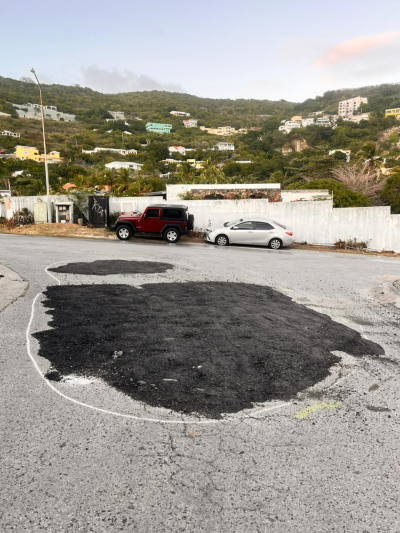
 PHILIPSBURG:--- The Ministry of VROMI’s announcement of another round of night-time hot asphalt repairs may sound like progress, but anyone familiar with our road history knows what follows. Fresh patches today, fresh failures tomorrow, and another press release when the cycle repeats. If potholes could speak, they would likely greet the asphalt crew like old friends. At this point, patching has become the infrastructure equivalent of putting cologne on a broken leg. It may smell better, but the problem underneath remains the same.
The truth is that Sint Maarten’s crisis has never truly been potholes. The real issue lies beneath the surface. As an engineer, it is clear to me that we have a drainage problem and a compromised road foundation. Until those are addressed, every patch begins its countdown to failure the moment it cools. Water becomes trapped beneath the surface, the surrounding asphalt softens, the edges crumble, and one pothole quietly becomes three. What appears to be a repair is actually the first step toward the next expense.
This becomes even more concerning when we recall Minister Patrice Gumbs's commitment to evidence-based decision-making. It was a welcome promise. Yet after a year and a half in office, not a single meaningful data-gathering measure has been implemented. No height surveys before road works. No elevation assessments to guide drainage. No evaluation of materials or methods, no traffic counts. Evidence-based decision-making cannot exist without evidence, and the public is being asked to trust a process that produces none.
Opportunities to address these matters together have also slipped by. Parliament still has pending requests for meetings on infrastructure, flooding, drainage, building permits, and housing, including a housing meeting that has been avoided since April 2024. These sessions are not confrontations but opportunities for clarity, planning, and accountability. When they remain unaddressed, policy becomes less collaborative and more improvisational, guided by preference rather than informed debate. Meanwhile, beautification efforts are being presented as progress. The public was told drainage would be a priority, yet what followed was a series of roadside swales that are flat and unable to guide water, now serving as mud collectors. A swale that does not drain is not a drainage system. It is landscaping with unintended consequences. These installations increase long-term maintenance needs and worsen the very issues they were meant to solve. One only needs to look at Suckergarden Road to see this in real time.
The familiar explanation is that deeper solutions are too expensive. But research into improved asphalt mixes and drainage strategies does not require millions. Even a modest public commitment to studying better materials or mapping water flows would show that the country is moving toward sustainable improvement. The absence of such steps leaves the impression of a ministry working week to week rather than preparing for the decade ahead.
In the spirit of progress, I continue offering solutions. A modern approach begins by collecting the basic data we currently lack, including elevation surveys, drainage mapping, and documentation of soil conditions, before any work begins. The next step is to pilot asphalt mixes designed for our climate and traffic loads, something many countries routinely do without incurring massive costs. Finally, drainage must be engineered as an interconnected system rather than as scattered features placed without context. These are practical, affordable steps that deliver tangible improvements and position the Ministry to make informed decisions rather than repetitive guesswork.
Some will say I should help rather than critique. My recommendations are all on record in Parliament. They were provided in the hope of supporting better outcomes for the country. The Minister is free to accept them or ignore them, but when the opposite becomes the standard approach and predictable failures follow, accountability becomes necessary. Oversight and solutions are not competing roles. They are essential partners.
Because at some point, patching becomes less of a solution and more of a symbol. A symbol that we are managing decline instead of moving forward. The Minister promised evidence. The public is still waiting for the evidence that evidence matters. And until that changes, every pothole patch is less a sign of maintenance and more a reminder that we are stuck, sometimes literally depending on the road, in the same old cycle. If this is doing things differently, one shudders to imagine what more of the same would look like.
And let me be clear. My tone is measured because the country deserves maturity, not theatrics. But patience is not a substitute for progress, and silence is not a strategy. If shortcuts continue, and if the serious discussions remain avoided, the conversation ahead will not stay this gentle. I intend to press, to question, and to push for the level of accountability and competence our people deserve. And if the Minister is uncomfortable with the heat, he should know that the kitchen is about to get considerably warmer.