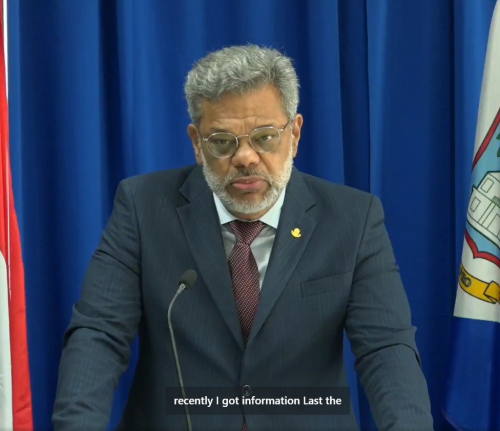
 PHILIPSBURG:--- While the government continues to offer assurances about the future of GEBE, residents and businesses across St. Maarten are left grappling with an unreliable power supply and a distinct lack of concrete progress. Prime Minister Dr. Luc Mercelina told Parliament on Monday that he intended to clarify the path forward. Still, he has instead illuminated a troubling pattern of stalled initiatives, financial dependencies, and a glaring absence of urgency.
For years, the prospect of transitioning to cleaner and more stable Liquefied Natural Gas (LNG) has been dangled as a long-term solution. Now, the government confirms this vision is effectively off the table. Citing a Trust Fund-financed study, officials state the "substantial additional capital costs" for storage, port upgrades, and infrastructure make the move unviable. This admission raises serious questions about the foresight and planning of previous administrations and whether the public was sold a pipe dream while the existing infrastructure was left to decay.
The government's current strategy appears to be a reactive scramble rather than a proactive plan. A formal letter was sent on June 17, 2025, requesting a "high-level overview of long-term maintenance" from GEBE. That such a fundamental assessment is only being requested now, in the midst of ongoing grid instability, suggests a profound failure in oversight and management. The focus has been reduced to mere "grid stabilization," a low bar that tacitly accepts the status quo of inconsistent electricity.
Instead of a bold energy revolution, St. Maarten is being offered a bailout. The solution presented is a "capital loan from the Netherlands" to procure additional capacity. While this may provide a temporary fix, it deepens the nation's financial reliance on external entities and fails to address GEBE's core operational and financial mismanagement. The hope that this, combined with consumer and GEBE investments in solar, will suffice for the "next five to ten years" feels less like a strategy and more like a gamble.
Promises of transparency and affordability also fall flat under scrutiny. The government touts mandating BTP to regulate tariffs as a step toward accountability. However, with NV GEBE conducting its own "comprehensive tariff study," citizens are right to be skeptical about whether these measures will lead to genuine relief or simply provide new justification for the high cost of unreliable power.
The official narrative speaks of a vision for a "stable, sustainable, and affordable" energy supply. But for the people of St. Martin, the reality remains one of uncertainty. With the LNG transition abandoned, maintenance plans only now being formulated, and solutions dependent on foreign loans, the government's words provide little comfort. The critical question remains: When will St. Martin see a GEBE that works for its people, not one that is a perpetual drain on their patience and finances?