




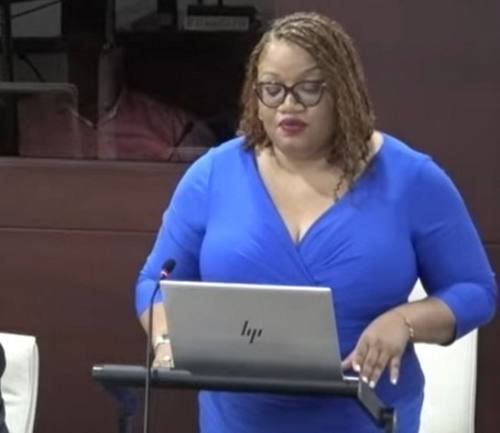
 PHILIPSBURG:--- In a parliamentary session yesterday, Minister of Finance Marinka Gumbs took the floor to address ongoing concerns surrounding the draft National Ordinance on Basic Payment Accounts. While the Minister presented updates on financial matters, including the much-touted 30.3 million guilder CAPEX loan, her appearance left many questions unanswered and raised eyebrows over the handling of critical issues.
The session, part of Public Meeting No. 11 for the 2024-2025 Parliamentary Year, was marked by delays, adjournments, and a lack of clear direction. Despite the Minister’s claims of progress, including securing funds for housing development and infrastructure upgrades, critics argue that the session exposed glaring inefficiencies in the legislative process and a lack of urgency in addressing pressing financial challenges.
One of the key points of contention was the draft National Ordinance on Basic Payment Accounts, a bill aimed at promoting financial inclusion. While the Minister assured Parliament that the ordinance would close the gap for those excluded from the economic system, her responses to questions about inequality and digital banking services were seen as evasive. Members of Parliament repeatedly pressed for clarity on why certain safeguards, such as explicit wording on lawful registration, were omitted from the draft, leaving banks in a state of uncertainty.
The Minister’s update on the CAPEX loan, while framed as a victory, also drew criticism. The funds, earmarked for projects like the prison completion and land acquisition for housing, were secured at an interest rate of 3.52% over 30 years. While this was presented as a positive step, skeptics questioned whether the government’s priorities align with the immediate needs of the population, particularly as the island grapples with economic challenges.
Further complicating matters, the session revealed a lack of coordination between the Ministry of Finance and the Central Bank. Amendments proposed by MPs were met with feedback from the Central Bank that highlighted errors, redundancies, and unnecessary additions. This back-and-forth has delayed the legislative process, with the Minister now requesting additional time to review revised amendments—a move that some see as yet another example of bureaucratic inefficiency.
The Minister’s handling of questions about digital banking services also came under fire. While she acknowledged the importance of modernization, her insistence that these issues would be addressed in future legislation left many wondering why they were not incorporated into the current draft. This piecemeal approach, critics argue, undermines the government’s commitment to financial inclusion and modernization.
As the session adjourned, it became clear that the road ahead for the draft National Ordinance is fraught with challenges. With the Caribbean Financial Action Task Force’s plenary meeting looming in May 2026, the government faces mounting pressure to demonstrate progress on legislative priorities. However, yesterday’s session did little to inspire confidence in the Minister’s ability to navigate these complexities.
Minister Gumbs may have secured a loan and presented a vision for financial inclusion, but her parliamentary appearance has left many questioning whether her leadership is up to the task. As the island waits for action, the clock is ticking—and patience is wearing thin.