



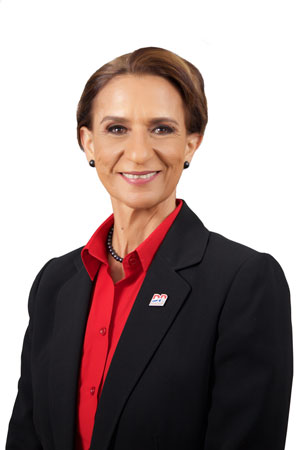
 PHILIPSBURG:--- In response to recent public discussion and media inquiries, the President of Parliament has reflected on current parliamentary practices and their impact on the effectiveness and independence of the legislature.
The President noted that situations arising from the customary practice of requesting meetings of Parliament while simultaneously asking for the presence of Ministers have prompted a closer examination of whether this approach best serves Parliament’s role as an independent constitutional institution.
“This practice, in actuality, places Parliament’s schedule at the mercy of the executive branch,” the President stated. “That was never the intention of our parliamentary system, nor does it align with my focus on a more independently functioning Parliament.”
According to the Rules of Order, the convening of meetings of Parliament and requests for the presence of Ministers are governed by distinct procedures. While Members may request that a Minister be questioned in chamber or provide information, such a request requires the explicit approval of Parliament. Convening a meeting, however, is a separate procedural matter.
“The Rules of Order are very clear on this point,” the President emphasized. “Requesting and convening meetings is one matter; requesting the presence of a Minister is another. Going forward, I intend to stress this distinction more clearly.”
The President further highlighted that the Rules of Order already provide mechanisms to address urgent matters, including the option of requesting an urgent debate. These tools, when applied correctly, allow Parliament to function effectively without blurring institutional roles. In addition, I will continue my push to focus on topical committees rather than entire ministries.
In elaborating, the president provided the example of parliamentary committees on climate change, infrastructure, healthcare. These are very focused areas. “The proposal I launched in this regard during the closing of the 2024-2025 parliamentary year for a committee on the country’s electricity supply has received a favorable response from the Committee of Petitions. This “GEBE” committee will now be formally proposed for approval. It should be noted that the rules of order do not limit committees to interaction with government ministers only, but allow for work visits, hearings, interviews, etc. The individual committees can then table proposals for formal decision making. “The parliament as a body stands to benefit from this approach.”
The President of Parliament further noted that this position is consistent with earlier statements made since assuming office, in which she has repeatedly emphasized the importance of a more independently functioning Parliament grounded in constructive collaboration, sharper focus on agenda topics, stronger committee work, and ongoing training for Members. “Independence does not mean isolation,” the President stated. “It means a Parliament that is confident in its role, disciplined in its procedures, and capable of working collaboratively -internally and with the executive -while maintaining clear institutional boundaries.”
“Just as earlier procedural refinements, such as the introduction of interruptions were aimed at improving parliamentary debate, my current focus is on reinforcing Parliament’s independence within the framework of our existing Rules of Order,” the President said.
Acknowledging public and parliamentary concern about effectiveness, the President underscored that meaningful improvements can be achieved through greater procedural discipline.
“I hear the frustration expressed by Members of Parliament and by the general public,” the President noted. “I am convinced that some tightening up within our present Rules of Order would already go a long way.”
At the same time, the President stressed that effective governance requires cooperation between both the legislative and executive branches.
“Parliamentary effectiveness is not a one-sided responsibility,” the President stated. “It also depends on cooperation by the executive branch, for example by answering written questions in a timely manner, appearing during Question Hour, and responding to matters arising from meetings of Parliament.”
The President concluded by reiterating that the objective is not confrontation, but institutional balance.
“Strengthening Parliament is about ensuring that each institution functions as intended, with mutual respect for roles, responsibilities, and democratic accountability,” the President said.