




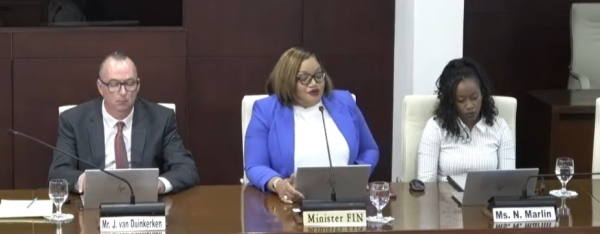
 PHILIPSBURG:--- The Parliament of Sint Maarten recently began deliberations on five draft national ordinances aimed at modernizing the country’s financial supervision framework. These laws, presented by Minister of Finance Marinka Gumbs, are designed to align Sint Maarten with international standards and ensure compliance with the Financial Action Task Force (FATF) recommendations.
The five draft ordinances include:
- Supervision of Securities Intermediaries and Asset Managers
This ordinance introduces a licensing requirement and subjects securities intermediaries and asset managers to prudential and conduct supervision. Minister Gumbs explained that this law is critical to closing gaps in the current legal framework and protecting Sint Maarten from financial fraud and other risks. “A properly regulated capital market supports investment, entrepreneurship, and sustainable economic growth,” she stated. - Supervision of Virtual Asset Service Providers
In response to FATF’s Recommendation 15, this ordinance establishes a licensing regime for virtual asset service providers. It aims to prevent money laundering and terrorist financing while promoting responsible innovation in the digital financial sector. Minister Gumbs noted, “Virtual assets are a reality of the modern financial landscape. Our task is not to ignore them but to regulate them in a careful and proportionate manner.” - Oversight of Payment and Securities Settlement Systems
This ordinance focuses on the resilience and reliability of payment and securities settlement systems. It introduces oversight mechanisms to ensure these systems meet international standards, thereby safeguarding Sint Maarten’s financial infrastructure. - Supervision of Operators of Financial Market Infrastructure (FMI) Systems
This law codifies the principles for financial market infrastructures (PFMI) into Sint Maarten’s legal framework. It aims to protect the country’s financial stability and maintain its international connectivity. Minister Gumbs emphasized the importance of this ordinance, stating, “Clearing and settlement systems form the backbone of our payment and securities infrastructure.” - Supervision of Payment Service Providers
Perhaps the most impactful for residents, this ordinance introduces a licensing regime for payment service providers, paving the way for modern digital payment solutions. Minister Gumbs highlighted the potential for increased financial inclusion, stating, “This law opens the door to new and more affordable methods of financial service provision for the residents of our country.”
The Minister stressed the urgency of passing these laws to avoid Sint Maarten being placed on the FATF’s gray list, which could have severe economic consequences, including reduced foreign investment and higher transaction costs. “Being gray-listed signals to the world that a country’s financial guardrails are weak,” she warned.
However, the draft laws have sparked debate among Members of Parliament. Concerns were raised about the timing of the legislation, the Central Bank of Curaçao and Sint Maarten's capacity to enforce the laws, and the need for amendments to address Sint Maarten’s unique circumstances. Some MPs also questioned the harmonization process with Curaçao, expressing frustration that Sint Maarten often appears to be following rather than leading in legislative matters.
Minister Gumbs acknowledged these concerns but reiterated the importance of aligning with international standards. “These laws are not about Curaçao or the Central Bank. They are about protecting Sint Maarten’s economic and financial stability,” she said.
The deliberations are set to continue, with MPs expected to pose further questions and potentially propose amendments. The outcome of these discussions will determine whether Sint Maarten can meet its international obligations and strengthen its financial system for the future.