




 PHILIPSBURG:--- A recent court ruling in Aruba is sending a clear signal to civil servants across Aruba, Curaçao, and St. Maarten: prolonged inactivity and refusal to accept suitable work can ultimately lead to dismissal from government service.
The judgment, issued on March 9, 2026, and published on March 26, underscores that reintegration obligations are not optional and that authorities are entitled to terminate employment when officials fail to cooperate. The case is widely seen as a benchmark for how governments in the Dutch Caribbean may address long-standing issues involving inactive personnel.
Aruba civil servant
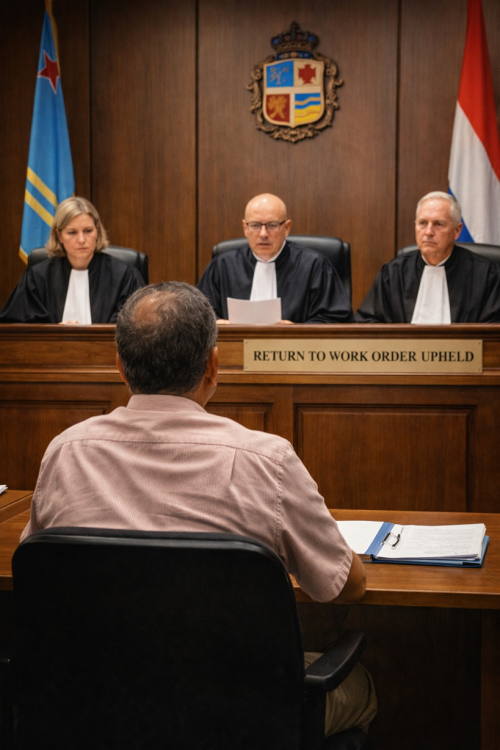
The Court of First Instance in Aruba has upheld the dismissal of a civil servant who had remained largely inactive for years and repeatedly declined suitable job offers, ruling that the government was justified in granting him honorable discharge on grounds of unsuitability.
The court declared the objection against the dismissal unfounded, confirming that the Governor of Aruba acted within the law in terminating the official’s employment effective April 1, 2025.
Long history of reassignment
The case concerns a government employee whose career dates back to his time at the telecommunications company SETAR prior to its privatization in 2003. At that time, he chose not to remain with the company and was subsequently reassigned within the public sector.
Over the years, the civil servant held various temporary positions, including at the court registry, but also spent extended periods on non-active status. His most recent assignment, at the Cabinet of the Minister of Education, ended in September 2021, after which he again remained inactive.
Reintegration efforts
In 2023, authorities launched a formal reintegration process to return non-active civil servants to the workforce. As part of this process, the employee was offered multiple positions at salary scales ranging from 9 to 11.
However, he consistently refused these offers, maintaining that he was entitled to a position at scale 12 under earlier agreements related to the SETAR privatization. The court noted that this claim had already been rejected in previous rulings, including a decision by the Court of Appeal in Civil Servant Matters in December 2025.
The court found that the employee’s refusal to accept suitable positions effectively made his reintegration impossible.
Dismissal deemed justified
The government ultimately decided to dismiss the civil servant on the grounds of unsuitability, citing his lack of cooperation during the reintegration process. According to the court, this decision was supported by sufficient evidence.
“The persistent refusal to accept appropriate employment and adherence to a claim without legal basis demonstrates a lack of the attitude and disposition required of a civil servant,” the court stated.
Judges emphasized that dismissal is considered a measure of last resort, but concluded that no lesser measure would have been effective in this case. The employee had been given ample opportunity, guidance, and warning about the consequences of his actions.
No violation of due process
The claimant argued that the dismissal violated his fundamental rights and that he had not been properly heard. The court rejected these arguments, finding that he had been adequately informed and given multiple opportunities to present his views throughout the reintegration process.
It also ruled that the government had fulfilled its duty of care and had made sufficient efforts to find him suitable employment.
Based on these findings, the court concluded that the dismissal met all legal requirements under the applicable civil service law. The objection was therefore declared unfounded.
The ruling leaves open the possibility of appeal to the Civil Service Appeals Tribunal within 30 days.
CREDITS StMaartenNews.com with permission.