




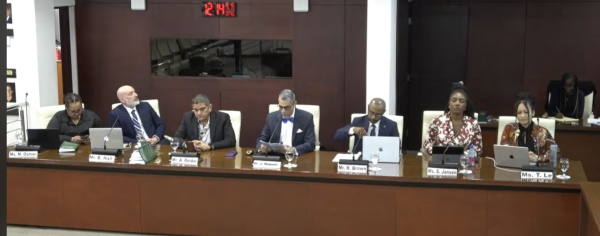
 PHILIPSBURG: --- A high-stakes parliamentary committee meeting on Thursday, April 9, 2026, brought renewed attention to the proposed legalization and regulation of cannabis in St. Maarten, as lawmakers, experts, and stakeholders engaged in a detailed and, at times, deeply personal discussion on the issue.
The session, convened by the Committee for Agriculture, Fisheries and Animal Husbandry, marked the continuation of an earlier meeting held on March 13. At the center of the debate was a comprehensive proposal presented by Native Nations SXM, the entity selected by government to guide the development of a legal cannabis framework.
A Government-Led Initiative
The proposal stems from a broader government objective outlined in its 2020–2024 governing program, which identified cannabis regulation—spanning medicinal, scientific, recreational, and religious use—as a key economic and policy priority. The initiative was further reinforced in the country’s economic recovery plan, where cannabis was listed among six targeted tourism export sectors.
Following a formal Request for Proposal (RFP) issued in September 2022, Native Nations SXM emerged as the selected partner. The government tasked the organization with delivering a full roadmap to legalization, including research, legislation drafting, regulatory frameworks, and implementation timelines.
Notably, the agreement requires no upfront financial cost to the government. Instead, Native Nations is compensated through a 10-year concession allowing it to operate key segments of the cannabis industry—cultivation, processing, testing, and distribution—while contributing $750,000 annually to a local foundation supporting social, economic, and environmental initiatives.
Tourism at the Core of Economic Projections
A central theme of the discussion was the projected economic impact of legalization. Representatives clarified that much of the anticipated revenue would be driven not by the island’s population, but by its robust tourism sector.
St. Maarten, with a resident population of approximately 100,000 across both sides of the island, receives over two million visitors annually. The proposed model estimates that 28% of tourists may participate in cannabis consumption, contributing significantly to projected revenues.
Officials emphasized that this figure reflects participation rates—not revenue share—and is based on comparative data from jurisdictions such as Nevada and the Netherlands, where tourism heavily influences cannabis markets.
Opportunities and Concerns for Local Farmers
The proposal outlines a mixed model for local agricultural participation, combining entrepreneurship with structured employment.
- Outdoor cultivation would be led by local farmers operating as independent entrepreneurs, with guaranteed purchase agreements and the added benefit of crop rotation with food production.
- Indoor cultivation, by contrast, would be centralized and create an estimated 250 jobs, with workers employed directly under Native Nations.
However, lawmakers raised concerns about autonomy, questioning whether farmers would truly benefit as independent business owners or become dependent on a centralized system. It was confirmed that commercial home cultivation would not be permitted, though limited personal-use growing may be allowed under strict caps.
Export Potential and Regional Positioning
The proposal also envisions St. Martin as a regional export hub, particularly for CBD products. Immediate opportunities were identified in neighboring territories such as French St. Martin, St. Barts, Martinique, and Guadeloupe, where cannabis derivatives are already regulated.
Long-term ambitions include entry into European markets, contingent on meeting stringent EU Good Manufacturing Practice (GMP) standards. Native Nations representatives indicated that training programs and infrastructure support would be provided to help local farmers meet these requirements.
Banking and Regulatory Oversight
One of the most pressing concerns raised by Members of Parliament was access to banking services—an issue that has plagued cannabis industries globally.
To address this, the proposed framework includes:
- A Cannabis Oversight Authority
- Full compliance with anti-money laundering (AML) and counter-terrorism financing (CFT) standards
- A comprehensive “seed-to-sale” tracking system, monitoring every stage of production and distribution
Officials stated that these measures were developed in consultation with the Central Bank of Curaçao and St. Martin, with the goal of ensuring the industry remains transparent, auditable, and bankable.
Public Health Debate Takes Center Stage
Perhaps the most emotionally charged portion of the meeting came during discussions on public health, particularly the relationship between cannabis use and mental illness.
Medical expert Dr. Joseph Rosado addressed concerns about cannabis-induced psychosis, emphasizing that:
- The commonly cited 3% psychosis rate reflects baseline population levels, not cannabis-related cases.
- Risk is primarily associated with genetic vulnerability, not general use.
- Regulation, rather than prohibition, allows for early intervention, dosage control, and safer consumption practices.
Dr. Rosado also argued that regulated cannabis markets often lead to a reduction in the use of more harmful substances, citing decades of research from jurisdictions like the United States and Canada.
Learning from Global Models
Throughout the session, comparisons were drawn to international experiences, including:
- Uruguay, the first country to legalize cannabis, which reported reduced illicit market activity and stable public health indicators.
- Canada, where legalization led to decreased criminal justice involvement but also exposed risks of overproduction and market imbalance.
- Various U.S. states, where studies suggest positive impacts on crime rates, tax revenue, and public health outcomes.
Officials stressed that St. Martin’s model has been designed with the benefit of hindsight, aiming to avoid the pitfalls seen in other jurisdictions.
A Decision with Lasting Implications
As the meeting concluded, it was clear that while significant groundwork has been laid, many questions remain—particularly regarding governance, economic equity, and long-term sustainability.
Members of Parliament requested additional documentation, including detailed reports on stakeholder consultations, comparative analyses, and the foundational agreements guiding the project.
With legislation expected to be submitted in the coming weeks, St. Martin now stands at a critical juncture—poised to potentially become a pioneer in the Caribbean cannabis industry, but facing the complex task of balancing economic opportunity with public health and social responsibility.
Further deliberations are expected as Parliament reviews the full legislative package in the weeks ahead.