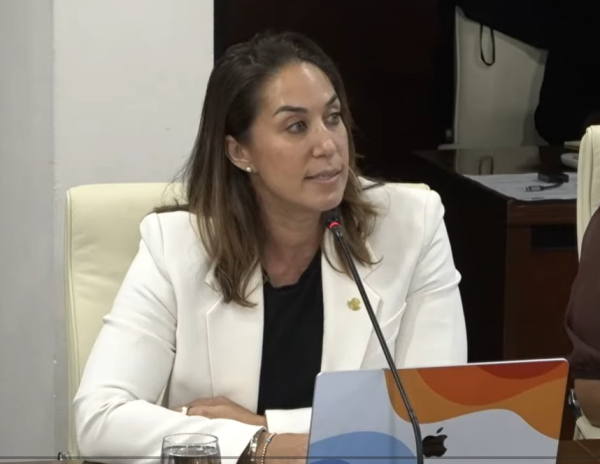
 PHILIPSBURG:--- Let me start with something simple. The questions MP Lewis has been talking about in the press have not yet reached my office. They will be answered in full once they come through the proper channel in Parliament. But because the narrative being advanced in public right now is wrong, a few things need to be said straight away.
For the sake of clarity, one important point should be corrected at the outset. The Chief of Police has not been “appointed” to a separate post of Secretary-General. What is at issue is a temporary stand-in arrangement to ensure continuity of the Ministry when the Secretary-General is absent or unavailable. Such arrangements are governed by Article 25 of the Civil Servants Ordinance and exist precisely to prevent administrative stagnation. “Acting Secretary-General” is not a job. It is not a position that gets posted, advertised, or filled through a recruitment process. It is simply the rule for who steps in on days when the Secretary-General is away, sick, traveling for work, or otherwise unavailable. Every ministry needs someone who can sign papers and keep the work of government moving. That is all this is.
Now to the heart of the “conflict of interest” claim, because it rests on a basic misunderstanding of how the justice chain actually works.
A conflict of interest arises when someone ends up in a position to supervise themselves, or to check their own work, or to make decisions about their own pay, promotion, or discipline. That is not the situation here, and it never has been. The Chief of Police does not report to the Secretary-General. He never has. Under the law, the Chief of Police answers to the Minister for operational policing matters, and the Secretary-General runs the civil service side of the ministry. They are two separate tracks that both lead to the Minister, not one track where one person sits above the other. And on both of those tracks, the Minister holds political responsibility and the final decision. A stand-in does not set policy. A stand-in does not take decisions that are reserved to the Minister by law. Nothing of substance moves in this ministry without my knowledge and my authorization. That is how the system is designed, and that is how it is being run.
As a lawyer and as the sitting Minister of Justice, I take that responsibility seriously. The decision to designate the Chief of Police as a stand-in was mine, made with full awareness of the applicable legal framework. Mr. John has my confidence. He has served as Chief of Police since 2015, has performed well in that role, and has played a constructive part in bringing cohesion to the Ministry.
And this is where the concern deepens, not about the arrangement, but about the person raising the alarm. MP Lewis is a former Minister of Justice and a former police officer. The Kingdom Act on the Police and the broader framework governing how the Chief of Police, the Minister, and the civil apparatus of the ministry relate to each other are not unfamiliar territory to him. It is territory he has worked in for years, from both sides. A misunderstanding of this basic structure, from someone with his background, is difficult to explain as an honest mistake. The public is entitled to ask whether the confusion is real or whether the framework is being misrepresented on purpose to manufacture a controversy. Neither possibility reflects well on the seriousness of the concerns he claims to be raising.
That brings us to the history, and this is where the facts matter most.
This arrangement is not new, and it is not unusual. For years, under several different governments, the role of acting Secretary-General has been filled by whichever service head within the ministry made sense at the time. Under Minister Kirindongo, the Chief of Police filled it. Under Minister Anna Richardson, the role rotated among multiple service heads over the course of her tenure. For a long stretch spanning multiple administrations, including during MP Lewis’s own tenure as Minister of Justice, the Head of the Financial Intelligence Unit filled it. None of this was treated as a conflict of interest at the time. No fifty-question letters were sent to Parliament. No press releases were written about good governance and institutional integrity. The work of the ministry simply continued, because that is what the stand-in arrangement exists to make possible.
So the question answers itself. If the same arrangement was acceptable under Minister Kirindongo, across Minister Richardson’s full tenure, and during MP Lewis’s own time as Minister of Justice, it cannot suddenly become a scandal now. The arrangement has not changed. The person writing the press release has.
I welcome scrutiny. Every minister should. But scrutiny only means something when the same rules are applied to everyone. Raising an alarm about something that was perfectly fine when you were the one doing it is not scrutiny. It is politics.
Public debate is important, but it should remain grounded in the applicable legal framework and in the facts.
The people working in our justice sector deserve better than that, and so does the public. When MP Lewis’s questions reach my desk through Parliament, they will be answered, fully and on the record.