




~Parliament Presses for Answers as Key Questions Remain Outstanding~
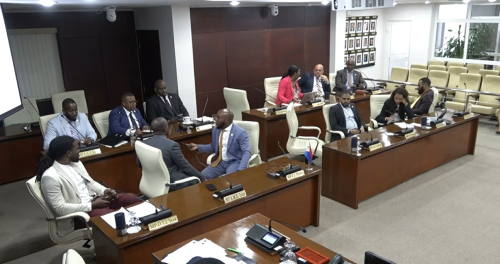 PHILIPSBURG:--- Prime Minister Dr. Luc Mercelina spent hours defending government policies, healthcare reforms, and political decisions during a tense parliamentary meeting that exposed growing concerns among Members of Parliament over accountability, transparency, and the future direction of healthcare regulation in Sint Maarten.
The public meeting, convened to continue discussions on matters previously raised by Members of Parliament, evolved into a broad examination of government policy, ministerial conduct, healthcare credentialing, educational statistics, and party governance. While the Prime Minister addressed several issues directly, lawmakers repeatedly expressed frustration over what they viewed as incomplete responses to critical questions.
The session ultimately concluded with a commitment from Mercelina to provide written responses to approximately 32 outstanding clarification requests within 1 week.
Healthcare Qualifications Become Center of Debate
One of the most detailed exchanges during the meeting focused on the qualifications and legal standing of healthcare professionals, particularly those serving as house officers in the medical system.
Responding to questions from MP Darryl York, the Prime Minister offered an extensive explanation based on his own experience as a surgeon.
Mercelina explained that a house officer is a physician who has completed university medical training and earned a medical degree but has not yet entered a specialized medical field. These doctors often work within hospital departments, assisting specialists while gaining clinical experience and determining their future medical careers.
The Prime Minister described the house officer as an essential component of hospital operations, responsible for patient admissions, monitoring patient progress, coordinating care plans, conducting ward rounds, and serving as an extension of specialist physicians.
However, despite the lengthy explanation, MP York indicated that the response did not fully address the core concern.
The parliamentarian sought clarity not on the practical duties of house officers but on their precise legal classification under healthcare regulations. Questions remained regarding whether house officers should be considered junior physicians, general practitioners, family doctors, or another professional category entirely.
Recognizing the need for greater clarity, Mercelina agreed to provide Parliament with a detailed written breakdown of healthcare professional classifications and licensing requirements.
The exchange highlighted broader concerns about medical regulation and the interpretation of professional qualifications within Sint Maarten's healthcare system.
Ongoing Concerns About Medical Registration
The discussion expanded into a larger debate surrounding healthcare licensing and the barriers faced by qualified professionals seeking employment in Sint Maarten.
Mercelina acknowledged concerns raised by MPs about locally trained healthcare professionals who have difficulty returning home to practice after completing their studies abroad.
The Prime Minister argued that existing regulatory structures create unnecessary obstacles and often rely too heavily on specific registration systems rather than on broader evaluations of professional competence.
He cited examples involving internationally respected specialists from Latin America, particularly Colombia, whose expertise is routinely trusted when Sint Maarten patients are referred overseas for treatment. Yet those same specialists may face challenges obtaining authorization to practice locally because of regulatory requirements.
According to Mercelina, such inconsistencies reveal weaknesses in the current framework governing healthcare credentials.
The Prime Minister emphasized that the government's proposed Healthcare Professional Registry is intended to modernize the system, establish transparent qualification standards, and create a pathway for qualified professionals—including Sint Maarteners educated abroad—to contribute to the local healthcare sector.
Supporters of the initiative argue that it could help address longstanding shortages in healthcare personnel while reducing dependence on foreign recruitment.
Critics, however, remain concerned that changes to registration requirements could lower standards if not implemented carefully.
Prime Minister Corrects Public Statements on Family Medicine Certifications
Healthcare issues resurfaced when Mercelina addressed earlier statements about the number of certified family medicine practitioners currently practicing in the country.
The Prime Minister admitted that earlier figures provided to him were inaccurate.
He explained that he had initially been informed that only four of the nineteen doctors working in primary healthcare held family medicine certification.
Subsequent verification revealed different numbers.
Mercelina informed Parliament that the correct figure is nine certified family medicine practitioners among twenty-one doctors currently working in frontline healthcare services.
The correction was welcomed by several members, though it also prompted discussion regarding the reliability of information provided to government officials and the importance of accurate public communication on healthcare matters.
Education Statistics Spark Political Dispute
Another contentious issue centered on comments previously attributed to the Prime Minister about the education levels of Sint Maarten's population.
Mercelina firmly rejected claims that he had described citizens as "uneducated."
Instead, he reiterated a statistic he has cited publicly on numerous occasions: approximately forty-two percent of the population has not completed secondary education.
The Prime Minister stressed that educational attainment and intelligence should not be confused.
He argued that individuals without formal secondary school diplomas may still possess extensive skills, experience, and practical knowledge that contribute meaningfully to society.
Nevertheless, opposition members suggested that previous public remarks may have created perceptions that portions of the population were being characterized negatively.
The exchange underscored broader political sensitivities surrounding education, social mobility, and economic opportunity on the island.
Parliamentary Questions on Ministerial Accountability
As the meeting progressed, several Members of Parliament voiced frustration over what they considered inadequate responses to governance-related questions.
MP York openly challenged the Prime Minister's decision to postpone answers to several issues involving ministerial accountability and government decision-making.
Among the unresolved questions were inquiries into the standards applied to ministers accused of misconduct, the consistency of government policy enforcement, and the legal interpretations that guide certain executive decisions.
York noted that the Prime Minister has historically been willing to answer difficult parliamentary questions directly and expressed disappointment that several straightforward inquiries remained unanswered.
The criticism reflected broader opposition concerns regarding transparency and equal application of government standards.
Mercelina maintained that some questions required legal consultation before definitive responses could be provided and reiterated his commitment to submitting comprehensive written answers.
Party Policy on Vacated Parliamentary Seats
Political accountability also emerged during discussions concerning parliamentary representation and party discipline.
Responding to a question from MP Duran, the Prime Minister clarified his party's position regarding elected officials who leave Parliament to accept ministerial appointments.
According to Mercelina, the party's longstanding understanding is that once a parliamentarian vacates a seat to serve in the executive branch, that individual should not expect to reclaim the seat later.
The Prime Minister stated unequivocally that there are no plans to revisit this principle.
The response may prove significant as political observers continue to monitor relationships between Parliament and the Council of Ministers, particularly during periods of governmental restructuring.
Representation on the Saba Bank
Questions regarding national representation on important resource-management bodies also surfaced during the meeting.
MP Sarah Wescot-Williams Labega inquired whether Sint Maarten currently maintains representation within the governance structure of the Saba Bank.
Mercelina confirmed that the country remains represented and announced an upcoming change in leadership.
According to the Prime Minister, Mr. Tazio Bervoets has been serving as Sint Maarten's representative but is scheduled to be replaced by Mr. Kevin James following a shareholder meeting set for June 17.
The announcement provided assurance that Sint Maarten's interests remain formally represented within discussions concerning one of the region's most valuable marine resources.
Mediation Proposal in Political Dispute Confirmed
A separate line of questioning focused on tensions involving former Minister Brug and the URSM party.
MP Sjamira Roseburg asked whether mediation had ever been considered as a means of resolving disagreements between the parties involved.
Mercelina confirmed that mediation had indeed been proposed.
According to the Prime Minister, discussions with the minister began in early 2025 and continued for an extended period. While mediation was eventually suggested by MP Roseburg, government leaders believed the conflict had already progressed too far for such intervention to be effective.
The Prime Minister, nevertheless, publicly acknowledged Roseburg's efforts and recognized her proposal as a constructive attempt to seek resolution.
Mental Health Facility Dossier Submitted to Parliament
Toward the conclusion of the meeting, Parliament received confirmation that a complete dossier relating to the island's mental health facility had been delivered through confidential parliamentary channels.
The Chairperson informed Members that all relevant documentation was now available for review.
Although the contents were not discussed publicly during the meeting, the submission is expected to play an important role in future parliamentary oversight and policy discussions concerning mental healthcare services.
Meeting Adjourned Pending Written Responses
After several hours of debate, Parliament agreed to suspend the session until the Prime Minister submits written responses to the remaining clarification requests.
Mercelina requested approximately one week to prepare answers, a timeline accepted by the Chair.
The continuation of the meeting is expected after Members receive the documentation and have an opportunity to review both the Prime Minister's responses and the additional healthcare-related materials he promised to provide.
The next phase of parliamentary scrutiny is likely to focus heavily on healthcare reform, licensing regulations, ministerial accountability, and the government's broader approach to governance.
For many observers, the meeting highlighted both the complexity of the issues facing Sint Maarten and the increasing demand among lawmakers for detailed answers, measurable reforms, and greater transparency from the country's leadership.