




~Utility Company faces massive receivables, while some push relief that could bankrupt the country's sole electricity and water provider~
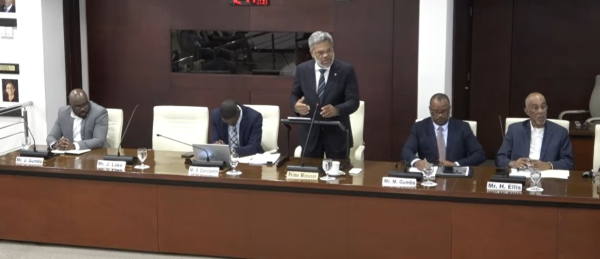 PHILIPSBURG — NV GEBE is owed approximately NAf. 184.7 million as of the end of December 2025, Parliament was told Friday, raising serious questions about how far politicians, businesses and consumers can demand relief while leaving the country's only electricity and water provider carrying a massive unpaid balance.
The figure was disclosed during the continuation of Parliament's public meeting on GEBE, when Prime Minister Dr. Luc Mercelina responded to questions regarding commercial arrears, consumer balances, and the utility's financial position. In response to questions about what is owed, the Prime Minister stated that outstanding amounts stood at NAf. 184.7 million at the end of December 2025.
The revelation comes at a time when public pressure is mounting for relief from high electricity bills, fuel clause charges, and past balances. But the same parliamentary discussion made clear that writing off arrears would not be a painless political gesture. It would create a multimillion-guilder hole at GEBE.
Relief or Bankruptcy?
One of the most pointed questions raised in Parliament was whether GEBE could simply erase outstanding arrears and allow households to restart from zero.
The answer was blunt: erasing outstanding arrears would have a multi-million-guilder negative impact on GEBE. The Prime Minister also warned that removing fuel costs entirely would be financially impossible because fuel remains the dominant cost driver of electricity generation. Eliminating the charge would not eliminate the cost; it would merely shift or hide it, leaving GEBE with an immediate funding gap.
That warning cuts to the heart of the national debate.
Consumers want relief. Politicians want to be seen fighting for relief. But GEBE cannot keep the lights on if millions in unpaid bills are treated as optional.
Who Owes GEBE?
The meeting did not provide a public list of names, nor was any individual debtor identified. However, the questions raised in Parliament made clear that the issue is not limited to small households struggling to survive.
MPs questioned commercial arrears and raised concerns about whether certain companies, entities or politically connected persons were receiving special treatment in efforts to get reconnected. Those claims were raised in Parliament, but no names of individuals or businesses were released during the meeting.
That is precisely why transparency is now essential.
If ordinary citizens are expected to enter payment arrangements or face disconnection, then the same standard must apply to politicians, well-known persons, large businesses, government-linked entities, and commercial customers.
A monopoly utility cannot survive if only the poor are expected to pay.
Payment Plans Exist
Parliament was also told that GEBE has payment arrangements in place.
For residential customers, the most common arrangement requires an upfront payment of 10 to 25 percent of the outstanding amount, with the balance payable over a maximum of 24 months. For seniors or customers who cannot afford the 10 percent upfront payment, arrangements can be based on payment capacity.
Commercial and industrial customers are generally required to pay 25 percent upfront, with the remaining balance spread over 12 to 24 months.
That means the issue is not whether people can negotiate. The issue is whether everyone is being treated equally.
No Free Ride for the Powerful
GEBE's financial problems did not appear overnight. The company is still recovering from a cyberattack, delayed billing, disputed accounts, fuel cost pressures, aging infrastructure, and years of governance instability.
But none of those changes one basic fact: electricity and water cost money to produce.
If politicians, influential persons, and business owners use their status to avoid payment, lobby for special treatment, or demand write-offs without funding the gap, then they are not defending the people. They are pushing the utility closer to collapse.
And if GEBE collapses, the burden will fall on the same people everyone claims to be protecting.
The Public Deserves the Truth
The public debate over relief must now include a harder question: how much of GEBE's crisis is caused by high fuel prices, and how much is caused by people simply not paying what they owe?
The government has said relief is possible, but only if it is lawful, financially responsible, and sustainable. Parliament was also told that tariff changes require verified cost data and that the government cannot simply impose measures that destabilize the utility.
That may not be the answer consumers want to hear, but it is the reality of running a national utility.
Publish the Categories
GEBE does not have to publish private personal information to give the country a clearer picture.
But it should disclose the categories of debt: residential, commercial, industrial, government, government-owned companies, and large delinquent accounts.
The public deserves to know whether the burden is borne by ordinary households or by large consumers hiding behind political noise.
A National Utility Cannot Run on Promises
The call for relief is real. Many families are struggling. Electricity bills are high. The fuel clause is under scrutiny. Consumers deserve transparency, fair treatment, and protection from billing errors.
But relief cannot become a slogan used to excuse non-payment by those who can afford to pay.
GEBE is a monopoly, but it is not a magic bank. It must buy fuel, maintain engines, pay workers, repair infrastructure, and keep electricity and water flowing.
If NAf. 184.7 million remains unpaid while public figures demand write-offs; then the country is not solving the GEBE crisis. It is deepening it.
The message should be clear: protect the vulnerable, investigate billing disputes, provide lawful relief where possible — but those who can pay must pay.