




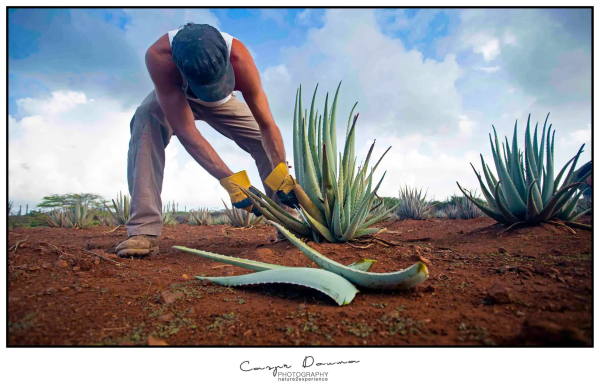
 KRALENDIJK, Bonaire — Bonaire's only commercial aloe vera plantation could soon disappear after the Public Entity Bonaire (OLB) moved to terminate the lease on agricultural land that has been home to the island's only commercial aloe operation for more than two decades, raising concerns about heritage preservation, agricultural policy, and the future of local production.
The plantation, operated by Onima Aloe N.V., has been cultivating aloe vera since 2002 and is home to approximately 15,000 aloe vera plants. The company says the OLB intends to reclaim the agricultural parcel despite the land itself being officially designated for agricultural use, with plans to allocate it to a non-agricultural function involving the Royal Netherlands Marechaussee (KMar).
Owner Jaap Ensing argues that the decision threatens not only his business but also an important part of Bonaire's cultural and economic heritage.
A Crop Rooted in Bonaire's History
Aloe cultivation has been part of Bonaire's identity since the 19th century, serving as an important contributor to the island's economy for generations. The traditional knowledge of harvesting aloe, extracting its gel, and producing aloe-based products remains a living craft, carried on today through Onima Aloe's operations.
The company produces its aloe products entirely on Bonaire, supplying local retailers, tourism businesses, wellness providers, small entrepreneurs, and long-time residents. According to Ensing, the complete production chain—from cultivation and harvesting to processing, manufacturing, and sales—takes place locally, creating jobs while supporting economic diversification and sustainable production.
Owner Rejects Claims of "Inactivity"
The dispute centers on the OLB's allegations that the agricultural parcel has been inactive.
Ensing strongly disputes that characterization, explaining that aloe vera is a drought-resistant, climate-adapted crop that naturally undergoes extended dormant periods during which little visible activity occurs.
He says the plants require minimal water and, once irrigated, quickly become ready for harvesting. Processing is then carried out at the company's laboratory located on Kaya Pos di Amor.
According to Ensing, what authorities describe as inactivity is simply a normal characteristic of aloe cultivation and should not be mistaken for neglect.
No Consultation, Says Entrepreneur
Ensing says he was caught completely off guard by the government's actions.
According to him, he received no prior warning, consultation, or opportunity to present his case before being served by a bailiff and finding the property closed off. He further claims there has been no discussion of alternative solutions or compensation for the investments made in the plantation, the anticipated production losses, or the costs of relocating the business.
Questions Over Government Policy
The proposed termination has prompted broader questions about the consistency of Bonaire's agricultural and sustainability policies.
Critics argue that replacing an active agricultural enterprise on land specifically designated for farming with a non-agricultural use appears to contradict government objectives promoting local food and product production, climate-resilient agriculture, economic self-sufficiency, and the preservation of Bonaire's cultural heritage.
Ensing has formally requested that the OLB reconsider its decision and conduct what he describes as a fair balancing of interests, taking into account not only the plantation's economic contribution but also its historical and cultural significance to Bonaire.
If the lease is ultimately terminated, the island risks losing its only commercial aloe plantation—ending a tradition woven into Bonaire's agricultural history for well over a century.