




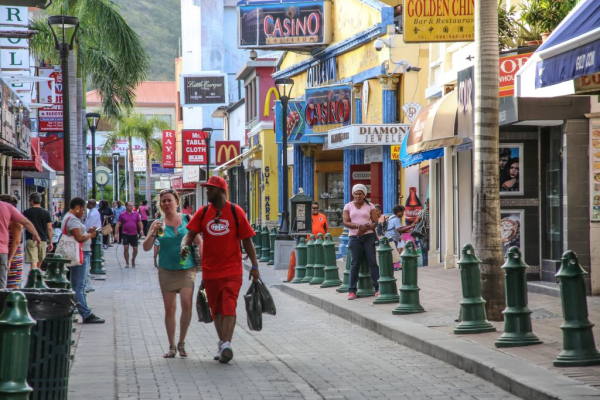
 The armed robbery that unfolded on Front Street at approximately 10:35 a.m. on Friday morning should be a wake-up call for every government official responsible for public safety and the economy. According to the Police Force of Sint Maarten, two-armed suspects entered a jewelry store, one carrying a handgun while the other smashed display cases with a hammer before fleeing with stolen jewelry on a scooter.
This was not a robbery committed in the dead of night.
It happened during business hours, in the very heart of Philipsburg's commercial district, while cruise passengers, shoppers, employees, taxi drivers and residents were moving through the streets.
What should alarm every citizen is not only the robbery itself, but eyewitness reports and videos showing gunfire during the escape.
The obvious question is one government cannot afford to ignore:
What if one of those bullets had struck an innocent person?
What if a cruise visitor had been walking past the jewelry store?
What if a child had been crossing Front Street with parents?
What if an elderly visitor had been sitting outside one of the cafés?
What if a disabled person in a wheelchair had been passing by?
What if a store employee had stepped outside seconds earlier?
What if one of the hundreds of pedestrians who fill Front Street every morning had simply been in the wrong place at the wrong time?
The difference between Friday's robbery and a national tragedy may have been nothing more than luck.
Luck is not a security strategy.
Front Street Is the Island's Economic Heart
Front Street is more than another road.
It is the face of St. Maarten.
It is where thousands of cruise passengers form their first impression of the island.
It is where millions of dollars circulate every year through jewelry stores, restaurants, souvenir shops, clothing stores and tour operators.
Every violent robbery occurring there damages confidence far beyond the value of the jewelry stolen.
Tourists talk.
Cruise passengers post videos online within minutes.
Travel advisors read international headlines.
Insurance companies assess risk.
Investors reconsider expansion.
Businesses begin questioning whether additional security costs are worth remaining open.
The financial consequences of violent crime extend far beyond the individual victim.
A Disturbing Pattern
Friday's robbery did not happen in isolation.
Within hours police were also investigating a shooting in Simpson Bay where multiple rounds struck parked vehicles near a popular location. Fortunately, nobody was injured.
Earlier that same day, officers responded to another firearm incident in Cul-de-Sac after an altercation escalated into a gunshot. A suspect was arrested, and fortunately no injuries were reported.
Individually, each case may have different motives.
Collectively, they send one message:
Firearms are becoming increasingly visible in public spaces.
Whether connected or unrelated, residents and visitors do not distinguish between investigations.
They see headlines.
They hear gunshots.
They watch videos.
They begin by asking whether the island is becoming less safe.
Tourism Cannot Be Separated from Security
Government often discusses tourism strategy as though it exists independently from crime prevention.
It does not.
Marketing campaigns cannot overcome videos of armed robberies.
Beautiful brochures cannot erase footage of suspects firing weapons in the island's busiest shopping district.
Millions spent promoting St. Maarten internationally can be undermined in seconds by one viral video.
Safety has become an economic issue.
Every robbery targeting tourists, jewelry stores or busy commercial districts directly threatens hotel occupancy, cruise spending, investor confidence and employment.
Justice and TEATT Must Work Together
Traditionally, crime has been viewed as the responsibility of the Ministry of Justice.
Tourism promotion belongs to TEATT.
That division no longer reflects reality.
Public safety and economic development have become inseparable.
Justice must continue strengthening intelligence, investigations, rapid response capabilities and firearm enforcement.
TEATT must recognize that protecting the tourism product extends beyond marketing campaigns.
Both ministries should jointly develop a comprehensive security strategy for Philipsburg and other tourism zones that includes increased police visibility, expanded surveillance technology, coordinated emergency planning with businesses, stronger partnerships with retailers, cruise stakeholders and the hospitality sector, and rapid communication during security incidents.
Business owners cannot continue bearing this burden alone.
The Cost of Inaction
Every robbery has victims beyond those directly targeted.
Employees experience trauma.
Business owners face financial losses.
Customers lose confidence.
Visitors reconsider returning.
Workers worry about their own safety.
Parents wonder whether downtown remains safe for their children.
The greatest tragedy on Friday is that no innocent bystander was struck.
The greater mistake would be assuming that luck will always prevail.
Government cannot wait until a tourist, a child, or a local resident is killed by a stray bullet in the middle of Front Street before declaring that public safety is a national priority.
The warning has already been delivered.
The question now is whether anyone in authority is prepared to act before luck finally runs out.