




~KPMG exposed serious governance failures and ignored red flags inside UNOPS; Dutch records show concerns reached the Pointe Blanche project before the agency was later entrusted with prison design, procurement and construction.~
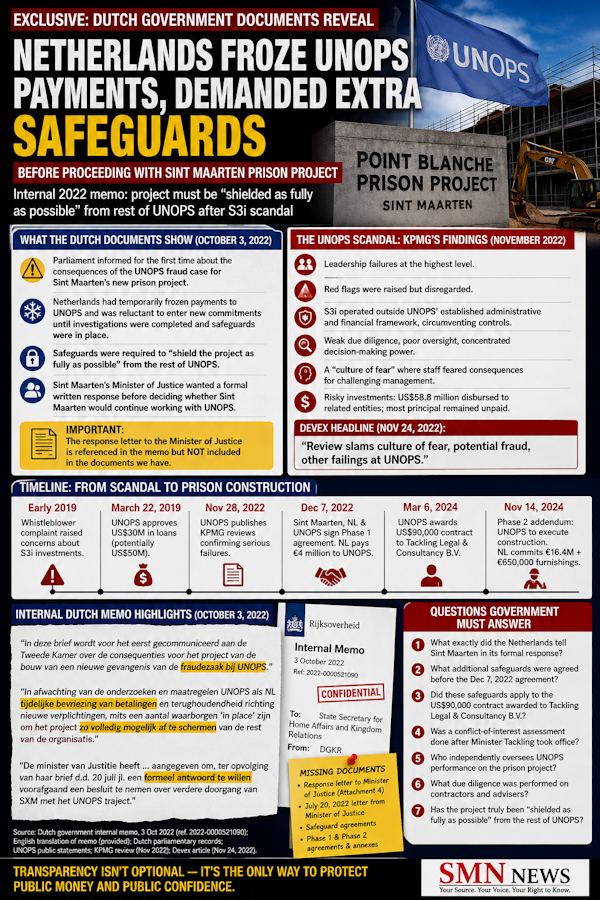 PHILIPSBURG:--- The Netherlands temporarily froze payments to the United Nations Office for Project Services (UNOPS) and demanded additional safeguards before moving forward with the agency on Sint Maarten’s new Point Blanche Prison, after a major scandal exposed serious governance, oversight and financial-control failures inside the UN organization.
The finding emerges from Dutch government records examined alongside the independent KPMG investigation into UNOPS’ Sustainable Infrastructure Investments and Innovation initiative, known as S3i.
The documents are significant because they establish that Dutch authorities did not regard the international scandal surrounding UNOPS as an unrelated problem elsewhere in the organization.
An internal Dutch government memorandum dated October 3, 2022, specifically addressed the consequences of the UNOPS affair for the construction of Sint Maarten’s new prison. Dutch officials recorded that payments to UNOPS had been temporarily suspended and that additional safeguards were being developed for the Sint Maarten project.
The memorandum went even further, stating that safeguards were required so that the prison project could be shielded “as fully as possible” from the rest of the UNOPS organization. Those safeguards were being considered with involvement of the relevant Dutch fraud expertise and were to be discussed with Sint Maarten and UNOPS.
That record places the present UNOPS relationship with Sint Maarten in a much clearer historical context.
The Netherlands knew there were serious institutional problems inside UNOPS. It froze payments. It exercised restraint concerning new commitments. And before continuing with the prison project, it wanted additional protections.
KPMG found serious failures inside UNOPS
The Dutch concerns followed the collapse of UNOPS’ S3i investment initiative.
Independent reviews conducted by KPMG found major deficiencies involving governance, oversight, risk management and internal controls.
KPMG concluded that a combination of technical, operational, oversight and governance deficiencies, together with risky decision-making and elements of a “culture of fear,” created an environment vulnerable to management overriding established controls.
The review also found that although UNOPS had administrative and financial rules and procedures, the selection of S3i partners did not follow all of those established requirements.
KPMG specifically cautioned that its work was not a forensic investigation and therefore did not make final determinations of criminal fraud or individual misconduct.
However, its institutional findings were severe.
The review found that red flags were raised at different levels within UNOPS but management and oversight functions did not effectively act on those warning signals.
Concerns have been raised about limited due diligence, concentration of investments with one partner, lack of collateral, operational capacity and reputational risks.
Nevertheless, major investments proceeded.
KPMG documented US$58.8 million in loan facilities disbursed to Sustainable Housing Solutions and related or affiliated entities, while total investment decisions reached US$63 million.
By November 2022, the principal remained largely unpaid, with KPMG recording only US$6.2 million in repayments by SHS and related entities at that stage.
International investigation described extraordinary breakdown
The findings received widespread international attention.
Development publication Devex reported on November 24, 2022, under the headline “Review slams culture of fear, potential fraud, other failings at UNOPS.”
Devex described the findings as revealing a “breathtaking breakdown of financial oversight” within the agency and highlighted the review’s findings concerning rapid expansion, risky business practices, the organizational culture and indications of potential fraud associated with one of the housing projects.
KPMG itself found that employees feared career consequences for challenging senior-management decisions and described elements of a “culture of fear” affecting decision-making.
The review also identified a high concentration of decision-making authority at the top of UNOPS.
These were precisely the types of institutional weaknesses that made independent safeguards important when governments continued entrusting the organization with major public projects.
Sint Maarten's prison was already under consideration
The Dutch records establish that while the UNOPS crisis was unfolding internationally, the agency was already being considered for a major role in Sint Maarten’s prison redevelopment.
The October 2022 memorandum shows that Sint Maarten’s then-Minister of Justice wanted a formal response concerning UNOPS before deciding whether the country would continue along the UNOPS route.
The Netherlands nevertheless concluded that the irregularities identified within S3i did not directly involve the Sint Maarten prison project.
That distinction remains important today.
There is no evidence in the KPMG investigation establishing fraud or financial misconduct involving the Point Blanche Prison project.
Instead, the Dutch response was to continue exploring the project while developing additional safeguards to reduce the institutional risks exposed elsewhere within UNOPS.
The prison project subsequently moved forward.
UNOPS was eventually given major responsibilities
UNOPS’ involvement became substantial.
Under the prison-development arrangements, the agency became involved in the design of the new facility and the procurement process for construction.
The project later moved into construction, with UNOPS identifying CESAF Joint Venture as construction contractor and Artelia Joint Venture as supervising engineer.
The significance is not that either company has been implicated in the S3i scandal. They have not.
Rather, UNOPS was eventually entrusted with major responsibilities in precisely the areas—procurement, partner selection, project management, financial controls and oversight—that had been placed under intense scrutiny following S3i.
That makes the additional safeguards demanded in 2022 especially relevant.
UNOPS undertook reforms after scandal
UNOPS did not simply continue operating as though nothing had happened.
The organization publicly accepted the seriousness of the independent findings and began an extensive reform programme involving governance, risk management, internal controls and accountability.
The UNOPS Executive Board eventually decided to phase out S3i, while the organization moved to implement recommendations arising from the KPMG reviews.
Those reforms are an important part of the record and prevent a fair analysis from suggesting that the UNOPS of today is automatically operating under precisely the same conditions KPMG found in 2022.
The issue for Sint Maarten is therefore not whether UNOPS once experienced a major scandal. That is established.
The more relevant issue is whether the special protections demanded specifically for Sint Maarten were incorporated into the prison project and maintained as UNOPS’ role expanded.
Then came the US$90,000 Tackling contract
Another development makes that history particularly relevant today.
Official records from the United Nations Global Marketplace show that on March 6, 2024, UNOPS awarded Tackling Legal & Consultancy B.V. a contract valued at US$90,000.
The contract was titled:
“Establishment of a Professional Service Contract for Technical Advisory Services of Sint Maarten UNOPS office.”
UNOPS had published the invitation to bid on January 30, 2024, with a February 21 deadline.
The public UNGM record confirms the supplier, award date, contract value, and purpose.
However, the public award information reviewed does not establish that US$90,000 came from Point Blanche Prison funds. The contract is identified as providing technical advisory services to the UNOPS Sint Maarten office.
That distinction is important, and there is presently no factual basis to report that prison-construction funds financed the contract.
Tackling subsequently became Minister of Justice
Nathalie Tackling subsequently became Sint Maarten’s Minister of Justice, the ministry now working directly with UNOPS on the prison project.
That sequence does not establish corruption, favoritism or an unlawful conflict of interest.
It does, however, make disclosure of her precise relationship with Tackling Legal & Consultancy B.V. relevant to public accountability, particularly whether any financial or beneficial relationship remained after she assumed ministerial office and what conflict-management arrangements, if any, were implemented.
The issue became still more sensitive after UNOPS entered another area of the Justice Ministry’s work.
UNOPS adviser used in Heyliger sentence review
Minister Tackling’s July 2026 decision concerning former Member of Parliament Theodore “Theo” Heyliger shows that a UNOPS Technical Rule of Law Adviser was asked to examine competing calculations concerning his prison sentence.
UNOPS did not decide whether Heyliger would be released. That authority remained with the Sint Maarten authorities and ultimately the Minister.
But UNOPS provided technical input considered during the process.
The development shows how the relationship between the Justice Ministry and UNOPS has extended beyond the physical construction of a prison into technical Rule of Law assistance.
That expansion makes the safeguards first contemplated in 2022 more—not less—important.
UNOPS not named in 2023 Conditional Release Policy
Sint Maarten’s 2023 Conditional Release Policy identifies the prison, Probation Office, Prosecutor’s Office, Department of Judicial Affairs and Central Conditional Release Board as institutions involved in the conditional-release process.
UNOPS is not identified in the policy.
That does not establish that obtaining outside technical advice was prohibited.
But it demonstrates that UNOPS' involvement in the Heyliger calculation arose outside the institutional process expressly identified in the published policy and therefore warrants a clear explanation of the mandate under which technical assistance was provided.
The story now comes full circle
The chronology is significant.
In 2022, serious institutional failures inside UNOPS became public.
KPMG found weak governance, inadequate oversight, disregarded warnings, shortcomings in due diligence, concentrated authority and elements of a culture of fear.
The Netherlands responded by freezing payments and restricting new commitments to UNOPS.
Dutch officials specifically considered the consequences for Sint Maarten's proposed prison and wanted the project shielded as fully as possible from the wider UNOPS organization.
Sint Maarten and the Netherlands nevertheless continued with UNOPS under an arrangement that was supposed to contain additional safeguards.
UNOPS subsequently acquired significant responsibilities for the prison project.
In 2024, its Sint Maarten operation awarded Tackling Legal & Consultancy B.V. a US$90,000 technical-advisory contract.
Nathalie Tackling subsequently became Minister of Justice.
And in 2026, her ministry used UNOPS technical expertise to review the disputed calculation of Theo Heyliger's sentence.
None of those facts establishes wrongdoing in Sint Maarten.
But together they make the original Dutch safeguards a matter of immediate public importance.
The safeguards must now be made public
The strongest conclusion supported by the documents is not that the Point Blanche project is corrupt.
There is presently no evidence supporting such a declaration.
The documented finding is that the Netherlands itself considered UNOPS' institutional problems serious enough to freeze payments and require special protections before proceeding with Sint Maarten's prison project.
Those protections should no longer remain buried in agreements, correspondence and government files.
The 2022 correspondence between Sint Maarten's Justice Ministry and the Netherlands, the final safeguards incorporated into the UNOPS arrangements, relevant conflict-of-interest provisions and the mechanisms for independent oversight should be made public.
That disclosure is particularly necessary now that UNOPS' relationship with the Justice Ministry has expanded beyond the original prison-development arrangements.
The history documented by KPMG shows what can happen when red flags are identified but not effectively acted upon.
The Netherlands already recognized that lesson in 2022 when it demanded special safeguards for Sint Maarten. Four years later, the public should be shown exactly what those safeguards were, how they were implemented, and whether they remain in force today.