





~Economic Growth Continues, but Public Debt, Tourism Dependence and Vulnerability to External Shocks Remain Key Concerns~
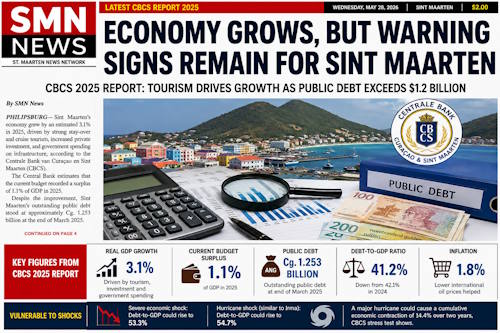 PHILIPSBURG:--- Sint Maarten continued to record economic growth during 2025, supported largely by tourism activity and investment, but the country’s public finances and vulnerability to external shocks remain important areas requiring attention, according to information published by the Centrale Bank van Curaçao and Sint Maarten (CBCS).
The Central Bank’s 2025 reporting provides an important picture of the economy and financial environment in which Sint Maarten entered 2026, highlighting economic expansion while also showing that the country continues to carry substantial public debt and remains heavily dependent on tourism.
CBCS’s reporting indicates that Sint Maarten’s economy continued expanding in 2025, with tourism remaining an important contributor to economic activity.
The completion of the reconstruction of Princess Juliana International Airport contributed to the tourism sector’s performance, while private investment and consumption also supported economic activity.
Government investment in infrastructure, including roads, sewage systems and prison facilities, also contributed to activity during the period.
Public Finances Improve
One of the significant developments reported for Sint Maarten was an improvement in the country’s current budget position.
CBCS estimated that Sint Maarten recorded a current-budget surplus in 2025.
The improvement in the fiscal position came as economic activity continued to expand.
However, the country continues to carry substantial public debt.
CBCS data showed Sint Maarten’s outstanding public debt at approximately Cg 1.253 billion at the end of March 2025.
The debt stock had decreased by approximately Cg 3.9 million compared with the previous period.
According to the Central Bank, the decrease was primarily connected to a reduction in foreign debt following amortization of loans held by the Dutch State. Domestic debt also decreased slightly, including through partial repayment of arrears to TELEM.
The debt burden nevertheless remains significant.
CBCS estimated that Sint Maarten’s debt-to-GDP ratio declined from 42.1 percent in 2024 to 41.2 percent in 2025.
A declining debt-to-GDP ratio means that the size of the country's debt decreased relative to the value of its economy. It does not necessarily mean that Sint Maarten eliminated a comparable amount of its outstanding debt.
Dutch State Remains Major Creditor
The composition of Sint Maarten’s public debt also remains significant.
CBCS has reported that the Dutch State holds the overwhelming majority of Sint Maarten’s public debt.
According to the Central Bank’s analysis, approximately 86 percent of Sint Maarten’s public debt between 2018 and 2024 was held by the Dutch State.
The Central Bank noted that these loans generally carry favorable financing conditions, including low or zero interest rates, thereby limiting interest rate and exchange-rate risks.
The remainder of the country's debt includes domestic obligations, including arrears to institutions such as SZV and APS.
Sint Maarten therefore remains substantially dependent on financing provided through the Kingdom relationship.
Cg 73.5 Million Refinanced
The country's debt obligations did not disappear with the improving debt-to-GDP ratio.
CBCS reported that Cg 73.5 million in bonds was refinanced in 2025.
Another bond of approximately Cg 58.7 million matures in 2029, meaning management and refinancing of existing obligations will remain part of Sint Maarten's financial picture.
CBCS has also identified a separate US$50 million European Investment Bank loan obtained in connection with the reconstruction of Princess Juliana International Airport.
The Central Bank explained that this loan is not included in the Government's public debt stock because the airport is responsible for servicing the obligation.
Inflation Moderates
Consumers also faced a different inflationary environment during 2025.
CBCS estimated inflation in Sint Maarten at approximately 1.8 percent in 2025, with lower international oil prices contributing to the moderation.
Lower inflation, however, represents a slower rate of increase in overall prices rather than a reversal of previous price increases.
Tourism Remains Economic Engine
Tourism remained central to Sint Maarten's economic performance.
The strength of both stay-over and cruise tourism contributed to economic activity, reinforcing the importance of the tourism industry to employment, consumption, investment and the wider economy.
But that dependence also remains one of Sint Maarten's structural vulnerabilities.
An economy heavily reliant on international visitors is particularly sensitive to developments outside the country's control, including global recessions, disruptions to international travel and natural disasters.
CBCS's analysis of Sint Maarten's debt sustainability demonstrates just how quickly the country's financial position could change under adverse conditions.
Hurricane Could Send Debt Ratio Sharply Higher
The Central Bank subjected Sint Maarten's public finances to stress scenarios to determine how the country's debt could respond to significant economic shocks.
Under a severe economic-growth shock, CBCS calculated that the debt-to-GDP ratio could increase to approximately 53.3 percent.
Under a hurricane shock comparable with the economic impact of Hurricane Irma, the ratio could reach approximately 54.7 percent of GDP.
The hurricane scenario assumed a cumulative economic contraction of 14.4 percent over two years, reflecting the scale of economic disruption Sint Maarten experienced following Hurricane Irma.
The stress test illustrates the particular challenge facing a small island economy where a single major natural disaster can severely affect tourism, government revenue, businesses, employment and economic activity simultaneously.
Growth Against a Vulnerable Economic Base
The picture emerging from the Central Bank's reporting is therefore mixed but important.
Sint Maarten entered 2026 following another period of economic growth. Tourism remained strong, inflation moderated, and the current budget position improved.
At the same time, the country continued carrying public debt exceeding Cg 1.2 billion, with the Dutch State remaining its dominant creditor.
The debt-to-GDP ratio declined, but CBCS's own stress testing shows that another major hurricane or severe economic downturn could reverse that improvement considerably.
The Central Bank's findings consequently underscore both sides of Sint Maarten's current economic position: an economy that continues to grow, but one whose public finances and economic performance remain particularly vulnerable to circumstances beyond the country's control.
For Sint Maarten, the challenge remains whether economic growth during strong tourism years can translate into sufficient fiscal and economic resilience to withstand the next major shock.