




~Former Justice Minister Roland Duncan reveals new prison plans were already on the table after 10-10-10, but successive governments failed to deliver until Anna E. Richardson secured the project.~
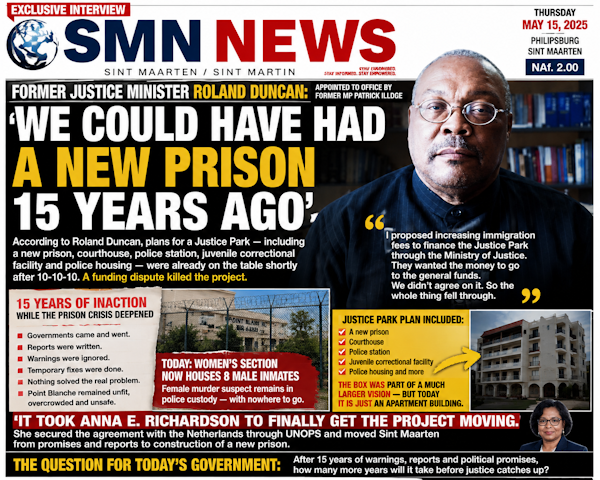 PHILIPSBURG:--- Today, Pointe Blanche Prison is overflowing. The women's section is reportedly housing eight male inmates. A female murder suspect arrested Wednesday evening faces an uncertain future once the legal period for police detention expires because there may be nowhere to house her locally. A convicted female drug trafficker was reportedly deported because there was no available accommodation for women.
But according to former Justice Minister Roland Duncan, none of this should have happened.
In an exclusive interview with SMN News, Duncan disclosed that within months of Country Sint Maarten coming into existence in October 2010, plans were already being developed for an entirely new Justice Park that would have included a new prison, a courthouse, police facilities, police housing and a juvenile correctional institution.
If those plans had materialized, Sint Maarten's correctional system might not be facing the crisis that exists today.
Instead, the project collapsed.
According to Duncan, the dispute had nothing to do with whether a prison was needed.
It was about money.
He said he proposed increasing immigration fees to finance the Justice Park through the Ministry of Justice, but the Government wanted those revenues paid into the General Fund instead. Duncan refused, arguing that if Justice generated the funding, Justice should control the project.
The disagreement ultimately killed the proposal.
Whether one agrees with Duncan's position or not, his interview exposes a troubling reality.
Government knew as far back as 2010 that Pointe Blanche Prison had no long-term future.
Fifteen years of warnings
What followed was not one failed administration.
It was government after government acknowledging the prison's deficiencies while relying on temporary fixes instead of delivering a permanent solution.
Over the years, independent institutions repeatedly sounded the alarm.
The Law Enforcement Council warned that Point Blanche lacked the systems necessary for proper inmate classification, rehabilitation and reintegration.
The European Committee for the Prevention of Torture (CPT) criticized detention conditions.
The European Court of Human Rights found that detention conditions at Point Blanche violated Article 3 of the European Convention on Human Rights.
Successive Kingdom reports continued identifying structural deficiencies.
Yet the prison remained exactly where Duncan said it could not realistically expand.
Ironically, Duncan himself explained why.
He said Pointe Blanche sits on a cliff, leaving little room for expansion, while constant exposure to salt air continuously undermines the structure itself.
Successive governments inherited the problem—but failed to solve it
Since 10-10-10, Sint Maarten has seen numerous Ministers of Justice and multiple coalition governments.
Every administration inherited the same prison.
Every administration received reports warning about overcrowding, deteriorating infrastructure and inadequate detention conditions.
Every administration promised reform.
Yet year after year, prisoners remained inside a facility that virtually every oversight body agreed was no longer suitable for modern corrections.
Instead of a new prison, governments relied on renovations, temporary repairs and emergency measures.
The crisis continued to deepen.
Anna Richardson finally moved the project forward
It was not until former Justice Minister Anna E. Richardson that the project finally moved beyond discussion.
Richardson secured the agreement that allowed Sint Maarten and the Netherlands to move forward with the new prison project through UNOPS, transforming years of recommendations into an actual construction programme.
Regardless of political affiliation, that marked the first time since Country status that a new prison moved from concept to implementation.
Today, construction is finally underway.
But it comes after nearly a decade and a half of delay.
The cost of waiting
The consequences of those delays are no longer measured in reports.
They are measured in daily operational realities.
According to information obtained by SMN News:
- the women's section is reportedly occupied by eight male inmates, including six convicted of violent crimes and two politicians convicted of white-collar offenses;
- a female murder suspect arrested this week may soon require transfer from police custody to Point Blanche under the law;
- a mentally ill inmate is reportedly housed in the prison's computer laboratory;
- and a convicted female drug trafficker was reportedly deported because no accommodation was available for female prisoners.
These are not simply administrative inconveniences.
They are indicators of a correctional system operating under extraordinary strain.
The question for today's Government
Roland Duncan's interview is not about revisiting political battles from 2010.
It is about asking why a problem identified at the birth of Country Sint Maarten was allowed to fester for fifteen years.
How many governments acknowledged the prison crisis?
How many budgets discussed a new prison?
How many reports warned that Point Blanche had reached its limits?
How many opportunities were missed before construction finally began?
Today, the country is paying the price for those delays.
The prison is overcrowded.
The justice system is under pressure.
And the question that should concern every citizen is no longer who first proposed a new prison.
The question is:
Why did it take fifteen years—and a correctional system nearing collapse—for Sint Maarten to finally build one?