





~MP supports equal treatment of students but warns the government must urgently confront collapsing literacy and mathematics results.~
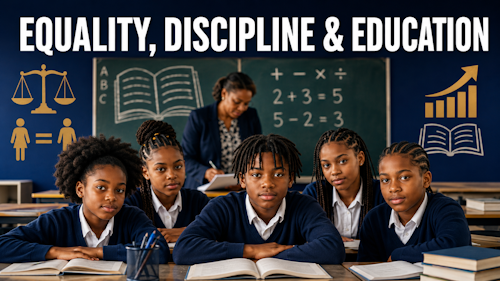 PHILIPSBURG:--- Member of Parliament Darryl York has delivered a timely and balanced warning on the national debate surrounding hair discrimination in schools: students must be treated equally, but the controversy over hairstyles cannot be allowed to overshadow the far more serious crisis unfolding inside Sint Maarten’s classrooms.
Speaking on The Breakfast Lounge with Lady Grace, York said he understands the discrimination experienced by people who wear locks and other natural hairstyles because he has faced it personally. However, he questioned why the hair debate appears to be receiving center-stage attention while reports continue to show alarming weaknesses in reading, comprehension and mathematics.
“I have locks, and I’ve been through hell for having my locks in different areas,” York said. “I totally understand the issue of the discrimination, but I feel this is getting front stage.”
York said the public should also be hearing clear answers about curriculum reform, declining academic performance, and the basic conditions under which children are expected to learn.
“I want to hear about curriculum. I want to hear what we’re doing to fix the grades,” York said. “I want to hear about the struggles that the students are going through, that when the girls go to the bathroom, they don’t have a seat to sit on.”
His concerns are supported by the latest Early Grade Reading Assessment and Early Grade Mathematics Assessment results presented to Parliament.
The findings revealed that 85 percent of Group 3 students were classified as “emerging” in number identification, while 80 percent of Group 5 students were emerging in multiplication and division. Only two per cent of Group 5 students reached mastery in that crucial mathematics area.
Reading results were equally troubling. Only one in four Group 5 students reached mastery in oral reading fluency. Within public schools, approximately two-thirds of students in both Group 3 and Group 5 remained at the emerging level for oral reading fluency.
Students classified as emerging are still at the beginning stage of acquiring the knowledge and skills expected at their grade level and require reteaching, repeated practice, and continuous assessment. The figures therefore point to a foundational education problem that could follow children into secondary school, employment and adulthood.
York’s position is not that hair discrimination should be ignored. His argument is that government must establish the proper order of national priorities. A child should not be unfairly targeted because of natural hair, but neither should the country celebrate progress on grooming policies while thousands of children struggle to read, comprehend instructions or perform basic mathematics.
The MP also defended the right of schools to establish reasonable rules, provided those rules are implemented fairly and consistently.
“I do believe in rules,” York said. “I do know there’s a discrimination part where you judge one child differently to the other. That I disagree with. But the fact that a school sets its own rules, I don’t disagree with.”
York said school rules should not simply be discarded because they are unpopular. Instead, they must be reviewed carefully, modernized where necessary and applied equally to every student.
“The rules should be respected, but the rules need to be applied correctly,” he said. “You can’t have two children sitting next to each other, allow one and disallow the next one.”
That distinction is important. Uniform and grooming policies can contribute to discipline and order, but they become discriminatory when the same standard is interpreted differently depending on a student’s hair texture, gender, ethnicity or hairstyle.
York is therefore calling for a middle ground: schools should retain authority to establish reasonable standards concerning cleanliness, safety and appearance, but those standards cannot be selectively or unfairly enforced.
“To me, it’s more about how it’s implemented than the fact that a rule is there,” he said.
Education Minister Melissa Gumbs previously announced legislation intended to prohibit hair discrimination in all educational institutions. The proposed protection would cover natural and protective hairstyles, including afros, locks, twists, braids and cornrows, provided the hair is clean, properly maintained and does not interfere with learning or safety. Religious head coverings would also be protected. The Ministry formally informed school boards of the planned legislative amendment in 2025.
There is room within such legislation for the balance York is proposing. Protecting students from discrimination does not have to mean abolishing every school rule. It should mean ensuring that regulations are objective, reasonable and equally enforced.
However, York is correct that legislation governing hairstyles cannot become the headline achievement of an education system in which so many children have not mastered basic literacy and numeracy.
The consequences extend far beyond examination results. Children who cannot read fluently or understand written instructions will face difficulties in nearly every subject. Those weaknesses eventually affect employability, productivity, crime prevention, and Sint Maarten’s ability to develop its own professionals.
The country cannot afford to become so consumed by how students wear their hair that it fails to confront what those students are learning—or not learning—beneath it.
Hair discrimination deserves a fair and lasting solution. But declining literacy, weak mathematics performance, inadequate school facilities, curriculum shortcomings and the deteriorating learning environment demand at least the same urgency.
York’s message should therefore not be distorted as opposition to equality. It is a demand for equal treatment, sensible discipline and honest national priorities.
Sint Maarten must protect the dignity of every child. It must also ensure that every child leaves school able to read, comprehend, calculate and compete. Anything less would be the most damaging discrimination of all.