





~Meyers says 2,500 questions have already been answered; Doran objects that MPs are being “robbed” of the opportunity for proper dialogue.~
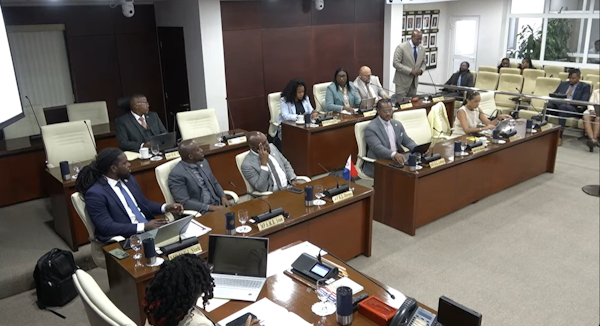 PHILIPSBURG:--- The long-awaited public debate on Sint Maarten’s 2026 National Budget opened Thursday with an immediate political fight over how much time Members of Parliament should be allowed to scrutinize Government, ending with Parliament voting to slash the traditional speaking time for MPs.
The dispute erupted before Finance Minister Marinka Gumbs could deliver her opening presentation on the proposed 2026 Budget.
Chairperson of Parliament Sarah Wescot-Williams initially announced that MPs would receive the customary 90 minutes in the first round and 45 minutes in the second round to question Government.
MP Franklin Meyers then intervened with a proposal to cut that time.
Meyers argued that Government had already responded to more than 2,500 questions submitted during the budget process and that Parliament was already in the second half of 2026.
He initially proposed reducing the first-round speaking time from 90 minutes to one hour.
That immediately drew opposition.
Doran: MPs Already “Robbed” of Opportunity
MP Egbert Jurendy Doran strongly objected to reducing the time available to MPs.
“We've been robbed of the opportunity of a CC, we've been robbed of everything else, now we want to rob ourselves of 30 minutes,” Doran told Parliament.
He called for the traditional arrangement to remain in place, arguing that MPs needed sufficient time to have a proper dialogue and possibly obtain answers to questions they had been asking Government “for the last few years.”
Meyers pushed back.
He rejected the characterization that MPs were being robbed and instead said civil servants had effectively been burdened by the enormous volume of questions they were required to process.
According to Meyers, civil servants had to work “night and day” on the approximately 2,500 questions, while roughly 1,300 pages of answers had already been submitted to Parliament.
Meyers also questioned whether allowing every MP another 90 minutes in the first round and 45 minutes in the second would result in productive scrutiny or political “grandstanding.”
“If you cannot get your message across in an hour, then your message is superfluous,” Meyers said.
His final proposal was therefore even broader: 60 minutes for MPs in the first round and 30 minutes in the second, cutting a total of 45 minutes from each MP's potential speaking time.
8-4 Vote Cuts Debate Time
The matter went to a vote.
According to the Chair's announcement, the proposal was approved eight votes to four.
MPs will therefore have 60 minutes instead of 90 in the first round and 30 minutes instead of 45 in the second round during this particular budget meeting.
The clash is significant because this is no ordinary piece of legislation.
The National Budget determines how hundreds of millions of guilders in public money will be collected and spent across Government, while the documents MPs are expected to scrutinize run into thousands of pages.
MP Dimar Labega earlier highlighted the scale of the exercise, saying civil servants and ministerial cabinets had dealt with more than 2,500 questions and a budget package of 1,339 pages.
“It was no small task,” Labega said while thanking the civil servants involved.
The reduction therefore sets the tone for what could become a contentious final stage of the 2026 Budget process: Government says thousands of questions have already been answered, while opposition MPs maintain that written responses cannot replace their right to confront ministers directly on the floor of Parliament.