





~VSA Minister says growing public needs collide with limited fiscal space; Cg. 22 million earmarked for medical assistance, Cg. 8.2 million for social assistance, while only three vacancies are funded.~
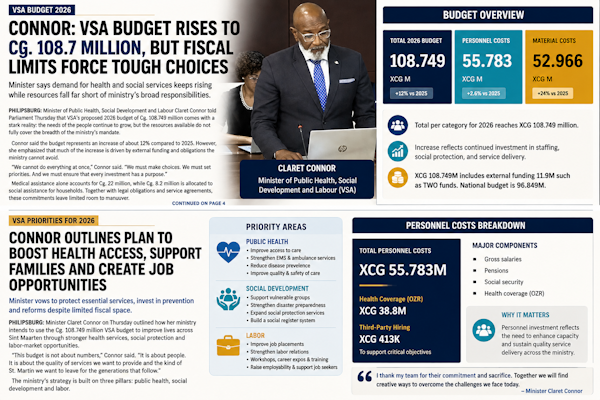 PHILIPSBURG:--- Minister of Public Health, Social Development and Labor Claret Connor has warned Parliament that the resources allocated to VSA for 2026 do not fully cover the breadth of the ministry’s responsibilities, forcing Government to make difficult choices as demand for healthcare, social assistance and labor services continues to grow.
Presenting VSA’s draft 2026 Budget Thursday evening, Connor said the ministry is operating in an environment where the needs of residents are increasing while Government’s fiscal space remains limited.
“We cannot do everything at once,” Connor told Parliament. “We must make choices. We must set priorities.”
The minister said the 2026 Budget attempts to protect essential services while investing in prevention, access to healthcare, employability, community resilience and reforms.
Budget Up About 12% — But External Funding Distorts Increase
Connor placed VSA’s total 2026 budget at just under Cg. 109 million, approximately 12% higher than in 2025.
But the headline increase requires important context.
Personnel costs amount to just under Cg. 56 million, up about 2.6%, while material costs total about Cg. 52.97 million, representing an apparent increase of roughly 24%.
However, Connor disclosed that excluding external funding, VSA’s material-cost budget is approximately Cg. 41 million — actually 4.2% lower than in 2025.
That distinction significantly changes the picture presented by the headline 12% budget increase.
Cg. 22 million for Medical Assistance
Medical assistance is the single largest component of VSA’s material expenditure at approximately Cg. 22 million.
Another Cg. 8.2 million is allocated to social assistance directly supporting households.
Accounting, advisory services and service-level agreements account for another Cg. 11.4 million, which Connor linked partly to ongoing reforms.
Those commitments mean much of the ministry’s available money is already spoken for before new policy ambitions are considered.
Connor said most material costs are committed to essential assistance and legal obligations.
That leaves VSA confronting a fundamental budget problem: healthcare needs, social pressures and demands on labor services are increasing, but a significant share of its resources cannot simply be redirected.
Only Three Vacancies Funded
Human resources present another major constraint.
Despite Connor acknowledging capacity gaps across VSA, the 2026 Budget provides approximately Cg. 297,000 for only three vacancies.
The ministry has also set aside approximately Cg. 413,000 for third-party hiring to address critical areas where internal capacity is insufficient.
Connor was explicit that the three funded vacancies are “definitely not sufficient” to address all of the ministry’s capacity gaps.
That admission deserves scrutiny.
VSA is responsible for public health, social development and labor at a time when Government says demand for all three is increasing, yet the Budget provides funding for only three additional vacancies.
Healthcare: Prevention, Mental Health and Ambulance Services
Connor said VSA’s public-health programme will focus on four broad areas: access and prevention; key health initiatives; quality and safety; and capital investment.
The programme includes disease-prevention initiatives, Emergency Medical Services awareness, mental-health legislation, non-communicable and communicable disease programmes, immunization, inspections, ambulance-staff training and certification.
Capital investments are intended to strengthen ambulance services, Collective Prevention Services and the Public Health Inspectorate.
Social Register and Vulnerable Households
Social development will focus on vulnerable groups, resilience and inclusion.
Connor said the Government is working on a social register system for empowerment and case management, while subsidies continue for councils, shelters and programs addressing youth, seniors, homelessness and parenting.
VSA also intends to continue disaster-preparedness training and emergency-response exercises through ESF-7.
The objective, according to Connor, is not simply to provide assistance when residents fall into difficulty but to help them regain stability and participate in society.
Labor: Government wants assistance recipients back into workforce
The labor component of the Budget focuses on job placement, labor relations and employability.
Connor said Government intends to improve matching between workers and available jobs through the NESC job portal and labor-market data, strengthen labor relations and compliance, recruit a permit officer, and use workshops, training and career expos to improve employability.
The strategy specifically includes preparing people receiving assistance for participation in the labor market.
That creates an important policy test for Government: whether training and employability programmes ultimately result in measurable movement from social assistance into sustainable employment.
Nearly Cg. 1.2 million in Capital Investments
VSA’s capital investment for 2026 totals just under Cg. 1.2 million.
Approximately Cg. 971,000 is intended for vehicles across the ministry, while another Cg. 258,000 is earmarked for disaster response.
Connor said those investments will support inspections, outreach, operations, and emergency response.
Connor: Resources Do Not Cover Everything
But Connor’s assessment of VSA’s financial position delivered the strongest message of his presentation.
Demand for medical assistance, social protection and workforce support continues to increase while fiscal space remains limited and vacancies continue to affect capacity.
“The resources available do not fully cover the breadth of our mandate,” Connor told Parliament.
He again acknowledged that financial and human resources remain a challenge and said Government will have to prioritize and find more efficient ways of providing services.
The numbers therefore leave Parliament with several critical questions.
How will VSA meet growing healthcare and social assistance demands when its underlying material budget, excluding external financing, is actually declining? How will a ministry with acknowledged capacity shortages close those gaps when only three vacancies are funded? And how much of the apparent 12% budget increase represents genuinely new spending power rather than externally funded programmes and existing obligations?
Connor’s presentation makes one point unmistakable: Sint Maarten’s health and social needs are growing faster than the resources Government says it has available to meet them.