





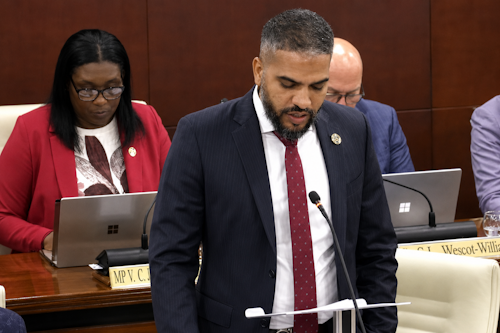
 PHILIPSBURG:--- Member of Parliament Viren Kotai used the 2026 budget debate to press the government on what he portrayed as a recurring problem: revenue-generating ideas remain under consideration while the government continues to struggle with its finances, tax compliance, and major administrative backlogs.
Kotai directed detailed questions to the Ministries of Finance, TEATT, Justice and VROMI, challenging the government to establish concrete deadlines for tax reform, short-term rental taxation, new security-related revenue streams and the processing of hundreds of outstanding permit applications.
His central message was straightforward: government cannot continue concentrating on expenditure cuts without giving equal urgency to expanding and improving its revenue base.
“There is only so much that we can cut before we can seriously have to ask ourselves where and how we can make more money,” Kotai told Parliament.
Short-Term Rentals: When will Government actually act?
Kotai began with the Ministry of Finance and the proposed taxation of short-term rental platforms.
He acknowledged the ministry's response that it is receiving technical assistance from the IMF and CARTAC, but said he was becoming “increasingly uncomfortable” with hearing that revenue measures are merely being considered.
“At some point, we have to move beyond consideration and into implementation,” Kotai said.
He demanded to know whether government has actually decided in principle to bring short-term rentals more effectively into the tax framework, what assistance has been requested from the IMF and CARTAC, what deliverables are expected and, crucially, when Parliament will receive a concrete proposal.
Kotai also asked whether Finance has calculated how much revenue the country is currently forgoing because the existing tax system does not adequately capture short-term rental activity.
That question could become increasingly important as government searches for additional revenue without continually increasing the burden on taxpayers already operating within the formal economy.
Kotai Targets Alcohol and Tobacco for More Revenue
Kotai also revived the question of excise or “sin” taxes on alcohol and tobacco.
He argued that these products are regularly consumed and questioned whether government could generate additional income by adjusting taxation on them. He asked Finance whether such a measure has been considered, how much additional revenue it could reasonably generate, and when a decision could be expected.
The proposal formed part of Kotai's broader argument that the budget debate cannot revolve only around controlling expenditure. Government must also identify realistic ways of increasing recurring income.
Kotai: 73.9% of Government Revenue Comes From Taxes
The MP then turned directly to Sint Maarten's tax structure.
According to figures cited by Kotai during the debate, approximately 73.9% of government revenue is generated through taxes.
He said profit tax represents approximately 9.6% of tax revenue, or roughly XCG 46 million, while turnover tax represents approximately 36.8%, generating around XCG 176 million.
Kotai contrasted the approximately XCG 176 million generated through the 5% turnover tax with roughly XCG 46 million from profit tax at 34.5%.
“The ratio is clearly off,” he argued, adding that maintaining high tax rates does not necessarily produce higher tax collection.
Kotai questioned whether Sint Maarten's profit-tax rate could itself be contributing to non-compliance and reducing the country's regional competitiveness.
He asked whether Finance has modeled the impact of lowering the profit-tax rate while simultaneously strengthening enforcement and compliance.
Most importantly, he demanded an actual timetable for comprehensive tax reform and asked what the government's future tax structure is intended to look like.
XCG 750,000 for Tourism Authority Draws Questions
Kotai's scrutiny extended to TEATT and the XCG 750,000 allocated as seed funding for the St. Maarten Tourism Authority (STA).
He questioned how much of that money can realistically and legally be spent during 2026 before the governing ordinance is finalized.
With the 2026–2027 high tourism season approaching, he also asked how government intends to ensure that marketing and airlift campaigns are adequately funded while the permanent STA structure remains under development.
Kotai similarly questioned the flagpole project, noting that no formal agreement or memorandum of understanding was currently in place according to the information before Parliament.
He asked what legal and financial exposure government faces by keeping the project in the budget and whether those capital funds could instead be frozen or redirected toward higher-priority tourism developments.
He further questioned what return-on-investment criteria the government used when it prioritized physical projects over direct tourism-product improvements and support for small and medium-sized businesses.
Philipsburg Parking: Build the Spaces, Then Regulate Them
Kotai welcomed plans to increase parking capacity in and around Philipsburg but argued that infrastructure alone will not solve the problem.
He called for comprehensive parking legislation covering designated zones, paid parking, permits, enforcement, wheel clamping and towing.
Kotai pointed Parliament toward Aruba's parking legislation as a possible model that could be adapted to Sint Maarten and asked government for a timeline for bringing additional Philipsburg parking capacity online.
Foreign Driver's License Fee Dead — But Kotai Wants Replacement Revenue
The Justice Ministry also came under scrutiny.
Kotai said his written questions addressed a previously discussed foreign driver's license fee. According to the written response he received, the Ministry of General Affairs advised that the proposal could not be implemented because of international law and Kingdom treaty obligations.
Kotai accepted that legal conclusion but argued that abandoning one mechanism should not mean abandoning the underlying objective.
The proposal, he explained, was intended to create a dedicated funding stream to strengthen security in important tourism and commercial areas, including Maho, Simpson Bay, Cole Bay and Philipsburg.
He therefore asked whether government is actively developing alternatives such as a car-rental tax or levy or a contribution connected to Chamber of Commerce business registrations or licenses.
Kotai again returned to his recurring criticism: are these measures actually being developed, or are they simply being “considered”?
“We are now in year two, going on year three of this government, and we are already looking towards another budget cycle,” he said.
VROMI Figures: 662 Applications Still Pending
Kotai saved some of his strongest scrutiny for VROMI.
Using figures provided by the department, he laid out the permit backlog year by year:
- 2022: 247 applications received; 82 pending
- 2023: 260 received; 101 pending
- 2024: 189 received; 123 pending
- 2025: 260 received; 206 pending
- 2026 to date: 155 received; 150 pending
That amounts to 1,111 applications received and 662 still pending — almost 60%, according to Kotai's calculation.
But the MP made an important distinction.
He cautioned that the remaining 449 applications should not automatically be described as permits issued, because applications could also have been rejected, withdrawn or otherwise closed.
He therefore requested a complete annual breakdown showing permits actually issued, applications rejected, applications withdrawn and applications remaining pending.
That distinction is critical because it would allow Parliament to determine the department's actual processing performance rather than drawing conclusions merely by subtracting pending files from applications received.
Kotai Raises Allegations — But Explicitly Says They Are Not Facts
Kotai then addressed what he described as longstanding stories and allegations that certain people could supposedly get permit applications processed more quickly if “the right person was taken care of.”
Importantly, Kotai explicitly told Parliament: “I am not presenting that as a fact.”
He said he was neither pointing fingers nor attempting to act as law enforcement. Instead, he argued that persistent stories about people being willing to pay for faster service should prompt the government to examine whether there is legitimate demand for an official expedited-processing system.
Pay More for Speed — Never for Approval
Kotai proposed a tiered permit-processing model.
Under his concept, applicants willing to use the normal processing period would pay the standard fee, while applicants requiring faster processing could pay a higher, officially established fee for a shorter guaranteed administrative timeframe.
But he drew a clear boundary.
“Paying more should never mean buying an approval,” Kotai said.
The additional charge, he explained, would pay only for faster processing and a decision within a defined period. Every applicant would remain subject to the same planning, legal and technical requirements.
Outsource Processing to Attack the Backlog?
If VROMI lacks sufficient personnel to provide such a service internally, Kotai said the government should examine outsourcing parts of the administrative and technical processing to a qualified external company through a transparent procurement procedure.
The government would retain its regulatory authority and final decision-making powers, while external capacity could clear the backlog and process new files according to established service standards.
Under Kotai's proposal, government would establish the standards, collect the fees, pay for contracted processing capacity, maintain oversight and retain the remaining revenue for government.
He asked VROMI whether such a system has been studied, what additional revenue it could generate, whether outsourcing has been considered, and what staffing or external capacity would be necessary to guarantee processing deadlines.
Kotai also suggested that revenue generated through the system could be reinvested into strengthening the permitting department itself.
“We Can't Continue to Do Business in the Same Manner”
With 662 applications still pending, Kotai concluded that government cannot keep using the same approach and expect different results.
His proposal effectively attempts to connect two problems exposed during the budget debate: government needs more revenue, while residents and businesses need faster government services.
Instead of letting demand for speed fuel allegations of unofficial payments, Kotai argued that the government could create a legal, transparent expedited service in which every payment goes directly into the public coffers and every applicant receives a clearly defined level of service.
“We can't continue to do business in the same manner and expect a different result,” Kotai told Parliament.
For the 2026 budget debate, that may be the larger question raised by Kotai's intervention: how many revenue reforms, tax changes and administrative improvements can government continue to study before “under consideration” finally becomes “implemented”?