





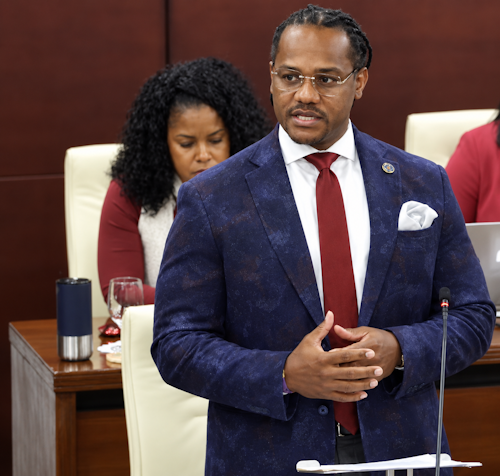
 PHILIPSBURG:--- Member of Parliament Dimar Labega delivered a wide-ranging critique of the draft 2026 national budget on Friday, warning that the government’s ambitious policies will mean little if ministries remain understaffed, revenue measures remain stuck in the discussion stage, and the government cannot demonstrate measurable improvements in the lives of residents.
Speaking during the first round of questions in the public meeting of Parliament on the 2026 budget, Labega said the policy-based approach behind the budget is commendable in principle, but questioned whether the government has the institutional capacity to execute what has been put on paper.
Labega said a recurring theme throughout the ministers’ presentations was the same: ministries have plans and an optimistic outlook, but personnel shortages, recruitment difficulties and institutional capacity problems are hindering their ability to deliver.
“Without personnel the plans will remain just that, plans,” Labega told Parliament.
“It is time to make a decision”
Labega was particularly critical of the pace at which government is moving on revenue-generating measures.
With Sint Maarten already eight months into 2026, he argued that government cannot continue responding to major policy questions by saying matters are being considered, researched or examined.
According to Labega, Sint Maarten desperately needs additional revenue, and there has been no shortage of ideas from either Parliament or the Council of Ministers. What is lacking, he suggested, is the willingness to select measures and carry them out.
“It is time to make a decision,” Labega said, warning that initiatives not implemented in 2026 could simply reappear as unfinished business in the 2027 budget.
Labega pushes national poverty reduction strategy
One of the strongest parts of Labega’s intervention concerned poverty.
He said he reviewed the extensive written questions and answers connected to the budget and found poverty reduction addressed across several ministries, but not yet tied together under a measurable national strategy.
He pointed to SME expansion and job creation, vocational education and skills training, restructuring of social assistance and affordable housing as examples of policies spread across different ministries.
However, Labega warned that their success depends on government having sufficient administrative capacity, reliable data and personnel capable of managing the programs.
“Without these, poverty reduction risks remain a policy goal rather than a measurable outcome,” he said.
Labega announced that he intends to present a motion during the second round calling for development of a national poverty reduction strategy.
He wants government to establish measurable targets and provide annual reporting so Parliament can determine whether policies are actually reducing poverty rather than simply financing separate programs under different ministries.
“Poverty is not going to wait for government to get ready,” Labega said.
He asked Prime Minister Dr. Luc Mercelina how the government will ensure its policies translate into tangible improvements for vulnerable households and, crucially, how it will measure their effectiveness through annual poverty-reduction targets.
More HR Spending, Yet Capacity Problems Continue
Labega then turned directly to what he described as one of the fundamental contradictions confronting government: rising spending on human resources while ministries continue reporting serious staffing problems.
He questioned why the human-capacity situation appears to be worsening despite increases in HR funding and argued that the problem therefore cannot be money alone.
“It’s about structure and prioritization,” he said.
Labega welcomed Mercelina’s statement concerning discussions with unions about increasing civil servants’ salaries. He said he had prepared a motion addressing human-resource capacity and adjusting salary scales to improve the government’s ability to attract and retain highly skilled local professionals.
He asked Mercelina whether fully staffing Personnel and Organization — P&O — will be treated as a priority, arguing that strengthening the department could have a cascading effect throughout government.
Labega similarly identified Legal Affairs as critical to breaking the capacity bottleneck. He referred to information presented during the budget process indicating that five of 17 positions were filled and that the department head position was vacant, while the presentation indicated only one legislative lawyer.
Why isn’t Government asking employees why they leave?
Labega also zeroed in on a seemingly basic management tool: exit interviews.
According to the information provided during the budget process, exit interviews are not regularly conducted, even though P&O is finalizing a strategic recruitment plan.
Labega questioned how government can develop an effective recruitment and retention strategy without systematically determining why employees are leaving.
“In order to have a strategic recruitment plan, you have to know why people are leaving the organization,” he argued.
He asked Mercelina directly why P&O has not consistently conducted exit interviews.
Labega also requested a projected timeline for the salary increases discussed by the Prime Minister, saying improved compensation could help attract Sint Maarten students and young professionals abroad back home.
Tourism Booming — But where is the revenue?
Labega then challenged the government over what he described as the disconnect between strong tourism activity and continuing poverty.
He questioned where the economic benefits go if tourism is performing strongly while vulnerable households continue to struggle.
He specifically pointed to the absence, according to his presentation, of taxes on Airbnbs and vacation properties and the lack of a visitor collection tax as examples of potential revenue streams that are not being collected.
He argued that tourism growth means little to struggling households if the economic benefits do not reach them.
Labega also said seven international public-relations firms appearing in the budget line items total approximately Cg. 3.4 million, and asked TEATT whether government intends to invest more heavily in local PR firms and content creators.
He argued that local professionals should be given opportunities to build portfolios and credibility, potentially through collaboration with international agencies, so they can eventually compete for contracts internationally.
He also demanded an update on the local brand ambassador program that Parliament unanimously approved in December 2025, asking why implementation has been delayed.
Labega: Cg. 1 Million for Sports is not Enough
Labega reserved some of his strongest criticism for the ECYS sports allocation.
According to the figures he cited, the sports budget stands at about Cg. 1 million, with about half allocated to sports facilities. He listed approximately Cg. 139,000 for school programs, Cg. 100,000 for national team development, Cg. 85,000 for international events and Cg. 90,000 for institutional strengthening.
“We cannot continue to function on this amount and expect extraordinary results when it comes to our sports product. It is simply not possible,” Labega said.
He said Sint Maarten has roughly 26 sports federations and commended the Sint Maarten Sports Federation for its efforts over the past two years to organize sports and help federations move toward international standards.
But Labega argued that Sint Maarten must make a fundamental decision about its sporting identity.
Does the country want mass participation, elite national-team development, or a deliberate combination of both?
Labega said he supports a balanced approach: grassroots participation in schools alongside a clear development pipeline for exceptional young athletes who can compete internationally.
He acknowledged that a limited budget cannot equally finance every sporting discipline and argued that public resources must be prioritized.
Labega said he will submit another motion calling on the government to establish a national sports excellence strategy to maximize limited public resources and improve Sint Maarten’s performance in regional and international competition.
He went further, saying difficult choices must also be made when deciding who receives public or private sponsorship.
With limited resources, Labega argued, youth teams and national priorities may deserve precedence over adults seeking financial assistance to travel abroad for recreational sports.
Police Capacity: Labega Floats Public Safety Support Entity
Turning to Justice, Labega said his earlier questions concerning police capacity and the Miss Lalie Center had largely been answered, but he raised a potentially significant new proposal.
Labega questioned whether government should explore establishing an armed public-safety support entity to assist an understaffed police force.
He envisioned such an entity concentrating on visibility patrols, deterrence, tourism security and protection of public spaces.
Labega stressed that any such organization would have to be highly regulated, staffed by properly trained professionals, and subject to clearly defined limitations. He argued that police cannot maintain adequate visibility across all business and residential areas when staffing is insufficient.
VROMI Permit Backlog and Garbage Contracts
Labega also raised concerns about VROMI’s capacity and the building-permit backlog.
Referring during his intervention to a backlog figure of 662 permits and only 25 approved in 2026, he asked whether Minister Patrice Gumbs Jr. had considered temporarily outsourcing complex outstanding files to qualified professionals such as engineers, contractors or lawyers.
He argued that clearing the accumulated backlog externally could allow existing ministry staff to focus on new applications rather than watching the backlog continue to grow into 2027.
On garbage collection and district cleaning, Labega placed responsibility on both government and residents.
He said residents also have an obligation to dispose of their garbage properly, rather than using overflowing neighborhood receptacles as an excuse to dump.
At the same time, he suggested the restructuring of district cleaning had not worked as intended because VROMI itself lacked sufficient capacity.
Labega welcomed the appearance of new tenders and said he wants them awarded as quickly and “as transparently as possible,” with qualified contractors receiving the work.
The central thread running through Labega’s budget intervention was therefore broader than any single ministry: St. Maarten has plans, programs and increasing demands, but government’s capacity to execute them is becoming the defining test of the 2026 budget.
For Labega, the approaching 2027 budget makes that test even more urgent. Without decisions on staffing, salaries, revenue collection, poverty targets and institutional capacity, Parliament could soon find itself debating another national budget containing many of the same unfinished promises.