





~MP challenges generator financing, promised consumer relief, tariff regulation and GEBE collections; revives KEMA Report and questions why past tariff findings have not translated into lower costs for consumers.~
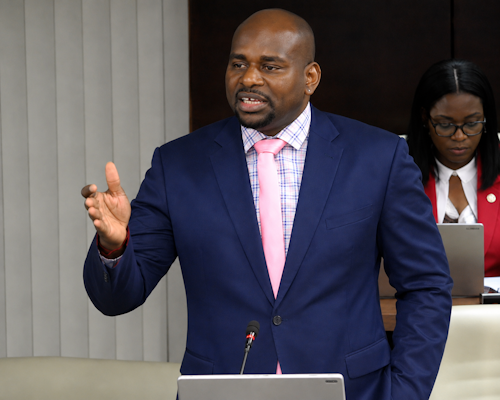 PHILIPSBURG:--- Member of Parliament and former Minister of Public Health, Social Development and Labor (VSA) Omar Ottley launched a sweeping attack on the handling of NV GEBE during the 2026 budget debate, questioning promised electricity relief, the financing of new generators, tariff regulation and what he described as the continued burden being placed on struggling consumers.
Ottley’s intervention centered on one fundamental question: while GEBE must protect its financial position, who in government is protecting the consumer?
“GEBE will always care about GEBE,” Ottley told Parliament. “Who will care about the people of St. Maarten?”
Generator financing comes under fire
Ottley revisited the financing intended to address GEBE’s generation problems, recalling that during the 2024 budget amendment government moved toward borrowing funds for generators while the country was already experiencing an electricity crisis.
He said he warned at the time that purchasing major generating equipment would not provide immediate relief because of the time required for manufacturing, shipping and installation.
Ottley said his support for borrowing on GEBE’s behalf was tied to the government providing consumer relief.
But he questioned where things stand now.
According to Ottley, GEBE received bids from firms in July 2026, yet reports later emerged that the company needed additional money to acquire the generators.
His argument was straightforward: if financing was already secured for generators but the bids now exceed what can be afforded, Parliament and the public deserve an explanation of how the financing plan fell short.
“We take a loan to buy generators, now that we can’t afford them,” Ottley charged.
Ottley questions possible removal of emissions equipment
Ottley also raised concerns over discussions about reducing generator costs by removing catalytic equipment.
He warned Parliament that catalytic converters serve an environmental purpose by reducing pollutants and emissions and questioned whether lowering the purchase price should take precedence over the potential environmental and public-health consequences.
His criticism was particularly sharp because, he argued, government cannot simultaneously express concern about public health while accepting greater pollution simply to make generators cheaper.
Where is the promised GEBE relief?
Ottley then returned to an issue that has repeatedly dominated the political debate surrounding the utility company: relief for consumers.
He accused Prime Minister Dr. Luc Mercelina of promising relief on multiple occasions without the population seeing the promised outcome.
“We speak on GEBE relief. It has been promised to the people once, twice, three times by the Prime Minister,” Ottley said.
The former VSA Minister said the reality confronting households cannot be reduced to figures on a balance sheet.
He referred to a video of a distressed man pacing and said that while some people laughed at the footage, it reflected the reality facing households wondering how they would feed their children.
For Ottley, that is precisely why Parliament and government cannot allow GEBE’s financial interests to become the only consideration in decisions about collections, disconnections and tariffs.
“Go cut the small man”
Ottley was especially critical of what he characterized as aggressive collection from ordinary consumers.
“Go cut, go cut, go cut the small man,” he said repeatedly while describing the approach.
He contrasted that with his assessment of former GEBE Temporary Manager Sharine Daniel, arguing that Daniel had concentrated on collecting from major debtors. Ottley acknowledged that he had been part of government at the time and said he disagreed with the decision to remove her.
His criticism carried a broader political message: GEBE is a company and therefore has an obligation to collect money, but elected officials have a separate obligation to ensure that government policy protects residents.
“If you keep going after the small man,” Ottley warned, “they have a voice here in Parliament.”
Ottley challenges government on tariff regulation
A substantial portion of Ottley’s presentation was devoted to his argument that government already possesses legal tools to intervene in electricity and water tariffs.
He asked government to obtain a Legal Affairs opinion on whether tariffs could be regulated by ministerial regulation under the Price Ordinance, despite provisions contained in the Electricity Ordinance.
Ottley pointed to Curaçao and argued that its regulatory approach demonstrates how the Price Ordinance can be used in the energy sector.
He then read from what he described as the legal framework governing economic supervision of electricity.
According to Ottley’s presentation, while the National Ordinance on Electricity Concessions provides the framework for electricity production and distribution, the Price Ordinance also addresses economic supervision and the affordability of electricity tariffs.
Ottley specifically cited Article 2 of the Price Ordinance, arguing that when prices for goods or services are contrary to or threaten the public interest, ministerial regulation is possible.
“The Price Ordinance allows us to act now,” he argued.
He presented Curaçao ministerial regulations as an example, saying electricity and water tariffs there are regulated and that differentiated tariffs could potentially be considered for institutions or groups such as the hospital, schools and seniors.
KEMA report returns to parliament
Ottley also revived questions about the KEMA Report, the study that played a documented role in developing GEBE’s tariff structure.
Ottley referred during his presentation to an earlier GEBE discussion in which he said the Prime Minister indicated government did not recall the report. He then drew attention to historical statements from former Minister of Economic Affairs Franklin Meyers concerning the tariff structure.
The historical record supports the KEMA Report's existence and relevance.
On September 7, 2011, SMN News reported that Meyers said government had allowed GEBE to introduce its new tariff structure based on the KEMA Report, provided the company could substantiate its pricing. Meyers said government wanted access to GEBE’s underlying cost and tariff figures so it could determine whether consumers were paying the true cost rather than absorbing company inefficiencies.
That report also records Meyers saying government itself had not conducted a separate tariff study at that point and that the KEMA Report was the report government had.
Even more significantly, an earlier SMN News report from June 17, 2011, identified it specifically as the KEMA Report of March 8, 2010. The government gave GEBE conditional approval to apply a new electricity tariff structure based on that report, on the condition that GEBE's inefficiencies should not simply be passed on to electricity consumers.
GEBE itself subsequently said its new tariff structure was based on an extensive study conducted by international consultant KEMA between 2009 and 2010, with the final report submitted to GEBE management in March 2010.
The historical documentation therefore leaves little ambiguity: the KEMA Report existed, it concerned GEBE’s tariff structure, and it was part of the government-GEBE tariff debate more than a decade ago.
Ottley’s question in 2026 consequently goes beyond whether anyone remembers the report. It raises what became of its findings, how they influenced the tariff structure consumers ultimately received, and what relevance those findings have to the present debate over electricity affordability.
Government was already fighting GEBE over inefficiencies in 2011
The historical record Ottley raises also shows how long some arguments about GEBE have persisted.
In June 2011, Meyers publicly argued that consumers needed relief and that GEBE should absorb its own inefficiencies rather than transferring them to customers through electricity charges. The government was also seeking an independent evaluation of the KEMA and KPMG reports.
A July 2011 report on the tariff controversy recorded by then-Prime Minister Sarah Wescot-Williams saying government considered the way the fuel-clause formula was being applied unacceptable and that residents' wages were not increasing sufficiently to absorb rapidly escalating electricity costs.
Fifteen years later, Parliament is again debating GEBE tariffs, fuel costs, company inefficiencies and relief for consumers.
That history gives additional weight to Ottley’s central challenge: after years of studies, reports, tariff discussions and political promises, why are St. Maarten consumers still asking when meaningful relief will arrive?
RAC/BTP Report also Questioned
Ottley separately raised the RAC/BTP report, telling Parliament that it concluded GEBE had collected approximately NAf. 12 million NAf. 13 million in excess from St. Maarten consumers.
He asked whether government or GEBE paid for the report and, if so, how much.
“It would be interesting to know if we paid money to ignore the advice,” Ottley said.
Ottley Points Back to 2008 Fuel-Clause Relief
To support his argument that consumers can receive immediate relief when energy costs fall, Ottley cited a 2008 announcement attributed to then-GEBE Managing Director William Brooks.
Ottley said the fuel clause was reduced by 28 percent that November compared with October as oil prices declined.
His point was that if consumers immediately absorb increases when fuel prices rise, they should likewise benefit when costs decline.
“Our clients feel the bite right away when the price increases. So, they should also benefit from the price decrease,” Ottley quoted from the earlier position.
Fifteen years later, the same questions remain
For Ottley, the 2026 GEBE debate therefore extends far beyond purchasing generators.
It is about whether government will intervene on tariffs, whether promised relief will materialize, whether environmental protections could be sacrificed to reduce generator costs, whether ordinary consumers are carrying a disproportionate collection burden, and whether recommendations contained in studies commissioned or considered over the years have actually been acted upon.
The historical KEMA documentation makes one aspect of that debate particularly difficult to ignore.
As far back as 2011, the government was publicly arguing that GEBE should not pass its inefficiencies on to consumers. The government examined tariff structures, demanded underlying cost figures, and insisted that consumers needed relief.
Now, in 2026, St. Maarten is again debating affordability, tariffs, fuel costs, GEBE’s financial position and relief for households.
As residents confront electricity bills alongside high food, fuel and housing costs, Ottley’s message to government was unmistakable:
GEBE’s responsibility may be to protect the company, but government’s responsibility is to protect the people.