





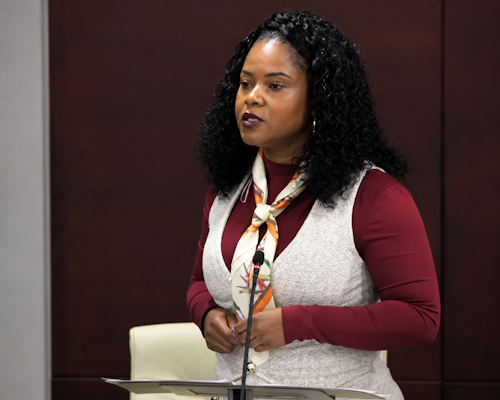
 PHILIPSBURG:--- Member of Parliament Sjamira Roseburg used the 2026 budget debate to press the Council of Ministers on a sweeping range of issues, but placed particular emphasis on measures that could directly affect household expenses, GEBE accountability, road safety, crime prevention and the government's failure to execute or modernize existing legislation.
Roseburg described the proposed budget as relatively straightforward, noting the projected economic growth, the Finance Ministry's projected NAf. 11 million surplus and the risks surrounding healthcare funds and GEBE. However, she made clear that Parliament should not simply approve a budget because the year is already advanced.
"Just approving a budget for approving's sake, without asking critical questions, that's not our job," Roseburg told Parliament.
Her intervention eventually turned to what could become one of the debate's more consequential proposals: expanding the list of essential goods exempted from Turnover Tax, commonly referred to as BBO, while strengthening price controls so consumers actually benefit from the exemptions.
Roseburg: People Are Feeling the Squeeze
Roseburg said the debate cannot be separated from what residents are experiencing outside Parliament.
She pointed to complaints about high rent, fuel, groceries and electricity costs and questioned what Parliament itself could do. According to Roseburg, existing BBO exemptions already cover several essential items, including bread, sugar, salt, milk, diapers, toilet paper, flour, chicken and fruits. Her concern, however, is that a tax exemption does not automatically guarantee that consumers see a corresponding reduction at the supermarket.
Roseburg therefore raised the possibility of amending the legislation to broaden the exemption list.
Among the additional products she identified were vegetables, fish, other meats, pasta, basic hygiene products, cooking gas, menstrual products, tea, soap and cheese.
But she went further.
Roseburg argued that eliminating the tax without effective price monitoring could defeat the measure's purpose. She therefore called for structural price controls rather than controls that become particularly visible during hurricane periods or emergencies.
She asked whether government is already considering changes to the BBO legislation and whether TEATT would support intensified price monitoring. If the government is not working on such amendments, Roseburg said she is prepared to pursue the legislative changes herself.
Her argument was simple: if government and Parliament agree that residents are struggling, they should pursue measures residents can actually see when they buy everyday necessities.
Roseburg said she hoped to secure support from her parliamentary colleagues if such an amendment reaches Parliament, stressing that groceries and cooking gas are recurring household expenses and therefore provide an avenue through which relief could be felt regularly.
GEBE: Where are the audited accounts?
Roseburg also put GEBE squarely before the Prime Minister.
She stated that GEBE has not produced audited accounts since 2021 and referred to a NAF. 75.6 million government-backed loan.
She asked government for a timeline for restoring audited financial reporting and demanded to know what safeguards are protecting the government in relation to the loan while audited reporting remains outstanding.
The MP also returned to a matter that has become increasingly important to consumers: GEBE's disconnection policy.
Roseburg said she has repeatedly requested the policy and wants a written document made available to the public.
She acknowledged that consumers who use electricity and water have an obligation to pay, but argued that customers must also have a clear process for billing disputes, payment problems, or requests for assistance.
"You cannot just disconnect for disconnecting's sake," Roseburg said, questioning the practice of announcing disconnections for areas without consumers having a clearly accessible policy explaining the procedure.
For Roseburg, the issue is not whether consumers should pay their bills. Her questions focused on what rules GEBE must follow and what recourse customers have for challenging amounts, seeking clarification, or requesting leniency.
Crime Fund Has Millions — Roseburg Wants to Know Where It Is Going
Justice was another major component of Roseburg's presentation.
She welcomed the development of the Crime Fund policy following a motion she said she and MP Ardwell Irion passed in 2024.
Roseburg said approximately NAf. 4 million is currently in the Crime Fund and immediately raised the question of how that money will actually be spent on crime prevention.
She later noted that the 2026 Crime Fund Policy Plan contains 11 projects and reminded government that the country is already in August.
Roseburg requested a project-by-project update identifying which initiatives have started, which have not, and the reasons for any delays.
She specifically highlighted the HULK project, which she described as important to St Maarten's youth, and said she understood the pilot had not yet started.
The MP also revisited her Ride Smart SXM proposal. Government had indicated that the proposal does not currently meet Crime Fund criteria, but Roseburg questioned that position because the evaluation framework itself is still being developed.
If Ride Smart SXM cannot qualify in 2026, she asked whether it could be considered for the 2027 Crime Fund Policy Plan or modified to satisfy the criteria.
Her wider concern is road safety involving scooters and motorcycles, including helmet use, reflective clothing and safer opportunities for bikers to practice or demonstrate stunts in a controlled environment rather than on public roads.
Second Chances After Prison
Roseburg also questioned Justice and Social Affairs about programs intended to move former inmates into employment.
She referred to Second Chance Builders and Construction Skills Training, which she said were presented as jointly supporting approximately 35 to 55 participants in post-incarceration job training.
Roseburg requested the specific budget for Second Chance Builders and asked whether these initiatives are intended to become part of a broader employment pipeline involving private-sector employers.
She also asked whether the relevant ministries will establish a formal memorandum of understanding and sought clarification on plans to finalize it in 2026 and execute it by mid-2027.
Roads and Safety: "Asking for a Next Accident"
VROMI also faced detailed questioning.
Roseburg requested a breakdown of increased material costs, particularly the amount allocated to road maintenance, emergency work and road markings.
She specifically asked whether road markings, including on Brouwer's Road, would be repainted using 2026 funds.
She also demanded greater transparency on capital projects, asking government to identify whether funding for each listed project is secured, requested, or not yet sought.
Roseburg singled out a road in Suffolk Garden that she said she drives on daily.
She described the condition as dangerous and asked government either to provide a repair timeline or explain what interim measures will be implemented to prevent accidents.
According to Roseburg, families and other motorists use the road daily, and its present condition is "just asking for a next accident to happen."
She also questioned whether road safety and maintenance funding remains adequate for 2026, particularly given the traffic fatalities recorded this year and the fact that the legally required separation of the road fund from the regular budget will not take place until 2027.
NAf. 230,000 Amendment for Legislative Lawyers
One of Roseburg's most concrete budget proposals concerns the shortage of legislative lawyers.
She recalled a motion she authored in 2025 addressing that shortage and said government has now indicated that legislative assistance is being pursued on a consultancy basis.
Roseburg said her research indicates that approximately NAF 230,000 in unused personnel funding could potentially be shifted to consultancy services.
She said she is considering a budget-neutral amendment to move the unused funds between budget lines so outside legislative lawyers can be hired to assist government ministries.
Roseburg specifically raised the possibility of securing legislative lawyers from Suriname or elsewhere, arguing that political willingness to change laws accomplishes little if government lacks the personnel needed to draft the legislation.
She later summarized the proposal as moving unused personnel funds to consultancy expenditure so legislative specialists could finally help execute an earlier parliamentary motion.
Hair Discrimination Law Still Delayed
Roseburg also turned to Education Minister Melissa Gumbs for answers about the proposed hair-discrimination legislation.
She recalled that the legislation had previously been expected in Parliament during the first or second quarter of 2026 but had been delayed beyond the beginning of the new school year.
Roseburg asked for the current timeline, the status of discussions with school boards and, crucially, when Parliament will actually receive the draft legislation.
She additionally requested an update on the structured school breakfast programme and any proposed cooperation with the French side.
Roseburg recalled that NAf. 50,000 had been secured following a motion and said the funding was intended to ensure children could be fed through the programme over a two-year period. She now wants to know how far government has progressed toward making the initiative structural.
Faster Government Services — But at an Optional Price
Roseburg also floated another revenue proposal: optional expedited government services.
She asked whether government had considered allowing residents or businesses to pay an additional fee for faster processing of services such as passports, identification cards, driver's licenses and certain immigration matters.
After MP Francisco Lacroes challenged the idea on the grounds that higher fees could affect poorer residents, Roseburg stressed that she was not proposing an increase in the ordinary fee.
Her proposal, she explained, would retain the regular procedure and price while creating an optional higher-priced expedited service for people who need documents urgently.
She argued that such a mechanism could particularly assist persons traveling urgently or investors and businesses requiring faster government decisions.
Pension Contributions, Prison Capacity and Other Questions
Roseburg welcomed Finance Minister Marinka Gumbs' disclosure that MPs and ministers are currently not contributing to their own pensions and said elected officials should pay what they are legally required to pay.
She asked when the legal correction targeted for 2027 will be completed and whether Parliament needs to take any action.
On prison capacity, Roseburg asked Justice Minister Nathalie Tackling for another clear explanation of the policy and law governing situations when the prison is full, specifically referring to Article 137. She also asked why the government had not established further details through a Landsbesluit, where the law allows it.
She additionally sought an update on salary adjustments for Justice workers, including whether the stated November deadline will be met and what caused the delay. Roseburg asked about payments covering 15 active employees and seven employees who resigned after January 1, 2023, as well as the potential financial liability associated with retired employees in a later phase.
Roseburg Wants Parliament to Legislate, Not Duplicate
Roseburg's lengthy presentation also made a broader argument about Parliament's role as co-legislator.
She called on every ministry to identify critical laws that are outdated or already being worked on, so Parliament and the Council of Ministers do not unknowingly duplicate each other's legislative work.
Her message was that Sint Maarten does not merely lack laws. In several cases, laws already exist but are outdated, poorly implemented, or lack the policies and institutional machinery needed to make them effective.
Roseburg said legislation should become "living" rather than simply remaining law on paper.
That theme connected many of her interventions: the Crime Fund exists, but she wants to know how its millions will be spent; tax exemptions exist, but she wants consumers to actually feel them; GEBE provides essential services, but she wants a written disconnection policy and restored audited reporting; Parliament passes motions, but she wants the legislative capacity to execute them.
For Roseburg, the 2026 budget debate therefore became about more than approving expenditure. Her proposals challenge both Parliament and government to show how the figures, laws and policies on paper will translate into measurable relief, accountability and services for the people of Sint Maarten.