





~MP Questions Foreign Entity’s Role, Secretive Agreement, Health Risks, Banking Problems and Claims Cannabis could become government’s financial “Save-All”~
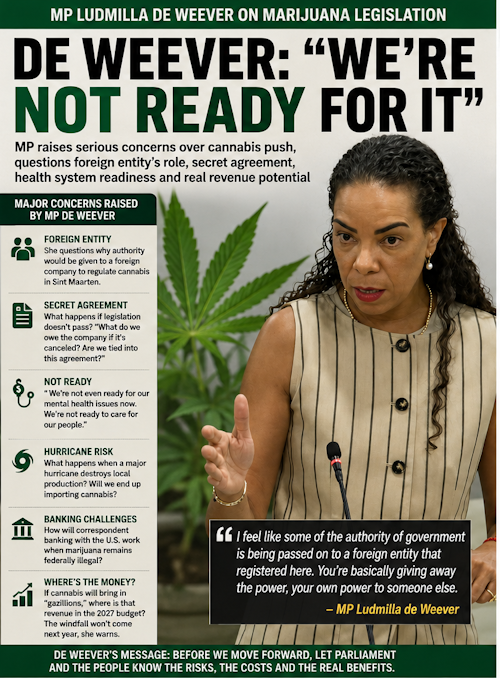 PHILIPSBURG:--- Member of Parliament Ludmila de Weever has delivered one of the strongest parliamentary challenges yet to the government’s proposed cannabis regulatory framework, warning that St Maarten may be rushing toward marijuana legislation without demonstrating that the country’s healthcare system, regulatory structure, finances or institutions are prepared for what follows.
De Weever used the 2026 budget debate to question why cannabis regulation has emerged so prominently while longstanding initiatives involving public transportation, the Meteorological Office and other policies remain unfinished.
The MP said the TEATT presentation listed cannabis regulation first among legislation and policy initiatives, followed by the public transportation ordinance, beach and vending policy, residential economic policy, sports tourism policy, hosting policy and festivals and events policy.
According to De Weever, all of those initiatives except cannabis regulation existed under previous administrations, with several tied to work dating back years.
Yet cannabis was sitting at the top.
“When you put something first, that’s the one that gets the most attention,” De Weever argued.
For De Weever, the question is therefore not merely whether cannabis should eventually be regulated. It is why this initiative appears to be receiving such attention now when government has repeatedly struggled to execute longstanding projects.
“You’re basically giving away the power”
De Weever raised an even more serious concern over the proposed regulatory structure.
The MP said she believes government authority is effectively being passed to a foreign entity that registered in Sint Maarten and questioned why regulatory power over the cannabis industry should be placed in those hands.
“I feel like some of the authority of government is being passed on to a foreign entity that registered here,” she said.
According to De Weever, the entity would have authority over how activities within the cannabis sector are regulated.
“You’re basically giving away the power, your own power to someone else,” she warned.
De Weever acknowledged that the current administration inherited the initiative from its predecessor. But she made clear that inheritance does not relieve the current government of responsibility for determining whether it is the right policy for Sint Maarten.
What has Government already signed?
Then came one of the biggest unanswered questions in her intervention.
De Weever wants government to disclose what financial obligations Sint Maarten already has to the company involved.
She asked what happens if Parliament ultimately does not approve the legislation or the project is canceled.
“If this cannabis legislation does not go through, what do we owe the company if it’s canceled? Are we tied into this agreement?” De Weever asked.
She demanded to know whether an existing contract or agreement exposes the country to financial liability if the government walks away.
“What is our liability? What do we have to pay because this contract or whatever agreement exists?” she asked.
De Weever said she has never seen the underlying agreement and described the situation as “shrouded in mystery.”
“I can’t trust anything that I can’t read,” she said.
That puts a significant question before TEATT: What exactly has already been agreed to, with whom, for how long, and at what potential cost to taxpayers if the cannabis project does not proceed?
“We’re not ready for it”
De Weever’s sharpest objection, however, was Sint Maarten’s readiness.
The MP juxtaposed cannabis legislation with the unfinished hospital, overseas medical referrals, existing mental-health problems and shortages in healthcare capacity.
“We’re not ready for it,” she declared.
“We’re not even ready for our mental health issues now.”
She questioned whether Sint Maarten is prepared for issues involving cannabis concentration levels and warned against adding another major public-health responsibility to systems already struggling to meet existing needs.
“We’re not even ready to literally care for our people now, yet you want to compound that,” she said.
Mental-Health and substance-abuse services already struggling
De Weever later returned to that contradiction.
She pointed to facilities providing services to people dealing with substance abuse and mental-health problems and questioned how cannabis legislation could be treated as a priority when such institutions themselves can face financial difficulties.
Her challenge to VSA was simple: prove the health sector has the resources to handle what legalization could bring.
“Just show me that you have the resources to handle it,” De Weever said.
The MP said her concerns were shaped by meetings with lawyers involved in marijuana legislation in Massachusetts, as well as doctors at Harvard.
According to De Weever, those discussions showed that even they had not been prepared for problems associated with concentration levels.
She then asked VSA whether Sint Maarten understood what it could face from a public-health standpoint.
“Are you aware of what you’re going to be dealing with when this stuff happens?” she asked.
De Weever: Medical Professionals Were Excluded
De Weever also made a striking allegation about the consultation process.
Despite what she described as extensive time spent on committees, studies and stakeholder discussions, she said medical professionals were excluded.
She called that “very weird” and “very bizarre.”
That concern takes on added significance because De Weever is simultaneously asking VSA whether the public-health system is prepared for legalization.
If healthcare professionals were not sufficiently involved, her remarks raise the question of what medical and public-health assessments underpin the proposed regulatory framework.
What Happens When a Hurricane Destroys Production?
De Weever also challenged the economics of producing marijuana in Sint Maarten.
The country sits squarely in the hurricane belt. The MP questioned how locally grown cannabis would be protected from a catastrophic hurricane and what happens to supply when production facilities are damaged or destroyed.
She predicted that inability to produce locally could result in cannabis being imported.
That, she said, creates another series of complications.
And What About American Correspondent Banks?
Among those complications is banking.
De Weever specifically raised the relationship with corresponding banks in the United States, noting that marijuana remains illegal under U.S. federal law.
“When you have to deal with correspondent banks in America, that is federally, it’s not legal, I want to know what you’re going to do,” she told government.
For a small island economy dependent on international banking relationships, De Weever made clear that this question cannot simply be treated as an afterthought.
Is Marijuana Supposed to Rescue the Budget?
The MP then turned to the government's apparent revenue expectations.
De Weever said she believes government may be looking at cannabis legislation as a potential “save-all” for budget shortfalls based on expectations that the industry will generate millions.
She rejected the idea that Sint Maarten should treat marijuana as some new financial gold rush.
“If we think that we’re going to make a gazillion amount of money from cannabis legislation, y’all need to rethink what your priority is,” she said.
She challenged Finance to prove the economic case.
When the 2027 budget comes to Parliament, De Weever said she expects to see projected marijuana revenue if government truly believes the industry will generate substantial income.
If that budget reflects no cannabis revenue, she questioned what all the committees, studies, stakeholder meetings and government effort were for.
And even if cannabis eventually generates revenue, De Weever warned that the money will not solve the population’s problems today.
“The windfall of money that we’re going to get from cannabis legislation ain’t gonna come next year, it’s gonna come years down the line,” she said.
De Weever’s intervention has therefore placed a series of questions squarely before government: Who controls the proposed cannabis industry? What powers would be given to the outside entity? What agreement has already been signed? What will cancellation cost? Were medical professionals properly consulted? Is VSA prepared? How will hurricane risk be managed? How will the industry interact with U.S. correspondent banks? And exactly how much money does the government realistically expect cannabis to generate?
Until those questions are answered, De Weever’s position is clear:
Sint Maarten is not ready.