





~MP says fatal traffic case exposed legislative gaps; calls for collective action while raising concerns over hospital financing, Justice, late budget and deteriorating state of the island~
 PHILIPSBURG:--- Member of Parliament Franklin Meyers has renewed his push for Parliament to turn the tragedy surrounding the death of Ryan Gumbs into concrete legislation, while warning that Sint Maarten cannot continue postponing difficult decisions until unresolved problems eventually become an even greater financial and social burden on government and the population.
During his contribution to the 2026 budget debate, Meyers returned to a broader theme that has increasingly defined his interventions in Parliament: government and Parliament must address structural problems before they become crises that taxpayers are ultimately forced to finance.
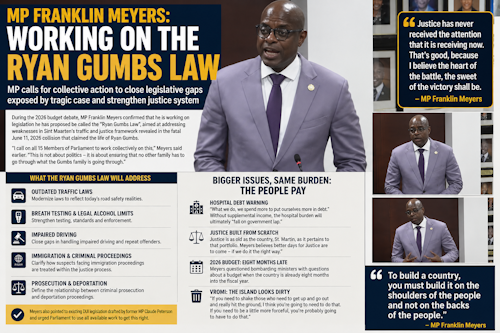
That position also provides the backdrop to Meyers' work on what he has proposed be called the “Ryan Gumbs Law” — legislation intended to address shortcomings in Sint Maarten's traffic and justice framework exposed following the fatal June 11, 2026, collision that claimed the life of Ryan Gumbs.
Meyers previously called on all 15 Members of Parliament to work together on the legislation rather than letting the matter become a partisan initiative. His proposal followed parliamentary deliberations over road safety and the circumstances surrounding the handling of the suspect in the Gumbs case.
The proposed Ryan Gumbs Law has not yet been presented as finalized legislation. Meyers' initiative has instead been framed as an effort to identify the gaps exposed by the case and develop legislation to prevent another family from facing similar circumstances.
Among the issues raised during those earlier deliberations were outdated traffic laws, breath testing, legal alcohol limits, impaired driving, the handling of suspects who may also face immigration proceedings and the relationship between criminal prosecution and deportation.
Meyers also pointed to proposed legislation on driving under the influence that former MP Claude Peterson had previously prepared and argued that Parliament should use the work as part of a broader effort to modernize the country's traffic legislation.
He even suggested that Parliament should examine its own spending priorities, including its travel budget, if financing was necessary to complete the legislative work.
The objective, according to Meyers, should not be political ownership of the initiative.
It should be closing the gaps.
From Ryan Gumbs to a larger question of government responsibility
Meyers' latest contribution to Parliament went far beyond traffic legislation.
He repeatedly returned to the consequences of leaving known problems unresolved, arguing that regardless of where a problem originates, the public eventually turns to government when the system fails.
He used the country's hospital as one example.
Meyers warned that continuing to spend while increasing debt without securing sufficient additional income for the hospital could eventually leave government carrying the financial consequences.
“What we do, we spend more to put ourselves more in debt,” Meyers said, warning that without supplemental income for the hospital, the problem will ultimately “fall on government lap.”
He argued that government cannot distance itself from such problems indefinitely because both the executive and legislative branches eventually have to confront the consequences.
Meyers illustrated his point with something as basic as garbage disposal.
When someone throws garbage from a vehicle or leaves garbage beside a bin without being held accountable, he said, “The government ultimately has to pick it up.
He applied the same principle to larger national problems, arguing that when structural issues are not addressed through a constructive plan, residents will eventually demand to know why government failed to fix them.
Meyers: Justice finally receiving serious attention
Meyers also devoted significant attention to the Ministry of Justice, saying the portfolio is receiving a level of scrutiny that he has not witnessed since Sint Maarten became a country.
While acknowledging the pressure currently facing Justice Minister Nathalie Tackling, Meyers said he welcomed Justice finally receiving sustained attention.
“In the 16 years that we've been a country, Justice has never received the attention that it is receiving now,” Meyers told Parliament.
Rather than viewing the scrutiny entirely negatively, Meyers argued that the pressure could force improvements.
He reminded Parliament that Justice occupies a unique position among the country's ministries because, unlike several other portfolios, Sint Maarten did not inherit an island-territory Justice department in the same form when it became a constituent country.
According to Meyers, the Justice portfolio essentially had to be constructed as part of the country's new constitutional structure.
“Justice is as old as the country, St. Martin, as it pertains to that portfolio,” he said.
Despite the longstanding problems, Meyers said he believes “better days for Justice” are possible, but stressed that improvements must be approached properly.
That argument is particularly relevant to the proposed Ryan Gumbs Law.
The circumstances surrounding Gumbs' death forced Parliament to confront not merely road safety, but questions about how criminal investigations, traffic legislation, immigration enforcement and the treatment of suspects intersect.
Meyers' legislative proposal therefore represents one potential response to the very Justice deficiencies he says Parliament is now finally scrutinizing.
Eight months into 2026 before Parliament deals with budget
Meyers was considerably less enthusiastic about the timing of the budget debate itself.
He questioned the usefulness of overwhelming the Council of Ministers with extensive questioning over a budget when the country was already eight months into the fiscal year.
Meyers recalled that government had previously been criticized for spending while the 2026 budget had not yet been approved.
He acknowledged that the criticism was justified because the budget was indeed outstanding.
But with Parliament now considering it eight months into the year, Meyers questioned the practical value of treating the exercise as though the country was still at the beginning of the fiscal year.
His comments come against the backdrop of the government's effort to break Sint Maarten's longstanding cycle of late budgets. Finance Minister Marinka Gumbs has presented the 2026 budget as part of a transition toward policy-based budgeting, while the government has simultaneously been pushing the 2027 budget process forward to complete it within the legally prescribed timeframe.
“The island seems to be dirty”
Meyers then turned his attention directly to VROMI Minister Patrice Gumbs Jr., saying visible improvements are needed in the physical condition of Sint Maarten.
“The island seems to be dirty,” Meyers said.
He acknowledged that governing is far more complicated than demanding that every problem be fixed immediately.
Having served for years in the executive branch himself, Meyers said he understands the limitations ministers face, particularly when financial resources are constrained.
“If all of the problems could be solved one, two, three, they would have been solved one, two, three,” he said.
But understanding those limitations, he made clear, cannot become an excuse for inaction.
Meyers told the VROMI Minister that where officials or departments need to be pushed harder to perform, the minister may have to do exactly that.
“If you need to shake those who need to get up and go out and really hit the ground, I think you're going to need to do that,” Meyers said.
“If you need to be a little more forceful, you're probably going to have to do that.”
For Meyers, the issue extends beyond aesthetics.
The appearance and condition of the country affect what he described as the “product St. Martin.”
When that product suffers, he argued, residents ultimately suffer as well.
Ryan Gumbs Law could become test of Parliament's willingness to act
Meyers' contribution effectively brought several apparently separate issues under one argument: Sint Maarten cannot continuously recognize problems, debate them and then leave them unresolved until their consequences become more expensive and difficult to manage.
The hospital requires a sustainable plan.
Justice requires continued institutional development.
VROMI must ensure that the country's physical condition does not deteriorate.
Budgets must be handled on time.
The shortcomings exposed after Ryan Gumbs' death should not simply disappear from Parliament's agenda once public attention moves elsewhere.
When Meyers first proposed the Ryan Gumbs Law, he appealed to all 15 MPs to participate. MPs Sjamira Roseburg and Darryl York also expressed support for the legislative initiative during those earlier deliberations.
If Parliament follows through, the initiative could transform one family's tragedy into legislation intended to strengthen the country's handling of serious traffic cases.
But Meyers' wider message during the budget debate was that legislation, budgets and government policies ultimately have to produce results for the people.
He closed his contribution with a line that summarized that argument:
“To build a country, you must build it on the shoulders of the people and not on the backs of the people.”