






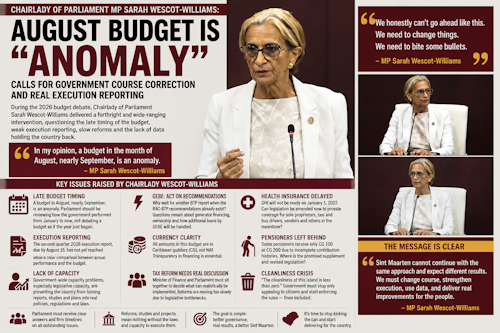
 PHILIPSBURG:--- Member of Parliament and Chairlady of Parliament Sarah Wescot-Williams delivered a sweeping critique of the handling of the draft 2026 budget, declaring that debating the country’s financial plan in the third week of August is an “anomaly” and warning that government cannot continue on its present course if it expects to deliver meaningful results.
Speaking during the continuation of the 2026 budget debate, Wescot-Williams said Parliament should by now be examining how government actually performed financially between January and August rather than still debating a budget as though the fiscal year were only beginning.
“In my opinion, a budget in the month of August, nearly September, is an anomaly,” Wescot-Williams told Parliament.
She thanked ministers for their presentations but said the timing created difficulties for both government and Parliament. She identified what she called several “red threads” running through the answers supplied by ministries and said they reinforced her belief that government needs a fundamental “course correction.”
According to Wescot-Williams, the limitations facing government are now so substantial that the country cannot achieve even a fraction of the ambitions presented by ministers unless the way government operates changes.
Second-Quarter Execution Report Still Missing
Wescot-Williams turned immediately to budget accountability, pointing out that the second-quarter 2026 execution report was due by August 15.
She said Parliament had not yet received it, although she understood it was on its way first to the Council of Ministers and subsequently to Parliament.
She also repeated her longstanding criticism of the format of quarterly execution reports, arguing that they do not provide Parliament with a sufficiently clear comparison between actual government performance and what was approved in the budget.
The Chairlady questioned why Parliament was being asked to consider plans and projections this late in the year without the latest execution figures needed to establish where the government actually stands.
She also pointed to government-wide capacity problems, particularly the shortage of legislative capacity, and questioned whether Sint Maarten can realistically execute the policies and reforms being presented.
GEBE: Why Wait Again?
GEBE emerged as another major issue.
Wescot-Williams questioned why the government continues to wait for another BTP report when recommendations already exist from the RAC-BTP process.
She asked why those recommendations could not already be acted upon and whether government had properly challenged GEBE over the utility company's disagreement with the findings.
“Why can we not execute the recommendations made by the RAC-BTP report?” she asked.
Wescot-Williams said simply waiting for another BTP assessment risks “kicking the can” further down the road.
She also raised significant questions concerning financing for GEBE's generators.
According to the information presented during the debate, government obtained financing intended for generators, but the available amount is no longer sufficient for three generators. GEBE itself is now expected to obtain additional financing.
Wescot-Williams questioned how that arrangement would work financially, particularly since the government is expected to purchase generators and lease them to GEBE while GEBE would simultaneously borrow additional funds for the equipment.
“Who owns what?” she asked, seeking clarification on whether GEBE's financing would be deducted from what the company ultimately owes government.
Tax Reform Needs Different Approach
Wescot-Williams also proposed changing the approach to tax reform.
Rather than allowing reform efforts to continue along what she considers an ineffective path, she proposed that the Minister of Finance and Parliament sit together to determine which elements can realistically be implemented.
She warned that unless government and Parliament discuss government proposals alongside the ideas coming from parliamentary factions, meaningful reform could remain stalled.
Her criticism extended to the TWO reform program.
Wescot-Williams said the picture she obtained from available TWO information was “alarming,” particularly because major reforms involving corporate governance, gambling and taxation have either progressed slowly or remain outstanding.
She linked those delays directly to Sint Maarten's shortage of legislative capacity, arguing that studies and reports are being produced but cannot be converted into policies, regulations and laws.
“We have the reports, but we're not getting any further,” she said.
Poverty Data Still Missing
The Chairlady repeatedly returned to poverty.
She questioned the status of the social registry and the continuing absence of a definitive poverty analysis, noting that government repeatedly stresses the need for evidence and data before policies can be properly designed.
“Where did that social registry project end up? Where is it?” she asked.
She also sought an update on the Disaster Reserve Fund.
Her broader criticism was that Sint Maarten continues to try to govern without the basic datasets needed for informed decision-making.
“We have no data,” Wescot-Williams said, pointing to gaps involving government payables, vehicle registration and information from the Tax Inspectorate.
Health Insurance Delayed Again
Healthcare was another major concern.
Wescot-Williams said it is already clear that General Health Insurance, or GHI, will not take effect on January 1, 2027.
She noted that implementation had previously been anticipated for 2025, then 2026, then 2027, and could now potentially move into 2028.
Rather than leaving groups without coverage while awaiting the complete GHI system, Wescot-Williams asked government whether legislation could be amended to provide medical insurance coverage to sole proprietors, taxi and bus drivers, vendors and similar workers ahead of full GHI implementation.
She specifically raised the possibility of amending the ZV legislation and demanded a clear government answer: can it be done, will it be done, and if not, why not?
Pensioners Receiving CG 100 or CG 200
Wescot-Williams also highlighted a proposed old-age pension supplement intended for people with incomplete contribution histories.
She explained that some individuals who did not accumulate the maximum number of contribution years can receive extremely small pension amounts — sometimes only CG 100 or CG 200 — and said a supplement had been contemplated for such pensioners.
However, according to the TWO information she cited, the required legislation needed substantial revision.
She questioned where that initiative now stands.
“The Cleanliness of This Island Is Less Than Zero”
Wescot-Williams delivered some of her strongest language when addressing garbage and enforcement.
She rejected descriptions of Sint Maarten's problem as simply “littering,” arguing that the island's condition has become much more serious.
“The cleanliness of this island is less than zero. No, zero comma zero,” she declared.
She argued that government cannot continue merely appealing to residents to behave responsibly and should instead use administrative enforcement, including fines, against those who disregard laws and regulations.
If additional money must be placed in the budget for enforcement, she said government should make the necessary adjustments.
Later, Wescot-Williams welcomed VROMI's renewed removal of abandoned vehicles and said government should be prepared to act decisively rather than remain paralyzed by fear of litigation.
She described vehicles being abandoned along roads, stripped for parts and subsequently turned into dumping sites.
“This country, this island needs to be cleaned up,” she said.
Climate Funding, Traffic and Mobility
Wescot-Williams also questioned VROMI over the Climate Impact Atlas.
She cited an earlier government response stating that funding for maintenance and further development of the atlas was not structural and that continued work would require either national-budget financing or longer-term external support.
She therefore asked whether funding for climate adaptation was actually reflected as a priority in the 2026 budget.
Traffic and mobility were also placed under scrutiny.
Wescot-Williams questioned the relationship between VROMI's UNOPS mobility study and a separate TEATT initiative seeking information on possible mobility solutions.
“What are we doing about this whole mobility thing? Who is doing what?” she asked.
Her concern was not merely that studies are being undertaken, but that government appears to solicit proposals without first clearly defining the policy outcome it wants.
She compared that approach with the cannabis-legislation process, questioning whether government should first establish its own position before asking outside parties to submit proposals.
Calls for Updates on Slavery-History Projects
The Chairlady also requested an update from ECYS on projects connected with funding related to the slavery past.
She referred to previously identified initiatives, including developing a national curriculum on Sint Maarten's history, monument remapping and beautification, digital infrastructure, upgrading the Philipsburg Cultural and Community Center, heritage scholarships, genealogical research for descendants, and upgrading the John Larmonie Center.
Gas-Price Relief Back on the Table
Wescot-Williams additionally asked government to examine whether current circumstances could justify another temporary reduction in gasoline prices similar to mitigation measures used in 2022.
She asked government to determine the financial consequences of such a measure and clarify whether the earlier temporary arrangement was ultimately incorporated into legislation.
“We Can't Go Ahead Like This”
Wescot-Williams ultimately tied the numerous issues together under one argument: government must stop proceeding as though the existing system will somehow begin producing different results.
She called for clear answers on healthcare, tax reform, zoning, TWO reforms and other outstanding matters and said that where ministers cannot immediately provide answers, they should at least state exactly when Parliament will receive them.
Her message to the Council of Ministers was unmistakable.
“We honestly can't go ahead like this,” she said. “We need to change things. We need to bite some bullets.”
With nearly eight months of 2026 already elapsed, Wescot-Williams' intervention effectively shifted the debate beyond what the government has put on paper. Her central challenge was whether the government has the capacity, legislation, financing, data, and political will to execute what it has promised—and whether Sint Maarten can afford to enter another budget cycle carrying the same unfinished reforms into 2027.