





~Finance Minister says Cg. 39 million first-quarter surplus does not mean cash is available; 2021 remains the latest approved financial statement, the supplier system is still incomplete, and government guarantees are outside debt calculation.~
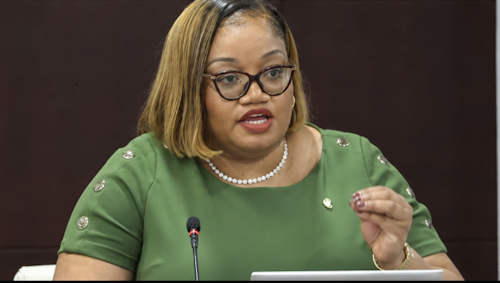 PHILIPSBURG:--- Minister of Finance Marinka Gumbs used Monday’s continuation of the 2026 budget debate to give Parliament a far more revealing picture of government’s finances, acknowledging that millions remain outstanding to vendors, the country’s financial statements remain years behind, government cannot yet provide a complete historical overview of supplier invoices and some significant obligations are not included in the debt figure being presented to Parliament.
At the same time, Gumbs defended the government’s positive financial results by drawing a sharp distinction between a budget surplus and actual cash available to pay bills.
The answers expose one of the central contradictions MPs have been hammering throughout the budget debate: government can report that revenues are outperforming expenditures while businesses that have already provided goods and services are still waiting to be paid.
Gumbs confirmed that the second-quarter 2026 report has been drafted and is under final review. She said she could provide preliminary figures to Parliament before the second round if requested.
But she immediately warned Parliament not to confuse a positive budget result with liquidity.
“Surplus means revenues exceed expenditures, while liquidity is the actual cash available to meet obligations,” Gumbs explained.
Government, she said, can therefore report a surplus while still facing cash constraints because loan repayments and other obligations consume cash even when they do not reduce the reported budget surplus in the same way.
Cg. 39 Million Positive — But Not Cg. 39 Million Sitting in the Bank
MPs repeatedly challenged Gumbs over the first-quarter result, which came in at approximately Cg. 39 million positive, roughly Cg. 36 million better than expected.
The obvious question was: if government performed that well, why are vendors still waiting, why are civil servants still waiting on certain payments, and why could government end the year with only around Cg. 5 million in free cash?
Gumbs said the answer lies in the difference between accounting results and cash.
The government uses revenues to pay salaries, vendor payments, study financing, school subsidies, operational expenses, and interest and loan repayments. She specifically warned that the fourth quarter places particularly heavy pressure on the treasury because COVID-related loans and other principal and interest obligations fall due.
“We cannot look at the cash position in August and assume that all of this money is freely available to spend,” Gumbs said in substance, stressing that Finance must already be accounting for what government must pay in September, October, November and December.
Her explanation may clarify how a surplus and unpaid bills can exist simultaneously, but it also places renewed attention on the size of government’s obligations and how well those obligations are being tracked.
Cg. 12.8 Million in Vendor Payments Registered — But That Is Not Necessarily the Full Picture
When asked for a breakdown of outstanding bills across ministries going back to 2017, Gumbs disclosed that approximately Cg. 12.8 million in outstanding vendor payments is currently registered in the central financial system.
But there is an important qualification: Finance can only report what has actually been registered in that system.
That means the Cg. 12.8 million figure should not automatically be interpreted as the total amount government owes all suppliers.
Earlier in the debate, government had already acknowledged that it did not possess the historical supplier overview MPs were requesting and that ministries themselves initiate payment advice. The system did not maintain the comprehensive record necessary to give Parliament a full year-by-year picture.
Gumbs told Parliament Monday that every ministry should know its own outstanding obligations through its Secretary General and financial controller, while Finance manages the central financial administration and payment process.
She acknowledged, however, that government needs better overall visibility and control of outstanding commitments and invoices.
The Ministry is therefore moving toward mandatory purchase orders and centralized invoice registration.
Her message was blunt: “No P.O., no pay.”
Under the new process, Finance must verify that the expenditure was authorized, the budget existed, and the person committing government had legal authority to do so. Invoices are centrally registered, then sent back to the responsible ministry to confirm that goods or services were actually received before payment can proceed.
Gumbs: Some Bills Are Delayed Because Rules Were Not Followed
The Finance Minister also pushed back against the suggestion that every unpaid invoice proves government lacks money.
She said some payment delays arise because procurement procedures were not followed.
In some cases, invoices arrive without an approved advice, signed contract, purchase order or proof that the official who made the commitment was authorized to commit government financially.
Gumbs said Finance cannot simply pay such invoices without due diligence.
She characterized that as a governance and compliance problem, not automatically a lack-of-money problem.
That distinction matters for vendors because it places some responsibility for delayed payments on individual ministries and officials who may have committed government without completing the required procurement documentation.
At the same time, it also raises a difficult question for suppliers: how many businesses provided goods or services in good faith based on instructions from government officials only to discover afterward that internal government procedures were not properly followed?
Financial Statements Still Years Behind
Gumbs’ answers also confirmed the depth of Sint Maarten’s financial-reporting backlog.
The 2021 financial statement remains the latest financial statement approved by Parliament.
The 2022 statement is being finalized and is expected to reach Parliament in the fourth quarter of 2026.
For 2023, Finance is awaiting SOAB's final report before proceeding to the next approval stage.
The 2024 financial statement has been submitted to SOAB for final review, while work on 2025 is ongoing.
Gumbs’ objective is to complete and submit both the 2024 and 2025 statements to Parliament by the second quarter of 2027.
This produces an uncomfortable accountability reality.
In August 2026, the Government is asking Parliament to approve the 2026 budget, but the latest financial statement Parliament has approved is from 2021.
The Finance Minister maintains that the legally appropriate documents for judging whether a budget was executed properly are precisely those financial statements.
That means Parliament is being asked to judge recent budget performance while the formal accountability chain lags by several years.
2025 Budget Amendment Abandoned
Gumbs also confirmed that the planned 2025 budget amendment never reached Parliament.
She said delays surrounding the 2025 budget made it impossible to complete the amendment before the end of that year.
Once the government entered 2026, it decided to prioritize the 2026 and 2027 budgets to break the recurring cycle of late budgets.
The 2025 annual accounts, she said, will instead show the actual execution and deviations from the approved 2025 budget.
The problem, again, is timing: under the current schedule, those 2025 financial statements are not expected before the second quarter of next year.
Debt-to-GDP: Finance Says 31%, IMF Says 41%
Gumbs also attempted to reconcile conflicting debt-to-GDP figures.
Finance projects government debt at the end of 2026 at approximately Cg. 1.047 billion.
Using an IMF-projected GDP of approximately Cg. 3.341 billion, the Ministry calculates the debt-to-GDP ratio at approximately 31%.
The IMF figure referenced in Parliament is approximately 41%.
According to Gumbs, the difference is primarily in the debt amount used rather than the GDP figure. She said IMF calculations can include projected borrowing that does not ultimately materialize.
As an example, she said the 2025 budget anticipated approximately Cg. 52 million in capital borrowing, while only around Cg. 30 million was ultimately borrowed.
But MPs received another critical piece of information Monday: not every financial obligation is included in the debt calculation being presented.
Pension Obligations and Government Guarantees Not Included
Gumbs confirmed that the government debt figure does not include amounts owed to the pension fund.
Those obligations, she said, are being taken into account in preparation of the 2027 budget.
The figure also excludes government guarantees because guarantees are treated as contingent liabilities and do not become actual government debt unless the guarantee is called.
That means the headline debt figure does not represent every potential claim that could ultimately land on the government’s balance sheet.
A government guarantee may not be debt today, but if the underlying borrower fails and the guarantee is called, the government becomes responsible.
The same applies to pension-related obligations that exist outside the headline debt number.
Political Pensions Paid Directly by Taxpayers
Gumbs also clarified the controversy surrounding pension contributions by ministers and MPs.
She stated that pensions and related allowances for political officeholders are not paid by APS.
They are paid directly from the budget of the Country of Sint Maarten.
Under the current arrangement, political officeholders do not contribute toward those pension benefits.
Gumbs described that situation as unfair, saying beneficiaries of a pension arrangement should contribute toward their entitlement.
She separately rejected the suggestion that reducing Parliament’s travel budget could substitute for those pension contributions.
The pension ordinance, she explained, requires the contribution to come from each individual political officeholder's remuneration. A travel-budget reduction would be an entirely separate budgetary issue.
The Accountability Problem is Bigger than the Surplus
Taken together, Gumbs’ answers reveal a financial picture far more complicated than a headline surplus.
Government can show Cg. 39 million positive on paper while still struggling with liquidity.
At least Cg. 12.8 million in vendor payments is registered as outstanding, but the government cannot yet guarantee it has a complete, centralized historical overview of every unpaid invoice.
The last financial statement Parliament approved is from 2021.
The debt figure excludes pension obligations.
Government guarantees are excluded unless called.
And the very systems intended to give Parliament better insight into outstanding invoices are still being developed.
Gumbs told Parliament she is “encouraged” by the direction Finance is taking but is not satisfied with where matters stand, citing efforts to restore budget discipline, improve tax compliance, modernize tax administration, strengthen procurement and manage debt and liquidity more responsibly.
The real test, however, will be whether the improvements arrive fast enough for Parliament and taxpayers to finally answer some basic questions with certainty:
How much does government actually owe, who is waiting to be paid, what liabilities sit outside the headline debt number, and when will Parliament finally have current audited financial statements with which to hold government accountable?