





~PM tells MP Darryl York St Maarten lacks capacity to safely implement, supervise and enforce cannabis regime; warns commercialization cannot be predetermined outcome.~
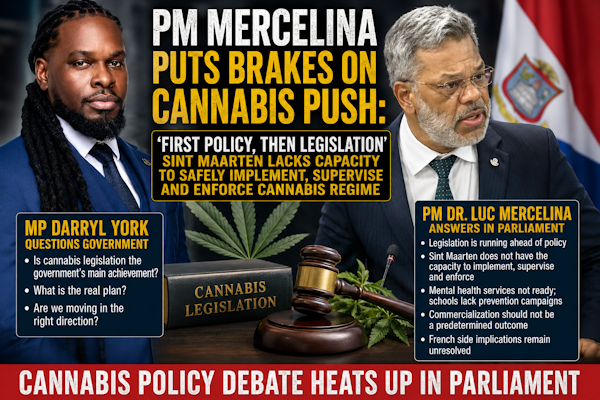 PHILIPSBURG:--- Prime Minister Dr. Luc Mercelina delivered his strongest public warning yet against rushing St Maarten into cannabis legalization and commercialization, telling Parliament that the country has not even settled the fundamental question of what cannabis policy it wants, while legislation is already moving ahead.
Responding Monday to questions from Member of Parliament Darryl York during the continuation of the 2026 budget debate, Mercelina said his concerns are rooted in public health, mental-health capacity, protecting young people, enforcement, legal uncertainty, and St Maarten's unique open-border situation with French Saint-Martin.
The parliamentary meeting continued deliberations on the draft National Ordinance establishing Sint Maarten's 2026 budget.
York put the issue directly to the Prime Minister, asking whether Mercelina would be satisfied if, by the end of the government's term, one of its principal achievements turned out to be cannabis legislation.
Mercelina's response effectively challenged the initiative's direction and pace.
“For me, in my capacity as Prime Minister, the issue is not whether cannabis legislation should become an achievement of this government,” Mercelina said. Instead, he said the government's responsibility is to ensure that any reform is “responsible, workable and in the interest of the people of St. Martin.”
Mental health concerns take center stage
Mercelina pointed Parliament to information attributed to the Mental Health Foundation, saying cannabis plays a significant role among clients admitted to the institution and that there are indications of an association with recurrent psychosis.
He further said there is currently no structured outpatient treatment network for cannabis dependence and no structural prevention and public-awareness programme specifically addressing cannabis use.
Young people, he stressed, are particularly vulnerable.
That does not mean Mercelina is rejecting regulation altogether.
The Prime Minister acknowledged that regulation could produce benefits, including improved product control, reduced criminalization and potentially greater control over the illegal market.
But, he warned, those benefits do not materialize simply because Parliament passes legislation. A regulated system would require effective supervision, controls on THC levels, protections for young people, limits on commercialization and continuous evaluation.
His conclusion was unmistakable: he will not judge his government's success by whether cannabis is commercialized before its term ends.
If responsible implementation requires more time, Mercelina said, the government should take it rather than rush legislation merely to claim a political accomplishment before the end of the term.
“The legislation is running ahead” of policy
The most consequential part of Mercelina's response came when he addressed the sequence in which the cannabis initiative is being pursued.
The Prime Minister said two principles underpin his position.
First, legislation must not move ahead of the fundamental policy decision determining what cannabis policy Sint Maarten actually wants.
Second, legislation must not move ahead of the country's ability to implement, supervise and enforce whatever system it ultimately chooses.
Mercelina then made a striking assessment of the present process:
“The legislation is running ahead of the fundamental policy decision.”
According to the Prime Minister, Sint Maarten has not yet answered what kind of cannabis policy it wants, yet legislation is already being developed. He said the process should occur in the opposite order: policy first, legislation afterward.
Even more significant was Mercelina's assessment of the government's present capacity.
He told Parliament that Sint Maarten must have the institutional capacity to implement, supervise and enforce a cannabis regime — and said the country does not have that capacity at this moment.
That declaration raises serious questions about how far the existing cannabis initiative should proceed before those deficiencies are addressed.
Commercial cannabis should not be assumed
Mercelina also challenged what appears to be an underlying assumption that cannabis reform must eventually produce a commercial cannabis industry.
He outlined several possible policy paths.
Sint Maarten could maintain prohibition while strengthening prevention and enforcement. Government could pursue medical cannabis only. It could establish a limited controlled model or pilot programme. Alternatively, it could eventually pursue a broader regulated framework.
But Mercelina said government should not begin with the assumption that a commercial cannabis market must ultimately be the objective.
He went further, telling Parliament that he feels commercialization is currently being treated that way.
If that is indeed the case, Mercelina warned, it could become a “very, very difficult and dangerous development for St. Martin.”
Drawing attention to his medical background, the Prime Minister said he knows what cannabis can do to young people, particularly when it is not properly regulated.
The remarks are especially significant because the Cannabis Legislative Inter-Ministerial Work Group has publicly described its mandate as including drafting cannabis legislation, developing licensing structures and designing economic, health and trade policies. Sint Maarten also held a national cannabis regulation symposium earlier this month as it evaluates a comprehensive regulatory framework.
Legalization, regulation and commercialization are not the same
Mercelina also sought to disentangle terminology that has frequently been used interchangeably in the cannabis debate.
He said legalization, regulation, commercialization, and policy are separate questions.
Legislation determines which currently prohibited cannabis-related activities the government wishes to permit, who may undertake them, and under what conditions.
Regulation establishes the rules governing permitted activities, including licensing, age restrictions, product standards, supervision and enforcement.
Commercialization, however, is another policy decision entirely: whether businesses will be permitted to produce, process, distribute and sell cannabis commercially.
Therefore, Mercelina argued, government should not begin by asking how a commercial cannabis market should be regulated. It must first decide what cannabis policy Sint Maarten actually wants.
Commercialization, he stressed, “should not be treated as a predetermined outcome.”
Schools, prevention and treatment are not ready
Mercelina returned repeatedly to the consequences for young people.
According to his presentation, the Mental Health Foundation has raised concerns about normalization of cannabis use, dependency and mental-health consequences, particularly among youth.
He also said the Mental Health Foundation and Turning Point are presently not adequately equipped to absorb a possible increase in demand for care.
Moreover, according to Mercelina, educational campaigns have not yet begun, particularly in schools.
For Mercelina, simply placing a minimum age in legislation would therefore be insufficient.
A responsible system would require prevention and education, accessible addiction and mental-health services, trained professionals, programmes specifically targeting youth and vulnerable groups, and the capacity to monitor the consequences of any policy change.
Government, he argued, should not expand legal access first and only afterward attempt to build the public-health infrastructure necessary to deal with the consequences.
Major legal questions remain unresolved
The Prime Minister also identified substantial legal work that must be completed.
If activities envisioned under a future cannabis system are presently prohibited under the Opium National Ordinance, the government must establish exactly what it intends to legalize, what remains prohibited and punishable, who qualifies for exceptions and the legal basis for those exceptions.
Mercelina said the relationship between the proposed Cannabis National Ordinance, the Opium National Ordinance and other relevant legislation must therefore be legally resolved.
“This is not merely a technical drafting issue,” was the thrust of his response: government must have legal certainty about what becomes lawful, what remains unlawful and under what conditions.
International treaty obligations are another unresolved matter.
Mercelina said government must establish which international drug-control treaties apply to Sint Maarten, what obligations arise from them and how much legal room remains for the various policy models being considered.
That analysis, he said, must distinguish medical and scientific cannabis from recreational and commercial activity.
Who will actually police the cannabis industry?
Mercelina then posed the practical questions the government will face once legislation moves from paper to reality.
Who issues licenses? Who supervises license holders? Who inspects cultivation and production facilities? Who inspects retail outlets? Who tests cannabis products for THC levels and contaminants? Who manages tracking and tracing? And who intervenes when operators violate the rules?
Those responsibilities require personnel, expertise, financing, inspection capacity, and effective coordination between government institutions — resources Mercelina indicated Sint Maarten presently cannot simply assume it has.
French border creates another complication
Then came an issue unique to Sint Maarten: the border.
Mercelina reminded Parliament that Sint Maarten shares an island and an open border with French Saint-Martin while operating under two different legal jurisdictions.
Cannabis policy, he said, therefore cannot be developed exclusively from the Dutch-side perspective.
Government must determine the applicable cannabis laws on the French side, how cannabis offenses are enforced there and what practical consequences could arise if two substantially different cannabis regimes operate on one small island.
Authorities must also examine whether additional cross-border arrangements would be required for enforcement, supervision and information sharing.
Mercelina lays down conditions before moving forward
By the end of his extensive answer to York, the Prime Minister had effectively established a series of conditions that he believes should precede implementation.
Government must first determine the cannabis policy Sint Maarten actually wants and what that policy is supposed to achieve. It must then determine which cannabis activities will become legal and which will remain prohibited, while resolving domestic-law and international-treaty questions. Public-health and youth safeguards must be strengthened, institutional and enforcement capacity must be established, and experts and implementing authorities must be properly consulted.
The significance of Monday's exchange therefore extends far beyond whether Mercelina personally supports or opposes cannabis.
The Prime Minister has publicly questioned whether the sequence itself is backward.
While a legislative process is advancing, Mercelina told Parliament that the underlying national policy has not been settled first. While commercialization is being discussed, he says it must not be predetermined. While regulation is contemplated, he says Sint Maarten presently lacks the capacity to implement, supervise and enforce such a system.
And while cannabis reform could potentially become one of this government's headline accomplishments, Mercelina told York that simply getting legislation passed will not be his measure of success.
For the Prime Minister, the test is whether Sint Maarten can do it responsibly.
If it cannot, his message to Parliament was clear: do not rush it.