





~Former Finance Minister challenges government on revenue collection, fuel relief, procurement and public spending; proposes redirecting travel money to Sint Maarten Day, public schools and NSI~
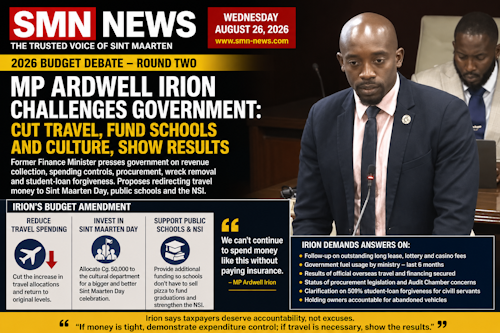 PHILIPSBURG:--- Member of Parliament and former Finance Minister Ardwell Irion delivered a broad financial challenge to government during the second round of the 2026 budget debate Wednesday, accusing the administration of increasing travel while residents face economic pressure and questioning whether government has continued revenue-collection and expenditure-control measures established under the former administration.
Irion coupled his criticism with a budget amendment of his own: reduce increased travel allocations and redirect money toward St Maarten Day celebrations, struggling public schools and the NSI.
Unlike MP Francisco Lacroes, the portion of Wednesday's debate provided to SMN News shows Irion presenting a budget amendment rather than separate motions. His intervention, however, contained a wide range of policy demands and requests for government action.
Irion Challenges Finance Minister: Former Government Did Raise Revenue
Irion began by responding to comments from the Minister of Finance concerning revenue-generating measures.
He rejected any suggestion that the former administration had failed to pursue additional government income.
According to Irion, the former government pursued collection of outstanding long-lease revenue and increased collections substantially, at one point reaching approximately Caribbean Guilders 8 million during the COVID period.
He also pointed to work on outstanding lottery fees and casino fees and asked whether the current administration has continued those collection projects.
Irion stressed that those measures were pursued during COVID-19, when Sint Maarten faced an extraordinary collapse in tourism.
His message to the government was that fiscal hardship cannot be used as an excuse for failing to pursue revenue.
Where Are Government's Spending Controls?
Irion then shifted from raising revenue to controlling expenditure.
He said the previous administration reduced telephone expenses and introduced tighter controls over government fuel consumption.
According to Irion, physical gasoline books were replaced by cards that made it possible to track fuel usage, identify spending by ministry and detect potential abuse.
He therefore asked whether the current Council of Ministers still receives and reviews that information, and requested the last six months of government fuel usage, broken down by ministry.
That led directly into one of his strongest attacks: government travel.
Irion argued that while the population is dealing with financial pressures, government has increased travel rather than tightening its belt.
He made an exception for ECYS in his remarks but accused the other ministries generally of increasing travel expenditures.
"Where Are the Results?"
Irion also challenged the value of official travel.
He said he personally does not travel to Parliament Hill because he does not believe taxpayers should be financing such trips while significant work remains unfinished at home.
His argument was not that government officials should never travel, but that overseas missions should produce identifiable results in policies, financing or projects.
Irion contrasted the present situation with travel under the former administration, which he claimed produced tangible outcomes and substantial external financial support for Sint Maarten.
That argument became the foundation of his budget amendment.
Caribbean Guilders 50,000 for Sint Maarten Day
Irion proposed reducing the increase in travel spending and returning travel allocations closer to their original level.
From those savings, he wants Caribbean Guilders 50,000 allocated toward Sint Maarten Day.
He argued that politicians frequently speak about national pride and complain that Sint Maarten's national and cultural celebrations do not receive the prominence afforded to celebrations elsewhere.
His response was simple: fund it.
"Let's put our money where our mouth is," Irion told Parliament.
With roughly three months before Sint Maarten Day, he argued that the money could be transferred to the cultural department to allow preparations for a larger celebration.
Public Schools Shouldn't Have to Sell Pizza
A second portion of Irion's amendment targets public schools.
The MP said it is "sad" and "embarrassing" that public schools must resort to activities such as selling pizza to raise money for basic graduation expenses.
He specifically referred to costs for graduation venues, gowns, sashes and caps.
Irion questioned why government-run schools should have to operate like private fundraising organizations to provide students with basic school activities.
His amendment therefore allocates additional money to public schools, while he urged ECYS to ensure that the payment process is sufficiently efficient for schools to actually receive and use the funds.
NSI Also Included
A third portion of the amendment would provide additional support to the NSI, which Irion described as short-staffed administratively because a key employee is currently unavailable.
The money, he said, should help the institution execute its responsibilities during the remaining months of the year.
Questions Over Student-Loan Forgiveness
Irion also demanded clarity from Prime Minister Dr. Luc Mercelina concerning the promised 50% student-loan forgiveness for qualifying civil servants.
He said civil servants continue asking questions because they do not have clear answers about how the measure is being implemented.
Irion specifically raised reports that certain applicants had received negative advice because they were not born on the Dutch side of Sint Maarten despite holding Dutch nationality and passports.
He stressed that this was information brought to his attention and asked the Prime Minister to clarify the eligibility rules rather than presenting the allegation as an established government policy.
Irion Questions Government Over Procurement
Irion also turned his attention to VROMI and procurement.
He questioned the status of procurement legislation and asked whether the General Audit Chamber had raised concerns with government about VROMI's procurement practices.
Irion argued that procurement had been a major political issue before the present administration took office and questioned why, nearly two years later, comprehensive procurement legislation had not been completed.
He also asked government to provide the relevant Audit Chamber correspondence and requested the Council of Ministers' position on the issues he said were raised. These were questions and assertions made by Irion during the debate; the transcript provided does not contain the government's subsequent answers to those questions.
Roadside Wrecks: Irion Wants Owners Held Accountable
Interestingly, Irion and Lacroes converged on one major issue: government should not continually spend taxpayers' money cleaning up abandoned vehicles without holding owners responsible.
Irion called for better cooperation between VROMI and Justice to identify vehicles, record license-plate information and establish the data necessary to hold people accountable.
He compared the issue to motorists damaging public infrastructure and argued that where insurance exists, government should pursue those responsible instead of automatically paying for repairs from the public purse.
"We can't continue to spend money like this without paying insurance," he argued.
Business Licenses and Mechanic Shops Also Targeted
Irion took the issue another step by questioning coordination between TEATT and VROMI when business licenses are issued.
He argued that Sint Maarten cannot grant a business license for a mechanic operation without first determining whether the location has the necessary VROMI approvals, only to later complain when vehicles accumulate along public roads.
For Irion, that represents the government creating a problem through one ministry and then asking another ministry to solve it.
He called for the relevant permits and spatial-planning requirements to be checked as part of a coordinated process before allowing such businesses to operate.
Taken together, Irion's intervention amounted to a challenge to government's financial priorities: if money is tight, demonstrate expenditure control; if travel is necessary, demonstrate its results; if schools are fundraising for basic needs, reconsider the allocation of public money; and if government says revenue is needed, aggressively collect money already legally owed to the country.
His budget amendment attempts to translate that argument into actual reallocations — taking money away from increased travel and directing it toward St Maarten Day, public education and NSI — while his broader questioning puts government on notice that Parliament wants evidence of where money is being collected, where it is being spent and what the country is receiving in return.