





~Tackling refuses to discuss Heyliger individually but says no former office, political influence, or prominent name can determine release; declares corruption an “attack on the people of St Maarten”~
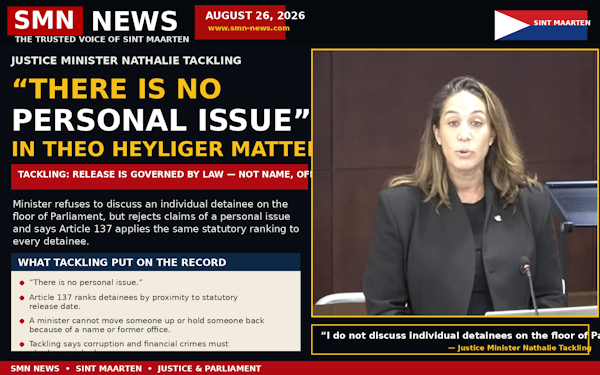 PHILIPSBURG:--- Minister of Justice Nathalie Tackling delivered one of her strongest statements yet on the politically sensitive debate surrounding former politician Theo Heyliger, rejecting suggestions that either she or the Public Prosecutor’s Office has a personal issue influencing the handling of a detainee while making clear that she would not discuss Heyliger’s individual circumstances on the floor of Parliament.
The issue surfaced during Tackling’s answers to questions from MP Viren Kotai about detention capacity, the execution of sentences, early release, and whether a personal issue involving the authorities and Heyliger.
Rather than discuss Heyliger’s individual detention situation, Tackling drew a firm line.
“The Member of Parliament has named a person, but I'm not going to follow him there,” Tackling told Parliament. “I do not discuss individual detainees on the floor of Parliament, and I do not make an exception because a name is said out loud on the floor of Parliament.”
But Tackling did answer the underlying allegation directly.
“There is no personal issue,” she said, explaining that the system governing release is established by law rather than by the personal preference of a minister or prosecutor.
Tackling: Name and Former Office Cannot Determine Release
Tackling said Article 137 establishes a ranking mechanism based on how close a detainee is, proportionally, to his or her statutory release date.
According to the minister, all detainees are measured against the same reference date and percentage, including persons serving sentences outside Sint Maarten.
She stressed that the calculation does not include a mechanism allowing authorities to consider the prisoner's identity, former political office, conviction, supporters, or opponents.
“There is no field in that calculation for the name of the inmates, nor for the office that that person once held, for what they were convicted of, for who speaks on their behalf, or for who would prefer that they were to remain there,” Tackling stated.
She went further, saying a Justice Minister could neither manipulate the mechanism to keep a particular individual incarcerated nor use it to move a favored person out.
“A minister who wished to keep a particular person in a cell could not do it through this article. A minister who wished to move one out could not do it either,” Tackling said.
That was Tackling's clearest response to the suggestion raised around Heyliger: she says the statutory process does not give her discretion to single him out, either negatively or positively.
Tackling pushes back on debate over white-collar prisoners
However, Tackling did considerably more than deny a personal issue.
Before addressing Kotai's individual questions, she confronted the broader argument that persons convicted of financial and integrity crimes are occupying scarce cells that could otherwise be used for violent offenders.
Tackling said that position has sometimes been presented as though it resulted from a decision she made.
“It does not,” she declared.
According to Tackling, the Public Prosecutor's Office is responsible for executing criminal judgments. She referred Parliament to the Prosecutor's 2024 annual report, saying it contains a published position that prison capacity should be available not only for people convicted of violent offenses but also for public officials and civil servants who misuse public funds or exploit their positions for personal enrichment.
Tackling insisted this was not a policy decision she made and asked MPs not to present it to Parliament or the public as one.
“The position is on the record, and its author is identifiable,” she said.
But Tackling then makes her own position crystal clear
While separating herself from the Prosecutor's policy decision, Tackling then offered her personal position — and it was equally forceful.
She rejected the proposition that financial and integrity offenses should somehow be regarded as a lesser category simply because no victim was physically attacked.
Tackling told Parliament that when a public official takes money belonging to the country, the damage extends far beyond financial statements.
“It is a school roof that we did not repair. It is a road that we did not fix. It is a police force that we could not staff, and a prison we could not build,” Tackling said.
She connected corruption directly to ordinary residents, arguing that every guilder taken was money the country had already intended to spend on its population.
She also argued that the damage includes the destruction of public trust, describing that trust as essential to a small country and warning that Sint Maarten continues to live with the consequences of money taken years earlier.
“Everybody that receives a prison sentence should spend time in Jail”
The issue returned later when MP Ardwell Irion asked Tackling whether she sees a difference in the threat posed by white-collar offenders and violent criminals.
Tackling's answer removed any doubt about her philosophy.
“At the end of the day, I think that everybody that receives a prison sentence should spend time in jail,” she said.
She said she does not treat white-collar crime as inherently different from other criminal offenses for purposes of whether punishment should be executed.
“To me, they're all criminal offenses, whether you did somebody bodily harm or you did the country harm,” Tackling said.
She then made perhaps her strongest political statement of the exchange:
“This country is suffering because of the corruption that has occurred over the past years. And that to me is also an attack on the people of St. Martin.”
Tackling said such offenses should therefore be punished accordingly and that detention-capacity discussions must consider the damage crimes cause to the country, not simply whether physical violence was involved.
No Special Treatment — Either Way
Tackling's remarks are significant because the Heyliger question was raised within a much larger political debate about Sint Maarten's severe detention-capacity constraints and which convicted persons ultimately occupy those scarce cells.
The minister acknowledged unequivocally that Sint Maarten has a cell shortage. She said the shortage has existed for more than 15 years and pointed to the new Pointe Blanche prison project, officer recruitment and training, and housing sentenced persons abroad as measures being used instead of simply releasing inmates early.
But she rejected any suggestion that limited capacity means prominent white-collar offenders should automatically make way for violent offenders.
Under Article 137, she said, the relevant ranking does not ask whether an offense was violent or financial, whether the case appeared on the front page, whether the prisoner is well-connected or whether anyone is advocating for that person's release.
“No one is moved up that list, and no one is held back on it,” Tackling declared, adding that this cannot happen because of a person's name, former office, or those speaking on their behalf.
Tackling Says Court Review Is Available
The minister also pointed to judicial safeguards.
According to Tackling, Article 139 allows a sentenced person to lodge a reasoned objection within 14 days against a decision or the absence of one. She emphasized that the court is independent of her ministry.
“The framework does not rest on my good faith,” Tackling told Parliament. “It does not require the honorable member to take my word for anything.”
Instead, she described it as a statutory ranking applied at the same percentage and subject to judicial review.
Minister Confirms 55 Percent was used in July 2025
Tackling also made another important disclosure during the wider discussion.
Asked whether government had previously gone as low as 58 or 56 percent of a sentence in applying early release, Tackling said she checked documents and confirmed that 55 percent was applied at the end of July 2025.
That admission is particularly relevant to the continuing debate over Article 137 and prison capacity because Tackling simultaneously maintained that using the provision is discretionary rather than automatic.
She described early release as a “relief valve” to be used as a last option, saying the government is working to avoid relying on it by increasing detention capacity.
Political question answered — But debate far from over
Kotai did not pursue the Heyliger issue further after Tackling's response. When given an opportunity for clarification, he told Parliament that the minister had made her position “very clear to me” and thanked her for her answers.
What Tackling placed on the parliamentary record is therefore unambiguous in two respects.
She denied that there is a personal issue involving the authorities and the detainee named by Kotai, while refusing to discuss Theo Heyliger's individual detention circumstances publicly.
At the same time, she made equally clear that she rejects the premise that corruption and financial crimes should receive lesser consideration simply because they are non-violent.
For Tackling, corruption can damage an entire country — its schools, roads, police, prison system, public finances and ultimately the trust citizens place in government.
And despite Sint Maarten's shortage of detention capacity, her stated position is that punishment cannot depend upon who someone is, what office that person once occupied, who argues for that person, or how politically sensitive the name may be.