





~De Weever’s motion sought the complete agreement signed by former VSA Minister Omar Ottley, the legal basis for alleged exclusivity and St Maarten’s potential financial exposure—but it was defeated 8–7.~
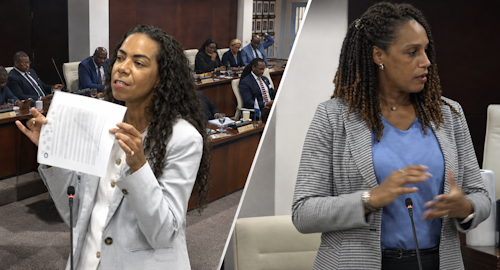 PHILIPSBURG:--- A deeply emotional intervention by MP Francisco Lacroes brought Parliament’s cannabis debate to a standstill Thursday as he publicly revealed that he was raised by a father addicted to drugs, witnessed his mother suffer and experienced abuse that shaped his decision never to smoke or consume alcohol.
But behind the emotion was a serious unanswered question: What exactly did the former government sign with Native Nations Cannabis SXM, what rights were promised to the company, and what could those commitments eventually cost St Maarten?
MP Ludmila de Weever tried to force those answers into the open with a detailed motion requesting the full cannabis agreement and all related documents.
The motion was defeated by eight votes against and seven in favor.
That vote means Parliament rejected a formal six-week deadline for government to disclose the documents or provide a written legal justification for anything withheld.
The motion was not seeking to stop cannabis legalization. It sought information about decisions reportedly made before Parliament passed any cannabis legislation.
What was signed—and under what authority?
De Weever’s motion placed several potentially far-reaching questions before Parliament.
It stated that the government initiated a cannabis Request for Proposal in 2022 and that Native Nations Cannabis SXM represented that it was selected as the preferred bidder and received a formal mandate agreement in April 2024.
Public representations, according to the motion, have referred to an exclusive preparatory right to import cannabis for distribution, as well as contemplated multi-year rights involving cultivation, production, processing, testing, distribution and sale.
The motion therefore sought to establish whether Native Nations were granted or promised any exclusive rights during the preparatory phase and whether they obtained, or were promised, a 10-year exclusive or preferential position once cannabis legislation is enacted.
It also sought answers on one of the most constitutionally important questions raised during the debate: Could a minister or the Council of Ministers legally promise commercial or concession rights connected to cannabis before Parliament enacted the legislation necessary to create the regulated industry?
De Weever wanted government to produce:
- The complete 2022 Request for Proposal and terms of reference.
- Native Nations’ proposal and the evaluation and award documents.
- The Council of Ministers’ authorization.
- The complete April 2024 agreement and all annexes, amendments, side letters and schedules.
- The legal authority relied upon to grant or promise any exclusive or preferential rights.
- All legal opinions concerning the government’s authority to enter the agreement before cannabis legislation was enacted.
- Valuations, financial models, revenue projections and feasibility studies relating to the reported 10-year arrangement.
- All termination, compensation, reimbursement, damages and liability provisions.
- The maximum known or reasonably estimated financial exposure to Sint Maarten if the government does not proceed or if Parliament rejects or changes the required legislation.
This was not a casual request for general information.
It was an attempt to establish whether an outgoing administration committed Sint Maarten to a potentially valuable commercial arrangement before Parliament had created the legal framework governing the industry.
De Weever: “This is merely a request for information”
De Weever strongly rejected attempts to portray her motion as an effort to derail cannabis regulation.
“This motion is not a request for stopping our trajectory of legalization,” she told Parliament.
She said Parliament is entitled to the information because MPs are responsible for scrutinizing government, protecting public finances and determining whether government had the legal authority to pre-commit the country.
De Weever said the information available to her indicated that exclusivity had been given in relation to Native Nations, but she stressed that she had not seen the contract and wanted the complete record before drawing conclusions.
She questioned whether government had committed the country to a 10-year arrangement and whether the same company involved in researching and developing the regulatory framework would later receive exclusive commercial rights once the legislation is passed.
Her concern was straightforward: if commercial rights were promised before Parliament enacted the law, then government may have effectively made decisions belonging to Parliament before MPs were allowed to perform their constitutional role.
De Weever also raised the possibility of financial consequences if the cannabis initiative is stopped or cannot legally proceed.
“That financial consequence—that is what I am after,” she said.
She further questioned why the reported long-term commitment was not disclosed in the national budget among contracts or obligations with potential future financial consequences.
TEATT Minister asks Parliament to wait
TEATT Minister Grisha Heyliger-Marten recommended that Parliament reject the motion in its existing form.
She said her position was not a refusal to provide information, but that the requested documents involved legal, contractual, procurement and potentially confidential matters requiring proper review.
The minister said she had requested legal advice on the agreement’s confidentiality provisions. She warned that government had to avoid breaching confidentiality or exposing the country to legal liability.
Heyliger-Marten committed to updating Parliament once it received legal advice, either in writing or during a closed-door meeting.
However, the motion already recognized the possibility that some information could be legally protected. It allowed government to provide a written legal basis for withholding particular material while still disclosing all portions that could lawfully be released.
The question Parliament must now confront is why the motion had to be defeated when it already provided a route to respect legitimate confidentiality concerns.
Ottley: “I was the one who signed the contract”
Former VSA Minister and current MP Omar Ottley removed any uncertainty over who signed the agreement.
“I was the one who signed the contract. It’s not a secret,” Ottley declared.
Ottley said he continues to support cannabis regulation and insisted that the proposal process was handled openly. According to him, the original requests involved a 30-year period, but the Council of Ministers determined that the country should not be tied to such a long arrangement.
He said the top three companies were asked to accept a reduced period and that Native Nations was the only company willing to do so, given the investment it intended to make.
Ottley maintained that the agreement does not override Parliament. He said the relevant rights cannot take effect unless Parliament approves the required legislation.
He also said the agreement contains confidentiality provisions, although he disputed suggestions that there was a separate non-disclosure agreement.
Ottley further claimed government can terminate the agreement with probable cause without financial obligation.
Those statements are important—but they are also exactly why Parliament should see the contract.
If there is no improper commitment, if Parliament’s legislative authority is fully protected, and if Sint Maarten faces no financial liability under the termination provisions Ottley described, disclosure through the appropriate confidential parliamentary procedure should confirm it.
Parliament should not be required to accept oral assurances about a potentially valuable 10-year commercial arrangement when the signed agreement exists.
Lacroes’ Painful Revelation
The debate then took a deeply personal turn when MP Francisco Lacroes spoke publicly about the effect of drug addiction on his childhood.
Lacroes said he was raised by a man addicted to drugs.
“Growing up, it wasn’t easy,” he told Parliament.
He said he watched his mother suffer and that the family experienced abuse “in ways that you could not imagine.”
According to Lacroes, his father warned him never to follow the same path and told him to ask people addicted to crack cocaine what drug they first used and whether they believed, when they started, that their lives would end that way.
Lacroes said the answers he encountered were consistently marijuana and that none believed they would eventually become seriously addicted.
Because of what he witnessed, Lacroes said he chose never to smoke or drink.
“I’m 50 years old. I chose never to smoke. I chose never to drink. Marijuana, cigarettes, alcohol have never touched my lips because of that experience,” he said.
His testimony brought an important human dimension to a debate that had largely focused on contracts, legislation and commercial rights.
Lacroes nevertheless acknowledged that cannabis may have a different meaning today, particularly as governments worldwide examine regulation and medicinal use. He also recognized that attempting to stop something already present in society may no longer be practical.
His objection was primarily procedural. He believed Parliament should first have discussed the agreement thoroughly behind closed doors before the issue reached the floor through a motion.
Lacroes said he would instruct his faction staff to request a meeting with the minister so MPs could receive the relevant information and determine whether the arrangement should proceed, be canceled, or be subject to further public scrutiny.
The motion did not seek to legalize cannabis
One of the most troubling aspects of the debate was the repeated movement away from the actual purpose of De Weever’s motion.
The motion did not ask Parliament to legalize cannabis.
It did not ask Parliament to reject legalization.
It did not order government to cancel the Native Nations agreement.
It asked for information.
Parliament was being asked to examine the RFP, the award process, the agreement, the alleged exclusivity, the government’s legal authority, the value of the rights involved, and the country’s potential exposure.
Those are ordinary oversight responsibilities—especially when a commercial arrangement may depend on legislation Parliament has not yet enacted.
MP Sjamira Roseburg correctly emphasized that the motion was not aimed at undoing or interfering with the agreement. She said it sought information Parliament had never been given the opportunity to scrutinize when the decisions were made.
Roseburg also noted that the motion accommodated legitimate sensitivity by allowing information to be provided through confidential procedures.
Eight MPs vote against disclosure deadline
Despite those safeguards, the motion failed 8–7.
Government may still provide the documents voluntarily or through a closed-door meeting, as the TEATT minister promised. But Parliament rejected the only measure that would have imposed a clear deadline and required a written legal explanation for material withheld.
That leaves the public with more questions than answers.
What exactly did Omar Ottley sign in April 2024?
What exclusive or preferential rights, if any, were promised to Native Nations?
When do those rights become effective?
Were they independently valued?
What does Sint Maarten receive in return?
Could Parliament reject or substantially amend the cannabis legislation without exposing the country to a claim?
And why should Parliament have to fight for answers concerning an agreement whose implementation ultimately depends upon legislation Parliament alone must debate and approve?
Lacroes’ testimony showed why cannabis policy must be approached with seriousness, compassion and an understanding of the damage drug abuse can inflict on families.
De Weever’s motion showed why the commercial and legal arrangements surrounding that policy must also face uncompromising scrutiny.
Cannabis legislation may eventually come before Parliament.
Before MPs vote on it, they must know whether the road has already been commercially mapped out, whether one company has been placed at the front of that road, and whether Sint Maarten has been financially committed before its elected Parliament was ever asked for permission.