






~Faction leader absent from parliamentary-year closing; MP Ludmila de Weever present but silent as other factions addressed the country.~
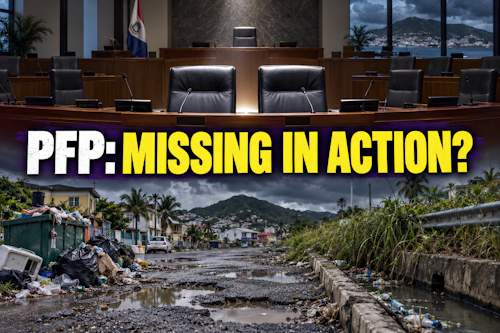 PHILIPSBURG:--- The Party for Progress entered Parliament in 2020 promising integrity, accountability, transparency and a new standard of political representation. Six years later, the party appears to be slipping into political dormancy—silent at a moment when the ministry placed under its political responsibility is facing some of the harshest public criticism in the country.
At the closing of the parliamentary year, PFP faction leader MP Raeyhon Peterson was not in attendance. The party’s other representative, MP Ludmila de Weever, was present but delivered no presentation to Parliament or the people of St Maarten.
While the NOW, Democratic Party, URSM, United People’s Party and National Alliance factions addressed the country, the PFP faction offered nothing. The Chair of Parliament also delivered remarks.
For a political party that once demanded explanations from everyone else, its failure to explain its own parliamentary performance speaks volumes.
Where Was the Party for Progress?
The closing of a parliamentary year is an opportunity for each faction to account for its work, identify its priorities and tell the public what it intends to accomplish during the next legislative period.
PFP apparently had nothing to report.
Peterson, as faction leader, was absent. De Weever occupied her seat but did not use the occasion to present the faction’s record, defend its performance or outline its agenda.
That silence is more troubling given information from some Members of Parliament alleging that the PFP faction regularly fails to attend meetings and contributes little to parliamentary activities.
SMN News has not independently verified the faction’s complete attendance record, and Parliament should publish the official attendance figures for every MP. However, the concerns cannot be ignored when the party was conspicuously silent at the formal closing of Parliament.
Public service is not measured by collecting a salary, occupying a seat, or appearing only when a vote becomes politically uncomfortable. MPs are elected to attend meetings, scrutinize government, draft legislation, represent citizens and provide leadership.
Six Years in Parliament—Where is the Legislation?
PFP first entered Parliament following the January 2020 election with two seats. Its original parliamentary representatives, Melissa Gumbs and Raeyhon Peterson, spent their first four-year mandate in opposition, criticizing the former government and presenting themselves as the guardians of good governance.
The party submitted motions, issued statements, opposed government decisions and produced policy positions. In April 2020, its MPs submitted a motion proposing a 15 per cent reduction in the salaries of ministers and parliamentarians. In 2021, the faction successfully championed a motion of disapproval against then-VROMI Minister Egbert Doran. It later prepared proposals and amendments concerning the controversial COHO legislation.
Those actions are part of the public record and should not be erased.
However, a motion is not a law. A press release is not a law. A position paper is not a law.
Despite PFP’s years in Parliament, SMN News could not locate a publicly documented PFP initiative national ordinance that completed the legislative process and became law. If such legislation exists, the party should identify it and show the country what six years of parliamentary representation produced.
Other MPs are now bringing initiative legislation to Parliament. MP Omar Ottley has presented draft legislation on admission and expulsion, while MP Darryl York has announced initiative laws on roads and succession land.
What is PFP’s legislative contribution?
After six years, the country deserves more than speeches about integrity and criticism of other politicians.
Opposition was easy—Governing is the test
PFP’s real test began when it moved from opposition into government.
Following the August 2024 election, PFP joined the governing coalition and retained two parliamentary seats, represented by Peterson and De Weever. The party also obtained responsibility for two important ministries through Minister of Education, Culture, Youth and Sport Melissa Gumbs and Minister of VROMI Patrice Gumbs Jr.
PFP can no longer behave as though the problems of government belong exclusively to someone else.
VROMI is politically tied to PFP, and Sint Maarten’s worsening garbage, road, drainage, permitting and general-maintenance problems are now part of PFP’s governing record.
The party that previously attacked ministers over accountability must answer for its own minister.
The party that demanded transparency must explain failed and delayed procurement processes.
The party that criticized previous governments over roads, cleanliness, and infrastructure must explain why residents, businesses, and even politicians describe the country as in its dirtiest and most neglected condition.
The Country is dirty—and the excuses are exhausted
Criticism of VROMI no longer comes from only one political faction.
Residents complain daily about garbage, overgrown public spaces, neglected roads, abandoned vehicles, clogged drains and deteriorating infrastructure. Parliament’s 2026 budget debate exposed widespread dissatisfaction with the ministry’s performance.
On August 27, Parliament approved a motion of disapproval against Minister Patrice Gumbs by a vote of nine to six. The motion cited continuing concerns about the country’s cleanliness, delayed building permits, roads, waste collection, abandoned vehicles and infrastructure.
Even PFP MP De Weever supported that motion.
She said the motion should serve as a warning and an opportunity for improvement. She also rejected the familiar excuse that nothing had been done in the past, arguing that the present government was elected to improve the situation.
De Weever was correct.
But voting for a warning is only the beginning. What has PFP done since issuing that warning to its own minister? What consequences followed? What deadlines were imposed? What corrective action was demanded?
If nothing changes, then the motion becomes another piece of paper, and PFP’s vote becomes political theatre.
Integrity cannot be a campaign costume
Integrity is not a slogan that a party wears during an election and removes after joining a coalition.
Accountability cannot apply only to political opponents. Transparency cannot disappear when questions reach a party’s own minister. Parliamentary participation cannot become optional once it has secured government positions.
PFP built its reputation by telling the country it was different. It presented itself as a younger, better-prepared and more principled alternative to traditional politics.
Today, the public must judge the party by its actions.
Where is the legislation?
Where is the visible parliamentary leadership?
Where is the faction’s public accounting?
Where is the aggressive oversight of VROMI?
Where is the progress?
De Weever’s vote is not enough
MP De Weever deserves acknowledgment for breaking with the majority and supporting the motion of disapproval against Minister Gumbs. She also voted against the 2026 budget and publicly questioned why promised changes were not materializing.
Those actions show that she recognizes the government’s performance problems.
However, appearing for votes while remaining silent at the closing of Parliament is not enough. If De Weever believes that PFP’s ministers or coalition partners are failing, she must speak clearly and consistently.
As faction leader, Peterson has an even greater responsibility. His absence from the parliamentary closing left the faction without a voice and deprived the public of an account of PFP’s work.
PFP must decide what it is
PFP now faces a political identity crisis.
Is it the integrity party that once demanded accountability, or has it become another coalition partner protecting access to government?
Is it willing to hold its own ministers to the standards it once imposed on others?
Will it produce legislation, attend meetings and lead parliamentary debates—or will it continue collecting the benefits of representation while other factions do the work?
Sint Maarten did not elect the Party for Progress merely to occupy two seats and control ministries. The country elected it because it promised something different.
At the closing of Parliament, however, PFP’s contribution was the absence of one MP and the silence of the other.
For a party called Progress, the country is entitled to ask why it now appears to be standing still.