




 MARIGOT:--- As France confronts anger over fuel prices and the cost of living, Saint Martin has an urgent question of its own: what is being done to help the island produce more of the food its people eat?
French fishermen have blocked ports over soaring fuel costs. Workers in other sectors have protested over pay and purchasing power. President Emmanuel Macron has urged the French public to “remain united” and acknowledged the strain on families, while Prime Minister Sébastien Lecornu’s government prepares a 2027 budget containing a proposed €54 billion in savings.
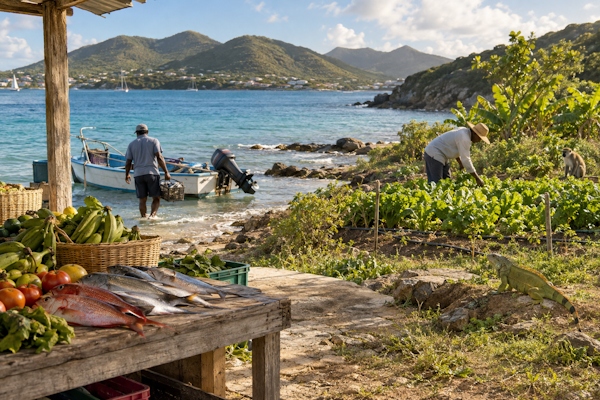
On Saint Martin, a debate about purchasing power cannot stop at fuel subsidies or the price of imported goods. It must also address whether local fishers can supply more fish at a viable cost, whether farmers can keep the crops they grow, and why residents still have no clear timetable for controlling invasive animals that threaten food production.
The sea: protection and access
The national Nature Reserve of Saint Martin was created in 1998 to protect marine and coastal ecosystems in the island’s northeast. Its founding decree prohibits line, net, and trap fishing, spearfishing, and the collection of marine animals within the reserve’s maritime boundary. It does not ban fishing throughout French Saint Martin. Among the areas excluded from the reserve boundary are the interiors of Cul-de-Sac Bay and Orient Bay; other fishing rules may still apply there. Founding decree, reserve boundary information
Protecting reefs and breeding habitats helps sustain fish stocks. At the same time, restrictions on nearby fishing grounds raise serious questions for people trying to earn a living from the sea. How much farther must affected fishers travel? What do those trips cost in fuel? Does limited access reduce the amount of affordable local fish reaching Saint Martin’s tables?
SMN News found no published assessment in the material reviewed that quantifies those costs. The absence of that evidence should prompt the Prefecture, the Collectivité and reserve managers to gather it with fishers.
One proposal deserves a formal answer: could carefully controlled seasonal fishing be permitted in a limited part of the reserve? Fishers should be able to identify the grounds and species at issue. Scientists should assess whether any opening could avoid damage to vulnerable habitats and breeding stocks. Authorities should then publish their conclusion.
There is a legal hurdle. The fishing prohibition is contained in the decree that established the reserve. A local permit cannot simply override it; authorities would need to establish the lawful route for any change. They should also examine how to improve access and support for fishing grounds outside the reserve.
Fish do not observe the island’s political borders. At an Anguilla Bank fisheries conference, fishers, scientists and officials from Saint Martin, Sint Maarten and neighboring islands discussed shared stocks and the need for coordinated management. That work offers a starting point for policies that protect fish while keeping fishing communities viable. Saint Martin Nature Reserve fisheries conference report
The land: who protects the harvest?
Farmers and residents face another obstacle: invasive monkeys. The French-side Nature Reserve says the animals have spread across Saint Martin and affect crops, residents and biodiversity. French and Dutch-side representatives discussed a coordinated response, but the reserve’s published account said the proposed French-side project was still being evaluated for its methods and cost. Saint Martin Nature Reserve
The Dutch side has taken action. The Sint Maarten Nature Foundation reported that veterinarians captured and euthanized 108 monkeys between January and November 2023. The government’s stated objective at the time was to remove 450 by 2025. That was a target, not a verified final total. The Foundation said its programme was expected to end in 2026 and that its impact and longer-term options would then be assessed. Nature Reserve report, Nature Foundation statement
The Sint Maarten Nature Foundation also lists green iguanas among the species covered by its invasive-species project. Its published description does not provide an iguana population count, a removal target or a completion date. Any control effort must distinguish the invasive green iguana from the endangered Lesser Antillean iguana. Nature Foundation project, Lesser Antillean iguana action plan
When exactly will the government remove the monkeys and invasive green iguanas affecting farming? The sources reviewed do not establish a current islandwide removal total or a verified timetable. Residents and farmers deserve that information from both governments.
The financial stakes are immediate. SMN News’s review of Sint Maarten’s draft 2027 budget found agriculture-related allocations and a proposed microloan programme, but no clear, species-specific 2027 timetable for monkey or iguana control. Asking people to borrow money to grow food while leaving crop losses insufficiently addressed is a poor foundation for food security.
A cost-of-food plan needs dates and answers
The governments on both sides of the island should publish a practical programme that residents can measure. It should establish the cost of restricted fishing access, decide whether a lawful and scientifically sound seasonal opening is possible, and state what support fishers can receive in permitted waters. It should also measure crop losses and set out who will control invasive animals, how the work will be funded, and when results will be reported.
None of those steps guarantees that grocery prices will fall. Authorities must measure whether increased local supply reaches consumers at prices they can afford. But without those steps, “produce more food locally” remains a slogan while fishers face fuel bills and farmers face damaged harvests.
Calls for an October 17 Yellow Vests protest are circulating in mainland France, but the date has not been established as a coordinated national action, and SMN News has found no confirmed Saint Martin strike tied to it.
Saint Martin does not need to wait for October 17 to act. The Prefecture, the Collectivité and the Government of Sint Maarten can begin by putting fishers and farmers in the room, publishing the evidence, and giving the public a timetable. Families fighting the cost of food need to know what will change—and when.