





The 2027 budget supports initial planning, but several sports programs are only partially funded; declining school enrollment also leaves less room for unexpected education expenses.
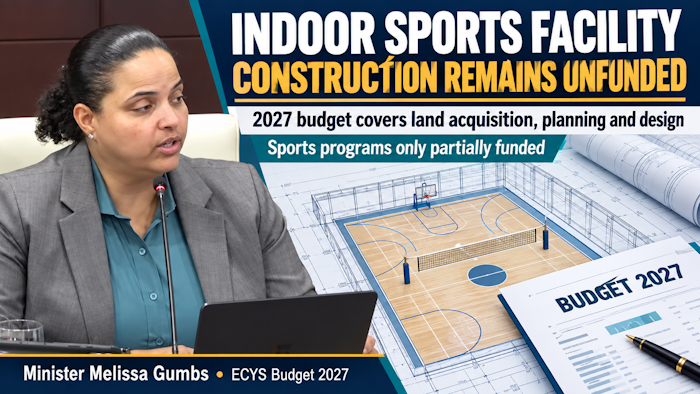 PHILIPSBURG:--- Construction of Sint Maarten’s proposed multifunctional indoor facility remains unfunded, Minister of Education, Culture, Youth and Sport Melissa Gumbs told Parliament, despite allocations for the project’s initial phase.
Responding to MPs during discussions on the draft 2027 budget, Gumbs said funding covers land acquisition and architectural planning and design. Additional financing will be required before construction can proceed.
Her responses also identified partially funded sports programs, outstanding implementation of a 2026 sports budget amendment, and limited financial flexibility for school innovation and unexpected needs.
Together, those disclosures draw a clear line between projects government intends to pursue and the activities the available budget can deliver.
Planning Money Does Not Finance Construction
Gumbs explicitly distinguished the initial phase of the multifunctional indoor facility from the construction phase.
The budget provides for preparatory work, but does not establish a funded path to completing the building.
This distinction matters for public expectations. Land acquisition and design can advance a project, but construction requires a separate financial commitment.
Before government can provide a credible delivery schedule, it must secure the additional resources.
Sports Scholarships and National Team Support Only Partially Funded
Gumbs said several planned sports initiatives are only partially funded for 2027.
These include facility support through the National Sports Institute, sports scholarships, national team and tournament support, sports tourism and sports awareness activities.
Available allocations will support some activity, but not the full extent envisioned.
The Ministry plans to assess sports investment through indicators including athletes supported, youth participation, school participation in swimming and tournaments, national teams assisted, facility use and stakeholder feedback.
Those indicators can help show what the allocations achieve. They will also need to make visible which activities remain beyond the available funding.
Approved 2026 Sports Amendment Still Awaits Allocation
Gumbs said the budget amendment initiated by MP Francisco Lacroes and approved during the 2026 budget process could remain outstanding into 2027 because the corresponding allocation had not yet been finalized.
The Department of Sport can operationalize the amendment and disburse funds once that process is completed.
The Minister also reaffirmed plans to train sports federations to prepare government funding requests, including the required documentation and procedures.
However, the allocation must first be finalized before funds can be used for the intended activities.
The disclosure highlights a significant implementation gap: parliamentary approval does not itself mean organizations have received funding.
Facility Rehabilitation Continues into 2027
Gumbs said rehabilitation of district courts is currently scheduled for completion at the end of 2026.
Works involving the Raoul Illidge Sports Complex, L.B. Scott Sports Auditorium, John Cooper/José Lake Ballpark, Belfort Hazel facilities and school gyms are scheduled for completion in 2027, subject to project timelines.
Maintenance and operation of existing facilities are expected to continue throughout the year.
Those repairs serve an immediate purpose: keeping existing spaces available while the proposed indoor facility remains without construction financing.
School Enrollment Falls by 913 Students
Beyond sports, Gumbs disclosed that the overall student population declined by 913 students between December 2020 and December 2025.
School-board funding calculations are tied to student numbers. Changes in enrollment therefore affect structural funding.
However, she cautioned that the slight reduction in the overall subsidy budget does not translate into a uniform reduction for every school board.
The broader reduction primarily limits funds available for incidental subsidies, leaving the Ministry with little or no flexibility to accommodate unexpected requests for innovation, facility upgrades, additional programs or other unforeseen expenses.
That limitation applies across school types and education levels.
Vocational Schools Face Rising Supply Costs
Responding to MP Egbert Doran, Gumbs said technical and vocational education is particularly expensive in disciplines such as mechanics, culinary training and construction.
Practical instruction requires materials that are consumed or altered during training.
“You cannot unbreak an egg, and you cannot unsaw a two-by-four,” she said.
Government funding covers necessities, but vocational schools also face rising costs when purchasing teaching supplies.
Schools have sought discounts and donations through private-sector partnerships. Gumbs suggested that pooling resources may require further discussion to use them more effectively.
Education and Labor Market Council Enters Activation Phase
The Ministry is pursuing a vocational education project intended to improve the connection between schooling and employment, strengthen basic and practical skills, and improve transitions into secondary vocational programs.
The Council of Education and the Labor Market, known as the ROA, is also being activated.
It is intended to bring together employer organizations, employee organizations and government to research labor-market needs, advise on vocational education and encourage internship opportunities.
Gumbs said 2027 would focus on activation, training, stakeholder engagement and initiating research. Its wider impact is intended to become evident from 2028 onward.
The timetable means the council should be judged initially on whether it becomes functional and produces useful work, rather than on employment outcomes it has not yet had time to influence.
Youth and Culture Programs Carry Longer Timelines
Gumbs outlined youth priorities including participation, work experience, after-school programs, monitoring of subsidized organizations and continued development of early-childhood frameworks.
Comprehensive social mapping is anticipated by the end of 2027.
Cultural initiatives under the Future Roots program run through September 2029 and include history curriculum development, heritage documentation, genealogical research, digitization and infrastructure improvements.
These programs require sustained reporting on delivery and expenditure, particularly where results extend across several budget years.
Parliament Needs a Clear Picture of What Can Be Delivered
Gumbs’s responses establish several distinct financial realities: some initiatives have initial funding, others are partially funded, and some approved measures still await allocation.
For the indoor facility, the central question is how construction will be financed. For sports organizations, it is when approved resources will become accessible. For schools, it is how the government will address unexpected needs within a budget that offers little flexibility.
The next stage of scrutiny must connect each commitment to its funding status, implementation schedule, and measurable results.