





Public schools will continue assisting children on a needs basis, while a permanent program would require additional funding or shared financial support.
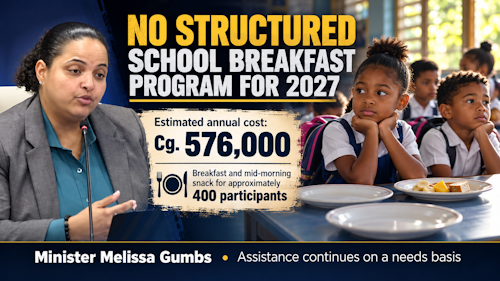 PHILIPSBURG:--- Sint Maarten will enter 2027 without a structured school meal program, Minister of Education, Culture, Youth and Sport Melissa Gumbs confirmed during Parliament’s Central Committee budget discussions.
Responding to questions from MP Sjamira Roseburg and Parliament Chair Sarah Wescot-Williams, Gumbs said the Division of Public Education cannot sustain the expense on its own.
Providing breakfast and a mid-morning snack to approximately 400 participants would cost an estimated Cg. 576,000 annually, she told Parliament.
Establishing a structured program would therefore require additional funding or shared financial support. Her responses did not identify a secured funding arrangement or launch date.
Assistance Continues, but Without a Permanent Program
Gumbs said public schools will continue providing breakfast to students their schools identify as needing assistance.
Existing arrangements have received support from Rotary Clubs and private sponsors.
That assistance provides an immediate response to identified needs. However, the Minister’s answers establish that the government has not planned a structured program for 2027 with sustained financing.
Roseburg also asked about a previous Cg. 50,000 allocation involving ECYS and VSA.
Gumbs said those funds were used during the relevant budget year. No subsequent provision continued that allocation.
The issue before Parliament is therefore how to move from assistance dependent on school-level arrangements and sponsorship to a consistently funded service.
Local Farmers Could Participate
Roseburg proposed linking school meals to local producers through TEATT’s Farm to School Market pilot.
Gumbs said the Ministry is open to exploring collaboration with TEATT and farmers to determine whether locally produced items could be incorporated into school meal assistance.
Any arrangement would need to meet practical requirements, including the types of food schools need, availability, suitability, consistent supply, and affordability.
Where those conditions can be met, she said, collaboration could support both students and the local agricultural sector.
Her response expressed willingness to explore the proposal; it did not announce an approved purchasing arrangement.
Healthier Habits Initiative Still Being Developed
Wescot-Williams also sought clarification on whether the healthier habits initiative was an ongoing program or a one-time activity.
Gumbs said it was initially intended as a joint ECYS–VSA initiative, but had not developed into an established, continuing interministerial program.
The public education physical education department is now developing a school-based version intended to operate continuously rather than as a single awareness event.
Schools would engage parents to reinforce healthier practices beyond the classroom.
The distinction matters: promoting healthy habits and ensuring that children have access to meals are related responsibilities, but each requires its own implementation and resources.
No Dedicated ECYS Book or Uniform Assistance Program
The Minister also confirmed that ECYS currently has no specific program or budget allocation for a book-lending scheme or uniform assistance for low-income families. She said that assistance would fall under Social Affairs.
Although proposals and partnerships have been explored, competing priorities and budget constraints have limited implementation.
Her responses place several household pressures before Parliament at once: meals, uniforms, and access to learning resources.
For the breakfast program, the government now has an estimated cost and a defined group of approximately 400 participants. The next question is whether ECYS, VSA and potential partners can establish the financing needed to turn that estimate into a dependable service.