





Justice Minister says the proposed service will increase visibility and support KPSM, while firearms would require a different mandate, training and supervision.
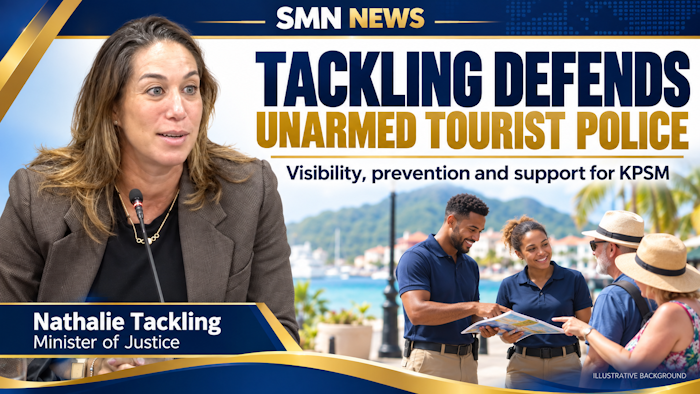 PHILIPSBURG:--- Minister of Justice Nathalie Tackling has firmly defended her decision that Sint Maarten’s proposed tourist police will not routinely carry firearms, telling Parliament that the arrangement is a deliberate policy choice rather than an oversight.
In responses to parliamentary questions, Tackling described the tourist police as a specialized, visible, preventive and service-oriented function that would work alongside the Police Force of Sint Maarten, KPSM.
Its personnel would assist visitors and residents, observe and report incidents, and call in regular police officers when intervention is required.
“The tourist police complements KPSM. It does not duplicate it, and it will not stand in for armed officers,” she said.
BAVPOL Status Does Not Automatically Mean a Firearm
Tackling explained that appointment as an extraordinary police officer, commonly referred to as BAVPOL, does not automatically authorize someone to carry a firearm.
According to the minister, the applicable framework allows authorization for specified weapons under certain conditions. However, she stressed that legal permission and an operational decision to routinely arm a particular category of officer are separate matters.
“The position is not that the law forbids arming these officers,” she said. “It is a choice not to, given the role that they will fill.”
Addressing questions about whether two years of training are required, Tackling distinguished the basic training of a fully qualified police officer from BAVPOL training. She said BAVPOL training alone does not qualify someone to become a routine firearm carrier.
Minister Rejects Comparison With Firearms Issued to Public Officials
Tackling sharply rejected a comparison between tourist police and ministers who may receive firearms for personal protection.
A minister, she argued, does not routinely patrol streets, arrest suspects or confront potentially dangerous individuals in the course of policing duties.
“Whatever applies to the personal protection of someone in public office says nothing about the training required by an officer who must act in the public domain,” she said.
She warned against using concerns about standards elsewhere to justify lowering requirements for tourist police.
“A firearm is not standard protective equipment. It is the authority and the responsibility to use lethal force.”
Dangerous Incidents Remain KPSM’s Responsibility
The minister said tourist police safety would depend on clear deployment procedures, communication equipment, situational awareness and direct support from KPSM.
Incidents involving firearms, serious violence or dangerous suspects would require a response from trained and equipped regular police officers.
If tourist police were expected to routinely intervene in situations where lethal force might be necessary, Tackling said the entire function would have to be reassessed. That would include selection standards, training, continuing firearms proficiency, command, supervision and reporting.
She also referred to past experiences with officers being armed without adequate preparation, saying government had a responsibility to avoid repeating those mistakes.
Training Details Still Being Finalized
Despite defending the policy, Tackling did not provide a fixed training duration in these responses.
She said the training components would form part of a plan of approach being finalized, with regional options under consideration.
Her remarks therefore establish the intended role and firearms policy, while leaving the final training arrangements to be detailed.
Tackling said regional tourist police models could offer lessons, although their organizational structures could not simply be equated with Sint Maarten’s proposal.
Sharp Rebuke of Parliamentary Opposition
Tackling accused a parliamentary critic of finding new reasons to oppose the initiative, despite repeated demands for greater police visibility and crime prevention.
“That is not scrutiny. Scrutiny tests a plan in order to improve it. This tests a plan in order to oppose it,” she said.
The minister acknowledged that she could not immediately produce a new class of fully trained police officers. However, she maintained that additional trained personnel performing a clearly defined preventive role could contribute to public safety.
“St. Martin’s residents and visitors are not served by stagnation,” she said. “They are served by action, and I intend to continue acting.”