





Minister accuses a parliamentary critic of opposing plans for opposition's sake, while questions about tourist police, prison delays, and funding expose the pressure on her ministry.
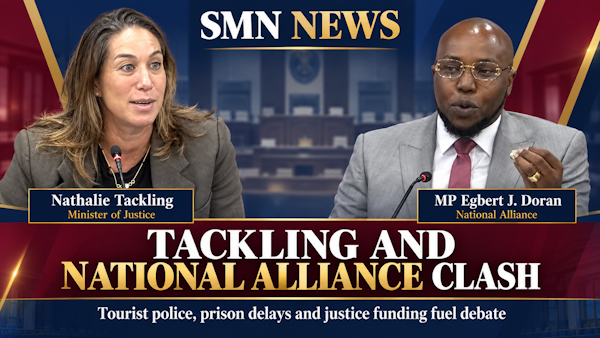 PHILIPSBURG:--- A dispute between Minister of Justice Nathalie Tackling and the National Alliance faction has brought the tension between government action and parliamentary scrutiny into sharp focus, with the minister forcefully defending her policies and accusing a parliamentary critic of seeking reasons to oppose them.
The confrontation emerged during Tackling’s responses to questions about the proposed tourist police, the new prison project and the resources needed to strengthen justice services.
Her strongest remarks criticized the decision that tourist police officers would not routinely carry firearms. Tackling maintained that the proposed service is designed to increase visibility, prevent crime and assist residents and visitors, while relying on KPSM for dangerous incidents.
But her response moved beyond explaining the policy. She questioned the motivation behind the criticism.
“There is always room to discuss the details, and I welcome that discussion,” Tackling said, before arguing that a member would find grounds to criticize regardless of whether a proposal met his demands.
“That is not scrutiny. Scrutiny tests a plan in order to improve it. This tests a plan in order to oppose it.”
Tourist Police Become the Flashpoint
At the center of the dispute is a practical question: what duties will tourist police perform, and what training and equipment will they need to carry them out safely?
Tackling said their role would be preventive and service-oriented. They would assist the public, observe and report, and bring in KPSM when regular police intervention is necessary.
She rejected the suggestion that BAVPOL status automatically brings authorization to carry a firearm. According to the minister, the law allows such authorization under conditions, but the government has deliberately chosen an unarmed model for this particular function.
“The position is not that the law forbids arming these officers,” she said. “It is a choice not to given the role that they will fill.”
Tackling also dismissed a comparison with firearms issued to ministers for personal protection, arguing that public officials do not undertake the same duties as personnel patrolling streets and confronting suspects.
Her position is that routinely arming tourist police would require a substantially different assessment of their selection, training, firearms proficiency, supervision and responsibilities.
Minister Says Criticism Risks Undermining Recruitment
Tackling argued that suggestions the officers would be sent into danger without adequate protection misrepresent the proposed service.
She said such claims could discourage potential recruits and portray tourism areas as places that can only be kept safe through armed policing.
According to the minister, safety would instead depend on clear procedures, communication equipment, situational awareness and direct support from KPSM.
“When an incident involves firearms, serious violence, or a dangerous suspect, that response belongs to trained and equipped KPSM officers,” she said.
The minister acknowledged that she cannot immediately produce a new class of fully trained regular police officers. She presented tourist police as a way to increase visible personnel while working within that constraint.
However, the training components remain part of a plan of approach being finalized. Her responses did not provide a fixed training duration.
That leaves Parliament with concrete details still to examine, even as the minister insists that the overall policy is sound.
Prison Delay Question Draws Another Sharp Response
The political tension also surfaced over the new prison project.
Tackling rejected a question premised on a ten-month delay, saying the procurement setback was six months and resulted from the need to retender the construction contract in 2025.
“The six months was a real unplanned delay. The contingency is a separate allowance,” she said.
She explained that additional contractor mobilization time in early 2026 was absorbed within existing programme allowances and did not further extend the overall timeframe.
Tackling described the presentation of a ten-month delay as “disingenuous,” maintaining that the revised timeline had been communicated consistently.
At the same time, she confirmed that the building permit had not yet been signed off and was awaiting Fire Department advice. She said the necessary permissions exist for current activities and that the outstanding hindrance permit is required for the second construction phase.
These distinctions are central to assessing the project’s progress. The minister’s responses did not provide a completion date or a date for final building permit approval.
Irion’s Questions Highlight Funding Exposure
National Alliance MP Ardwell Irion’s questions addressed another vulnerability: what happens if the Ministry of Justice does not receive its requested capital funding?
Tackling said the ministry has requested 4.47 million in the 2027 capital budget, excluding the largest projects she identified separately.
If that funding is unavailable, she said the ministry would need to determine which investments could be covered through the operating budget and which would have to be delayed.
She acknowledged that the specific risk had not yet been formally discussed with Minister of Finance Marinka Gumbs, and said the Finance Minister would address the capital expenditure questions herself.
Tackling accepted that vehicle leasing could help maintain services, but warned that it would place further demands on an already stretched operating budget.
“Leasing is a practical bridge, but it’s not a solution for us within the Ministry,” she said.
Her answer underscores that the debate concerns more than political personalities. Decisions about capital funding affect vehicles, equipment and the ministry’s ability to deliver services.
A Clash Over What Counts as Scrutiny
Tackling’s remarks reveal a minister increasingly frustrated by criticism of the measures she says she is taking to address longstanding shortages.
“A habit of opposing whatever the sitting government proposes is not progress and it is not political maturity,” she said. “It is stagnation.”
The supplied transcript records the minister’s responses rather than the National Alliance faction’s full contribution. It therefore does not establish the faction’s complete reasoning or its response to her accusations. Nor does it identify the member addressed in every passage of her strongest rebuke.
It does, however, establish a sharp disagreement over how to test justice proposals.
Tackling argues that criticism has become obstruction. Yet the outstanding training details, permit approvals and funding questions remain substantive matters for parliamentary examination.
The confrontation places a clear responsibility on both sides: government must provide the details needed to assess its plans, and parliamentary criticism must engage those details. For residents awaiting stronger public safety services, the measure of this debate will be what it delivers.