






Two Dutch judgments sharpen questions about prohibited representation, enforcement, and whether appearing in court establishes compliance with rules governing public office.
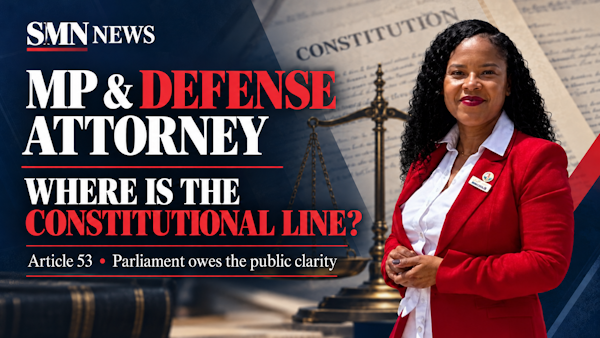 PHILIPSBURG:--- Parliament must provide a clear, legally supported explanation of whether a sitting Member of Parliament may defend someone prosecuted by Sint Maarten’s Public Prosecutor’s Office—and who is responsible for enforcing the constitutional restriction if it applies.
Reports that MP and attorney Sjamira Roseburg is representing a civil servant facing criminal proceedings have brought renewed attention to Article 53 of the Constitution. The provision expressly restricts parliamentarians from acting as lawyers in proceedings involving the Country. However, its application to criminal defense remains disputed.
Two Dutch judgments give this debate additional weight. They demonstrate that restrictions attached to elected or political office can affect legal representation, while also revealing a crucial distinction: an underlying prohibition and a court’s procedural power to exclude an attorney are separate questions.
Neither judgment conclusively determines Roseburg’s position under Sint Maarten law. Both strengthen the case for a public explanation grounded in law.
The constitutional question cannot be brushed aside.
Article 53(3)(a) prohibits MPs from acting as attorneys in court proceedings in which the Country is involved. Article 53(4) allows Parliament to grant exemptions in particular cases where the Country’s interest requires it. The wording does not expressly include or exclude criminal prosecutions. Whether they fall within its scope is the central dispute.
The question therefore goes beyond whether Roseburg is a qualified attorney. It concerns the limits attached to parliamentary office.
If the restriction covers criminal defense, a general entitlement to practice law would not settle the matter. If it does not, the public should be given legal reasoning supporting that conclusion.
Roseburg has already disputed broad interpretation.
The public aired this controversy in December 2024. A report published on December 30 presented legal advice attributed to attorney Roland Duncan alongside Roseburg’s response.
Duncan argued that criminal proceedings inherently involve the Country because prosecutors represent the state’s interests. Roseburg rejected that interpretation, maintaining that representing individuals in prosecutions brought by the independently operating Public Prosecutor’s Office falls outside the prohibition. She also disputed the characterization of publicly funded defense work as ordinary government contracting and stated that she would withdraw if a potential conflict arose. These were opposing legal positions, rather than a binding judicial resolution.
That disagreement deserves an institutional answer. The public should not have to choose between competing interpretations without knowing what position Parliament has adopted and why.
Prosecutorial independence is important, but invoking it does not automatically determine the meaning of Article 53.
The Kingdom legislation governing the Public Prosecutor’s Office assigns it responsibility for criminal enforcement, investigation and prosecution. It also permits the Justice Minister to issue written, reasoned general directions to the Prosecutor-General. Proposed directions concerning specific investigations or prosecutions require prior review by the Joint Court.
Those safeguards must be respected. They also illustrate why the relationship between prosecution, government and parliamentary oversight requires careful legal analysis.
There is no finding in the material reviewed that Roseburg used parliamentary authority to benefit a client. The concern is whether the law has authoritatively established the legal boundaries between her two roles.
The 2024 Dutch ruling shows that representation restrictions can have consequences.
On June 12, 2024, the Dutch Council of State upheld the refusal to allow a Waalwijk municipal councilor to represent a sports association in an administrative objection involving the municipality. The representation breached Article 15(1)(b) of the Dutch Municipalities Act.
Although the appeal succeeded separately on compensation for excessive procedural delay, the court upheld the refusal of representation. The judgment concerned a municipal dispute, rather than criminal defense or Sint Maarten’s Constitution.
Its relevance is therefore comparative: restrictions on the professional activities of public officeholders can be enforceable legal rules.
The 2026 judgment adds a critical distinction.
In a judgment dated August 17, 2026—ECLI:NL:RBNHO:2026:11287—the Noord-Holland District Court considered a lawyer who had become a municipal council committee member while representing a client against the municipality.
The court identified the applicable prohibition on such representation. However, it explained that the procedural power to refuse representatives under Article 8:25(1) of the Dutch General Administrative Law Act did not apply to attorneys because paragraph three expressly excluded them. It therefore attached no procedural consequence to the dual role and recorded that the lawyer had subsequently withdrawn.
The distinction matters. A court’s decision not to exclude an attorney under a particular procedural provision does not necessarily establish that the attorney’s conduct complies with every restriction attached to public office.
For Sint Maarten, that raises another question: if Article 53 applies to particular legal work, which institution must enforce it, how, and with what consequences?
The Dutch procedural exception cannot simply be assumed to govern proceedings here. Equally, the Dutch prohibition cannot be transplanted into Sint Maarten’s criminal courts without examining the applicable local law.
The Advocates Ordinance provides another relevant starting point. Article 5 grants attorneys broad representation powers subject to prohibitions imposed by national ordinance, while Article 3 requires obedience to the Constitution in the attorney’s oath. Neither provision independently resolves whether Article 53 covers criminal defense.
Roseburg, Wescot-Williams and the Bar should address the legal basis.
Roseburg should identify the authority supporting her interpretation and explain whether she relies on any relevant judicial ruling or parliamentary exemption.
Parliament Chair Sarah Wescot-Williams should explain whether Parliament has adopted a reasoned position, obtained independent advice or granted any applicable exemption. If an exemption exists, its scope and public-interest justification should be explained, subject to lawful confidentiality requirements.
The Bar Association should clarify its professional position and explain the respective roles of the association, disciplinary authorities and courts. An association’s opinion should also be distinguished from a binding determination.
These questions can be answered without disclosing confidential defense strategy or prejudging the accused. The defendant’s civil service employment does not resolve the issue: criminal representation and a separate employment dispute against government require distinct legal analysis.
The research reviewed for this article did not identify a published Sint Maarten judgment conclusively resolving Article 53’s application to ordinary criminal defense. It therefore does not justify declaring that Roseburg has definitively violated the Constitution.
It does justify demanding answers.
Parliament cannot expect public confidence in constitutional oversight while leaving the boundaries governing its own members unexplained.
Roseburg’s interpretation deserves a fair hearing. The constitutional restriction deserves an authoritative explanation. The public deserves to know how the rule applies, who enforces it, and whether the same standard governs every Member of Parliament.