






Chamber points to Parliament’s responsibility for conduct rules and highlights disclosure of outside interests.
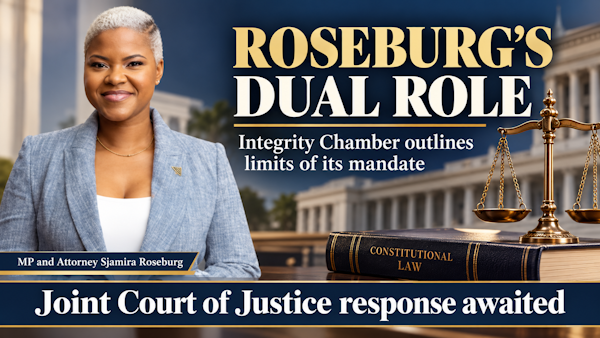 PHILIPSBURG:--- The Integrity Chamber told SMN News it cannot determine the interpretation or potential violation of constitutional provisions regarding a sitting Member of Parliament who also practices as a criminal defense attorney.
The response follows questions SMN News submitted on October 16, 2026, about MP and attorney Sjamira Roseburg’s dual roles, the application of Article 53 of Sint Maarten’s Constitution, and the safeguards required where parliamentary responsibilities intersect with legal representation.
SMN News is still awaiting a response from the Joint Court of Justice to its separate inquiry into the matter.
The Integrity Chamber’s reply leaves the central constitutional question unresolved. It neither endorses Roseburg’s interpretation nor finds that she has violated the Constitution.
Instead, the Chamber outlined the limits of its authority and identified other institutions it could approach.
“Questions concerning the interpretation or potential violation of constitutional provisions fall outside the scope of the Integrity Chamber’s mandate,” its Secretariat stated.
The Chamber suggested institutions consider including the Ombudsman, which it described as acting as guardian of the Constitution, or the Cabinet of the Governor. Its response did not indicate that either institution had been asked to examine this particular matter or had reached a conclusion.
The inquiry follows SMN News’ earlier reporting on whether Article 53’s restrictions on MPs acting as attorneys in proceedings involving the Country extend to criminal prosecutions brought by the Public Prosecutor’s Office. That coverage also examined who would enforce the restriction if it applies and whether Parliament has granted any exemption.
Roseburg has previously disputed the interpretation that the prohibition covers ordinary criminal defense, arguing that she represents individual clients and that the Public Prosecutor’s Office operates independently. Attorney Roland Duncan has advanced the opposing interpretation that criminal proceedings involve the Country. Those competing positions remain distinct from an authoritative determination of the constitutional issue.
In explaining its jurisdiction, the Integrity Chamber said its mandate concerning parliamentarians is limited.
“The Chamber’s jurisdiction extends to acts of Parliamentarians only insofar as they involve the exercise of public authority, as conferred to Parliament in the Constitution of Sint Maarten and other applicable legislation,” the Secretariat explained.
That distinction matters: the Chamber did not say that every action taken by a parliamentarian falls within its oversight. Nor did it rule on the compatibility of Roseburg’s legal practice with her parliamentary office.
On parliamentary procedures, exemptions and conduct guidelines, the Chamber pointed directly to Parliament itself.
“For questions regarding parliamentary procedures, exemptions, or conduct guidelines, such matters fall under the purview of Parliament itself,” it stated.
The response refocuses attention on the arrangements Parliament has established to identify and manage potential conflicts arising from members' outside professional activities.
The Chamber disclosed that it had previously advised Parliament on its draft Code of Conduct. Although that advice did not specifically address the situation raised by SMN News, it included recommendations on disclosing external interests.
“When implemented by Parliament, this would allow, among other things, for the early assessment and management of potential integrity risks arising from ancillary activities,” the Chamber said.
Its wording does not establish whether Parliament has since implemented those recommendations. The response also did not identify any disclosure, exemption, or conflict-management arrangement specific to Roseburg.
SMN News’ original inquiry sought guidance on safeguards where an MP represents criminal defendants while also scrutinizing justice policy, funding and ministerial conduct. It asked how to disclose potential conflicts without compromising attorney-client confidentiality, and when abstention or other measures might be appropriate.
The Chamber did not provide detailed answers setting out when those measures should apply. Its substantive guidance centered on the limits of its mandate, Parliament’s responsibilities and the value of disclosing outside interests.
SMN News expressly stated in its inquiry that it was not presuming Roseburg had violated the Constitution or improperly used her parliamentary position. The questions concern the legal boundaries and institutional safeguards governing the combination of elected office and professional legal work.
Those questions remain outstanding.
Parliament has yet to establish its position on the constitutional restriction, whether any exemption applies, and the practical arrangements for managing potential conflicts through the Chamber’s response.
SMN News awaits the Joint Court of Justice’s response concerning the legal questions raised in its separate inquiry.