






The former VROMI minister who approved the invalid Tesi transaction now sits in government as VSA minister. A portfolio change cannot erase the questions raised by the judgment.
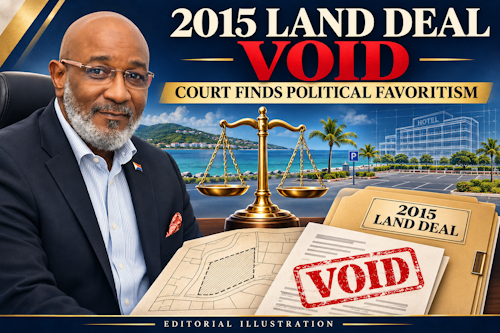 PHILIPSBURG:--- A damning Joint Court judgment on a 2015 government land transaction has brought an uncomfortable accountability question directly to the present Council of Ministers: how will government respond when the minister responsible for a decision condemned as political favoritism is once again sitting at its table?
The minister who approved the Tesi land transaction was Claret Connor, then caretaker Minister of VROMI. Historical reporting identifies him as the minister behind the November 18, 2015, decision, and records his subsequent public defense of it. Connor returned to the Council of Ministers as VSA minister on August 5, 2026, under Prime Minister Dr. Luc Mercelina.
The judgment delivered August 26, 2026, and published November 2, found that the land issuance decision violated fundamental constitutional standards and was void because it conflicted with public order.
The court concluded that the outgoing minister pushed the transaction through to benefit the developers while he still could, leaving the next administration facing an accomplished fact.
This was a civil judgment invalidating a government decision. It was not a criminal conviction. Its findings nevertheless demand a serious political response.
Who Held VROMI in 2015?
Four officeholders carried responsibility for VROMI during the calendar year:
|
Officeholder |
Period in 2015 |
Capacity |
|
Marcel Gumbs |
January 1–September 6 |
Prime Minister and acting VROMI minister |
|
Claret Connor |
September 7–November 18 |
VROMI minister following his transfer from TEATT |
|
William Marlin |
November 19–26 |
Prime Minister and acting VROMI minister pending Angel Meyers’ appointment |
|
Angel C. Meyers |
November 27–December 31 |
VROMI minister; continued in office afterward |
Contemporary reporting confirms that Marcel Gumbs held VROMI on an interim basis until Connor’s September appointment. The Governor’s Cabinet announced Connor’s transfer from TEATT and confirmed Meyers’ swearing-in on November 27. Reporting on the incoming Marlin administration records William Marlin temporarily assuming VROMI.
Maurice Lake belongs to the preceding period: his VROMI tenure ended in December 2014, rather than during the 2015 calendar year.
These distinctions matter. Holding the same ministry at different times does not make every officeholder responsible for the same decisions. The Tesi approval at the center of this judgment was issued under Connor.
A Public Land Decision Taken Against Explicit Opposition
The proposed arrangement would have transferred a 5,000-square-meter parcel from Port de Plaisance Medical Center N.V. into government ownership. In exchange, government would grant Tesi long-lease rights over approximately 4,300 square meters of public land.
The development proposals referred to a five-star hotel, casino, commercial facilities, and parking. The Minister’s November 18 letter required at least 100 public parking spaces within the future development.
But the approval did not emerge from an uncontested administrative process.
An August 14, 2015 internal advisory memorandum recommended rejecting the exchange. Parliament subsequently passed a motion of no confidence against the cabinet on September 30.
On October 28, Parliament went further: it specifically opposed the caretaker government making binding decisions involving the very land exchange later approved.
Connor nevertheless proceeded on November 18.
The court found that the caretaker minister should have refrained. The transaction was controversial, and no urgency had been demonstrated that justified deciding it before a new government took office.
The Court Found Favoritism, Not Merely an Administrative Error
The significance of the ruling lies in its assessment of purpose.
The judges concluded that the minister intended to confront the next administration with a completed commitment by accommodating the developers while he still had the opportunity.
The court described this form of political favoritism as a recurring abuse requiring firm action in St. Maarten’s small community.
It also found inadequate preparation: no resort construction plans had been submitted. The approval ran contrary to negative internal advice based on incompatibility with applicable planning requirements.
Those findings go well beyond a missing form or an innocent procedural oversight. They concern the use of ministerial power over scarce public land in circumstances where Parliament had expressly demanded restraint.
Public property cannot responsibly be administered as a departing minister’s final opportunity to settle a controversial transaction.
Meyers Reversed the Decision; Government Faced Years of Litigation
The successor administration did not complete the arrangement.
On December 16, 2015, Angel Meyers informed Tesi that he considered the decision null and void. Contemporary reporting also records his objections to Connor’s handling of land intended for public parking.
The companies pursued court proceedings to compel the government to honor the transaction.
The litigation reached the Supreme Court of the Netherlands, which overturned an earlier appellate judgment because the Joint Court had incorrectly concluded that the minister lacked authority to grant the land on a long lease.
That ruling did not validate the transaction.
On reconsideration, the Joint Court accepted that the minister possessed the necessary authority but found that this particular decision was void because of the circumstances in which that authority was exercised.
The distinction is fundamental: a minister can possess legal power and still exercise it in a manner that cannot stand.
Connor Previously Invoked the Council of Ministers
Connor’s earlier public explanation makes the present demand for accountability even more pressing.
In February 2018, responding to questions about the Tesi transaction, he argued that the decision was collective, saying it was a Council of Ministers decision that he executed.
The latest judgment expressly addresses the contention that the approval reflected the Council of Ministers’ position. The court found that this did not change its conclusion.
Cabinet backing could not cure a decision taken contrary to fundamental constitutional standards.
That history also raises a broader question about collective government: when a controversial transaction reaches the cabinet table, who insists on respecting parliamentary opposition, negative advice, and the limits of caretaker authority?
Collective decision-making must strengthen accountability. It cannot become a mechanism through which responsibility disappears.
Mercelina’s Government Must Address the Judgment
Connor’s appointment with VSA placed him back inside the Council of Ministers shortly before the August 26 judgment. His appointment was publicly framed around fairness, transparency, and integrity.
Those standards now require a concrete response.
Mercelina’s government should explain whether it has considered the judgment, what explanation it expects from Connor, and what consequences it believes should follow from such findings against a decision taken by a serving cabinet member during an earlier ministerial tenure.
Connor should publicly address the central findings: why the transaction proceeded after Parliament expressly opposed it, why it could not await a successor government, and how he answers the court’s conclusion that it amounted to political favoritism.
These are questions arising from a published judgment. They cannot reasonably be dismissed as election rhetoric or personal attacks.
This ruling provides no basis to accuse the present Council of Ministers of participating in the 2015 transaction. Its responsibility today is to demonstrate how it responds to the findings.
A Different Portfolio Does Not Erase Ministerial Responsibility
St. Maarten cannot afford a political culture in which a ministerial decision is condemned by the courts, years of litigation follow, and the public is expected to move on because the officeholder now manages another ministry.
The judgment does not establish personal enrichment or criminal wrongdoing. It does establish that the decision failed fundamental standards governing the exercise of public power.
The political case for Connor to step down rests on that finding and the responsibility attached to ministerial office.
At a minimum, Parliament should require a full public explanation, and government should explain what safeguards prevent outgoing ministers from repeating this conduct.
The court has rejected the transaction. The remaining question is whether government will attach meaningful political accountability to the conduct behind it.
Based on ECLI:NL:OGHACMB:2026:301, supplied in full, and historical reporting identifying the responsible minister and the sequence of appointments.