






TEATT Minister links diversification ambitions to the new hospital and proposed legislation, but says the required bills must still complete review before reaching Parliament.
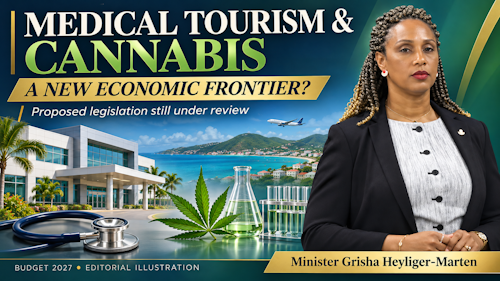 PHILIPSBURG:--- Minister of Tourism, Economic Affairs, Transport and Telecommunication Grisha Heyliger-Marten has identified medical tourism and a regulated medical cannabis sector as potential avenues to diversify St. Maarten’s economy, linking those ambitions to expanded hospital facilities and proposed healthcare legislation.
Presenting her ministry’s 2027 budget priorities, Heyliger-Marten said St. Maarten could explore attracting patients from neighboring islands and beyond for specialized healthcare, while developing opportunities for qualified medical professionals.
She also suggested that medical cannabis, under an appropriate regulatory framework and medical safeguards, could complement that direction through specialized treatment, research and wellness-related services.
However, the minister made clear that the legislative groundwork remains unfinished. The proposed healthcare professional legislation and cannabis legislation must still complete the necessary review and advisory processes before submission to Parliament.
Her presentation therefore sets out an economic ambition whose execution depends on decisions and safeguards still to come.
Hospital Development Placed at Center of Diversification Vision
Heyliger-Marten argued that the new hospital development could provide a foundation for exploring a regional medical tourism industry.
Proposed legislation governing healthcare professionals and their qualifications could help create a framework for attracting internationally qualified doctors, specialists and other healthcare workers, she told Parliament.
Combined with expanded hospital facilities, she suggested, this could support specialized services for residents and visiting patients.
The minister did not identify particular medical specialties, projected patient numbers, anticipated earnings or a launch date.
Those details will be necessary to establish whether the concept can become a viable industry and what additional capacity it would require.
For residents, a central question will be how any effort to attract international patients would also improve local access to care. The presentation did not set out arrangements governing that balance.
Medical Cannabis Proposed as a Complementary Opportunity
Heyliger-Marten placed medical cannabis within the same longer-term diversification discussion.
She said a properly regulated sector, supported by medical safeguards, could create opportunities connected to treatment, medical research and wellness services.
Those were potential areas identified by the minister, rather than an announcement of an approved treatment program or an operating cannabis industry.
The presentation did not provide a licensing model, identify authorized products, explain who could participate, or set out how medical oversight would function.
Nor did it establish a timetable for parliamentary consideration of the proposed cannabis legislation.
Those unanswered questions are substantial. Before the economic opportunity can be assessed, government must explain the proposed framework, its safeguards and the practical conditions under which businesses and healthcare providers would operate.
Four Million Guilders Covers a Wider Agenda
The minister identified approximately 4 million guilders in policy activities for the broader economic growth and diversification program in 2027.
That amount should not be presented as a dedicated medical cannabis or medical tourism allocation.
The wider program includes agriculture, livestock and fisheries, support for small and medium-sized enterprises, agricultural research, school agriculture, financing initiatives, policy work and economic forecasting.
The diversification agenda also includes ICT, digital businesses and the creative economy.
Heyliger-Marten argued that tourism should remain the principal economic pillar while additional industries are developed alongside it.
“One engine of growth should not have to carry the entire weight of our economic future,” she said.
Local Participation Must Be Part of the Business Case
The minister repeatedly emphasized that economic growth should translate into opportunities for St. Maarten’s people.
Applied to medical tourism and cannabis, that creates an immediate policy test: government must explain how residents, local businesses and workers would participate.
The presentation did not establish ownership requirements, training pathways, financing arrangements or the number and type of jobs these proposed sectors might generate.
Those issues will determine whether diversification creates accessible opportunities locally or remains an investment concept beyond the reach of smaller entrepreneurs.
The same scrutiny applies to public expenditure. Parliament will need to distinguish the cost of studying an opportunity from the cost of regulating, supporting and maintaining a new industry.
Tourism Expansion Must Account for Existing Pressures
Elsewhere in her presentation, Heyliger-Marten acknowledged that tourism development must consider carrying capacity, congestion, environmental pressures, accommodation development and the experience of residents.
She also identified wellness, health and medical tourism among a wider range of products that could help broaden visitor experiences and strengthen demand during the May-to-October shoulder and low season.
Some opportunities can develop through existing businesses, she said, while others require investment, training and regulatory development.
That distinction is particularly relevant here. Developing specialized healthcare services requires a more detailed implementation framework than simply adding another category to destination marketing.
Parliament Faces a Proposal Requiring Clear Benchmarks
Heyliger-Marten’s presentation places medical tourism and medical cannabis firmly within TEATT’s economic diversification ambitions. It also confirms that both depend on unfinished legislative work.
The next stage should clarify which services government believes St. Maarten can realistically offer, what market demand exists, how residents would benefit, and what regulatory and institutional capacity would be required.
For Parliament, the opportunity is to demand that evidence before projected benefits become political promises.
A credible diversification strategy will need to show how these proposed industries can strengthen the economy while supporting healthcare access, creating local opportunities and meeting clearly defined public safeguards.