






MP demands permit dates, locations and backlog figures from VROMI, while warning that administrative failures may also be obstructing existing government revenue.
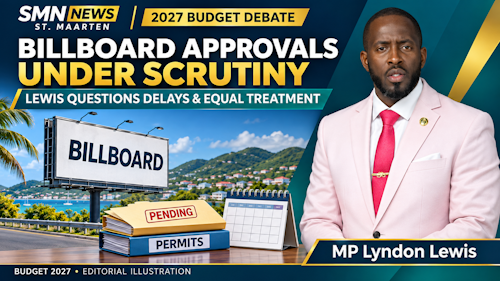 PHILIPSBURG:--- MP Lyndon Lewis has demanded that VROMI Minister Patrice Gumbs Jr. explain why some permanent billboard applications reportedly remain on hold pending a policy while other billboards are being installed.
During the 2027 budget debate, Lewis requested a detailed account of the approval process, the policy's status, and whether applicants are receiving consistent treatment.
“I understand that several applicants have been informed that their applications remain pending and cannot be processed until the policy is finalized,” he said.
“However, I have observed permanent billboards being installed in prominent locations.”
“This raises questions about the approval process and whether applicants are being treated consistently.”
Lewis’ contribution did not establish that any installed billboard lacked a permit or that an applicant had received improper preferential treatment. His questions sought the records needed to clarify the apparent discrepancy.
Publish Approval Dates and Locations
Lewis asked whether the city was currently accepting and processing permanent billboard applications.
If processing had been suspended, he wanted to know when that happened and how applicants were informed.
He also requested the number of pending applications and how long the oldest application had been awaiting a decision.
“What rules and criteria govern billboard approvals while the policy is being developed?” he asked.
“Were the recently installed permanent billboards approved before the suspension? Or have approvals been granted while other applications remain on hold?”
He requested an overview of permits granted during the relevant period, including approval dates and billboard locations.
That information would help distinguish installations proceeding under earlier approvals from any decisions made while other applicants were being told to wait.
Applicants Need Written Answers
Lewis said the policy was overdue for completion and asked what assistance or interim arrangements could be offered to applicants affected by prolonged delays.
He also requested written updates explaining the status of pending applications and the expected timeline for decisions.
His questions place communication and consistency at the center of the issue. Applicants need to know which rules apply, what information is outstanding, and whether government has set a realistic deadline for completing its work.
A pending policy does not, by itself, explain the status of every individual application.
Permit Delays Have Wider Economic Consequences
Lewis linked his billboard questions to broader criticism of VROMI’s administration.
He argued that delays affecting building permits and development approvals could obstruct projects and the economic activity from which government collects revenue.
He argued that government should not focus exclusively on inventing new revenue measures while existing administrative mechanisms remain inefficient.
He also criticized what he described as confusion involving contractors and bids.
Those criticisms were Lewis’ assessment of the ministry’s performance. His contribution did not quantify the revenue lost through delays or establish wrongdoing in individual cases.
Nevertheless, his questions sought to link service delivery to the government’s financial position: unresolved approvals can affect businesses, investment and public confidence.
Long-Lease Payments Allegedly Blocked by Records Problems
Lewis raised a separate concern about people allocated government land who, he said, had difficulty paying long-lease charges because their names were not reflected in the system.
He said some reported problems predated the current minister.
He argued that historical origins did not remove the present administration’s responsibility to correct them.
The contribution did not identify individual parcels, establish the sums outstanding, or verify the circumstances of each reported case.
It did, however, raise a question requiring an administrative answer: how many leaseholders cannot complete payments because the government’s records are incomplete or inconsistent?
Review Existing Fees Alongside New Revenue Measures
Lewis also urged Finance and Justice to address outdated fees.
Rather than relying solely on new taxation proposals, he argued that government should examine existing mechanisms and ensure they function properly.
His remarks did not include a detailed fee schedule or an assessment of the effect increases might have on applicants.
The distinction remains important: collecting existing charges accurately, correcting records and reviewing fee levels are separate tasks, each requiring its own evidence and implementation plan.
A Test of Consistent Administration
The billboard questions provide a specific test of Lewis’ wider criticism.
Government can answer them through identifiable records: the applicable rules, any suspension notice, the pending application list and the permits already granted.
Those records would allow Parliament to establish whether applicants faced different procedural circumstances or whether inconsistent treatment requires correction.
Lewis’ demand is therefore concrete. VROMI must explain who can obtain a decision, under which rules, and when those still waiting can expect an answer.