






DP parliamentarian demands answers on threatened investments, unexplained spending and stalled tax reform, questioning why the government is studying a development bank before producing an investment plan.
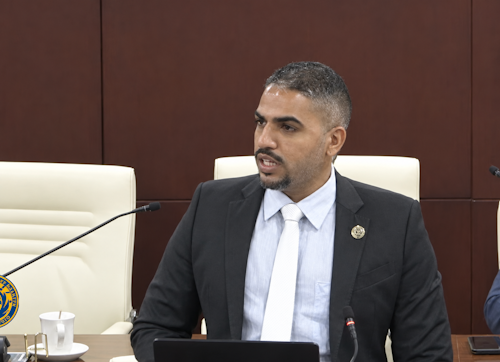 PHILIPSBURG:--- Democratic Party MP Viren Kotai delivered a pointed challenge to Finance Minister Marinka Gumbs during the 2027 budget debate, questioning how the government could seek a larger investment loan while failing to provide the planning documents repeatedly requested by the Committee for Financial Supervision, CFT.
Kotai placed the management of taxpayers’ money at the center of his contribution, arguing that the latest advice on the adopted 2026 budget exposed failures with consequences extending well beyond the government’s accounting records.
“This is not simply a matter of figures on paper,” he said. “It is a matter of accountability, of responsible governance.”
His intervention was particularly significant because it came from within the Democratic Party, the same party as the Finance Minister.
Kotai acknowledged both Parliament’s responsibility for the late adoption of the 2026 budget and the minister’s progress toward restoring the timetable for 2027. But he rejected those points as explanations for the shortcomings he outlined.
Neither, he argued, explained why the government had been asked twice to provide essential information and nevertheless sought “more money with less of a plan.”
A larger loan request without the investment plan
Citing the CFT’s advice, Kotai said the supervisory body received the adopted 2026 budget on September 24, nine months after the December 15, 2025 legal deadline.
He said the CFT could not determine whether the budget met the applicable legal requirements and could not issue positive advice on the 42.1 million-guilder investment loan request.
He noted that the request had increased from 37.5 million guilders even though the supporting investment plan had not been delivered.
Kotai described a pattern of inadequate follow-up: the CFT requested five items in February, largely repeated its requests in July, and subsequently concluded that the matters had not been sufficiently addressed.
He demanded the written status of each item and the minister’s written response on decision-making, which he said the CFT had requested twice.
The distinction in his criticism was important. Kotai argued that the problem was not a demonstrated inability to afford the investment, but the government’s failure to provide sufficient information for the budget and investment plans to be assessed.
In his assessment, the resulting development setback was “self-inflicted by process.”
Which projects will residents lose?
Kotai challenged Gumbs to identify the investments associated with the 42.1 million-guilder request and explain what would now happen to them.
He wanted projects named, locations identified, intended beneficiaries specified, and original delivery dates disclosed.
Of the 98 million guilders in new investments the government had announced, how much would realistically proceed in 2026?
“Is it going to be zero?” he asked.
His warning that investment would not materialize was a parliamentary assessment of the consequences of the unfavorable financing position. He also asked whether any borrowing route remained available before year-end or whether projects could be financed from the government’s own resources.
Kotai demanded to know whether any affected projects had already been tendered or contracted. If so, he asked who would pay the contractors and from which budget line.
He also asked whether the minister had warned the Council of Ministers and Parliament that the loan request was at risk, and when those warnings had been given.
His questions extended to the cost of postponement: higher construction prices, deteriorating infrastructure, possible loss of co-financing, expiring grant conditions and employment that delayed projects would otherwise have generated.
“Our people won’t feel the paragraph,” he said of the supervisory advice. “They will feel it as the projects do not start.”
Spending explanations and cash figures under scrutiny
Kotai highlighted several other findings he attributed to the CFT.
He said approximately 30 million guilders in additional personnel and goods-and-services expenditure had been explained only in general terms, without sufficient substantiation.
He also questioned why social benefits had been budgeted five million guilders below the previous year’s actual expenditure, which he said had occurred for a second time without explanation.
Another concern was an apparent inconsistency in the presentation of available cash: five million guilders in a table against 41 million in the accompanying text.
Those figures mattered, he argued, because government needed to establish whether it could finance investments itself if borrowing did not proceed.
Kotai also cited the CFT’s assessment that the country had little to no room to absorb unexpected setbacks or introduce new policy.
His criticism therefore concerned pressure on both sides of the government’s finances: uncertainty over capital investment and limited flexibility in day-to-day operations.
Tax reform: Who is actually steering?
Kotai rejected the suggestion that the budget difficulties could be treated as an isolated bad year, pointing to the pace and management of tax reform.
He traced the first phase to legislation submitted in October 2025 to repeal tax ordinances that had fallen into disuse. Parliament considered it in a Central Committee meeting in February, he said, yet the minister’s presentation on November 3 still described the 2027 focus as advancing that first phase.
Kotai said the minister had previously indicated that there was no single roadmap and that substantive profit-tax and wage-tax reforms were 36 to 48 months away.
He argued that such a timetable extended beyond the current parliamentary term.
He also questioned the dependence on externally financed technical assistance, saying the ministry itself had only two staff members assigned to the reform and that the Tax Administration had been without a head since July 2025.
Kotai did not reject technical assistance. He questioned who controlled the direction, timetable and accountability of the work.
“I question who is steering,” he said.
“A reform the Minister approves but does not direct on a timeline the Minister cannot show us is not a reform. It’s a process.”
He demanded a phased implementation plan with dates, the external assessment and the relevant country-package implementation agenda.
He also asked for the visitor levy’s implementation date and confirmation of whether its revenue was included in the 2027 budget, noting that the measure had reportedly not reached the Council of Advice by August despite a January 2027 target.
Why study a development bank before delivering the plan?
Kotai turned next to the proposed development bank, questioning the sequence of the government’s priorities.
He said the minister confirmed on October 22 that a feasibility study had been commissioned, but Parliament had not received its completion date, cost or terms of reference.
He agreed with the minister’s own acknowledgment that new financing mechanisms would not automatically resolve difficulties in executing capital projects.
For Kotai, that acknowledgment reinforced the need to complete project preparation and multi-year investment planning first.
He also questioned the separate investment fund mentioned by the minister: whether it involved another study, who was conducting it, what it cost and whether it would borrow.
Before creating another state institution, he argued, government owed Parliament a plan for the institutions it already owned, particularly given the financial risks he said the CFT had identified in government participations.
Kotai requested a commitment that Parliament would not take any decision to establish the development bank before receiving the multi-year investment plan.
Answers with dates
Kotai’s demands went beyond explaining past delays.
He asked which investments would move into 2027, whether the next loan request had been increased to accommodate them and whether the missing plan had finally been prepared.
Otherwise, he warned, the government risked encountering the same obstacle again.
He also questioned whether delayed investment would affect economic growth and the revenue projections underpinning the next budget.
Throughout his contribution, Kotai presented scrutiny as an obligation applying regardless of which government was in office.
Parliament, he said, had to satisfy itself that the figures were credible, the plans realistic and the public interest protected.
“I expect some answers with dates,” he said.